

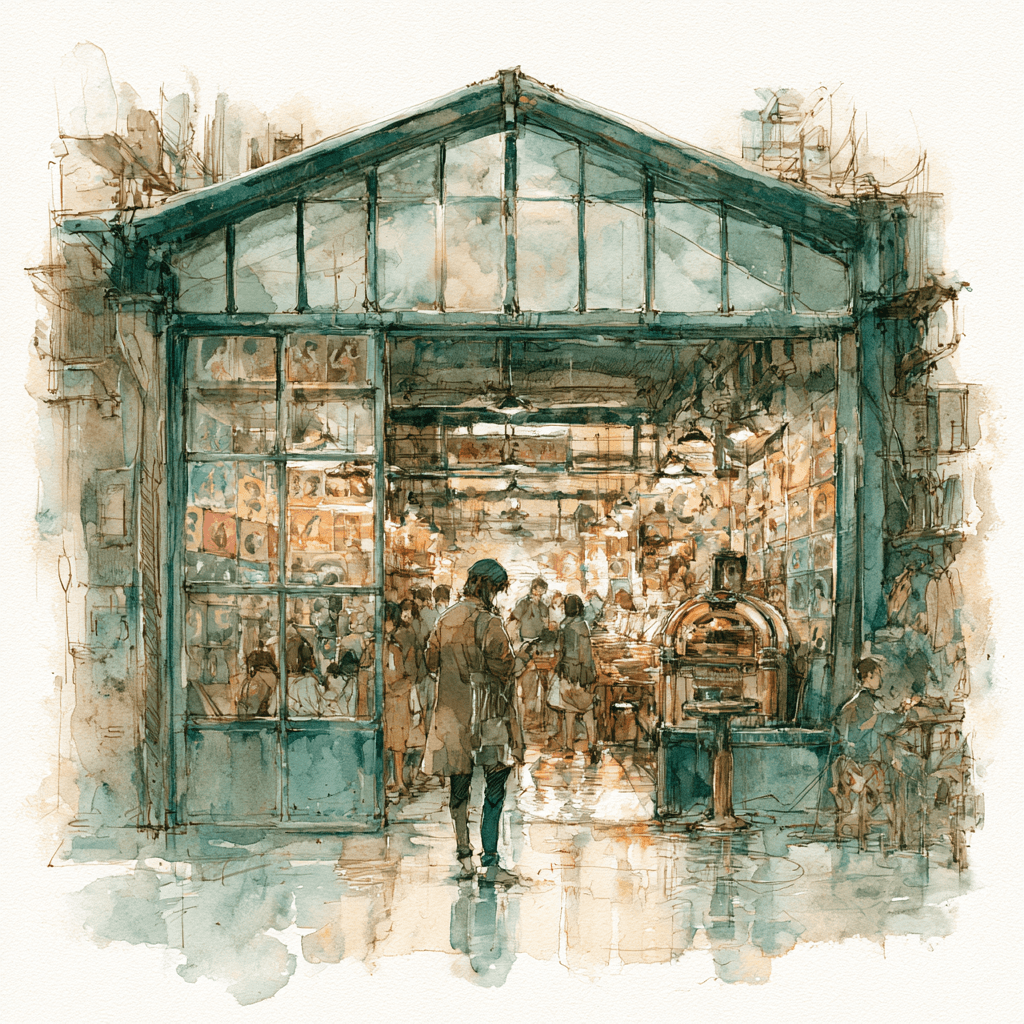
Postwar Cover Songs
After 1945, Taiwan's music industry rebuilt itself amid political upheaval and a radically shifting linguistic landscape. The Nationalist government's cultural policies favored Mandarin as the national language, and state-controlled radio stations increasingly promoted Mandarin-language songs as the soundtrack of the 're-Sinicized' nation. Yet beneath this official current, Taiwanese-Hokkien music found ways to survive and even flourish — not through confrontation, but through quiet adaptation.
The cover song became the era's defining musical form. Japanese-era melodies — many of them already beloved across the i…
The cover song became the era's defining musical form. Japanese-era melodies — many of them already beloved across the island — were given new Taiwanese-Hokkien lyrics and released on shellac records, then later on vinyl, by small labels in Taipei and Kaohsiung catering to working-class audiences. This practice was partly pragmatic (reusing proven melodies reduced production costs) and partly subversive (keeping Taiwanese-language music alive under a regime that increasingly marginalized it). Singers such as Wen Hsia, who sold millions of records and starred in over a hundred Taiwanese-language films, and Hung I-feng, whose 'Longing for the Spring Breeze' became an unofficial anthem of nostalgia, defined a postwar Hokkien sound that blended Japanese enka's sentimental vocal style with local narratives of migration, factory labor, and homesickness.
By the 1960s, however, the Nationalist government's restrictions on Taiwanese-language broadcasting — limiting Hokkien and Hakka programming to a small fraction of airtime — began to squeeze the commercial viability of Taiwanese pop. The quiet revival that had sustained itself through dancehalls, night markets, and the portable transistor radio was slowly pushed to the margins, setting the stage for the Mandarin-dominated campus folk movement that would follow.
Isle of Time