

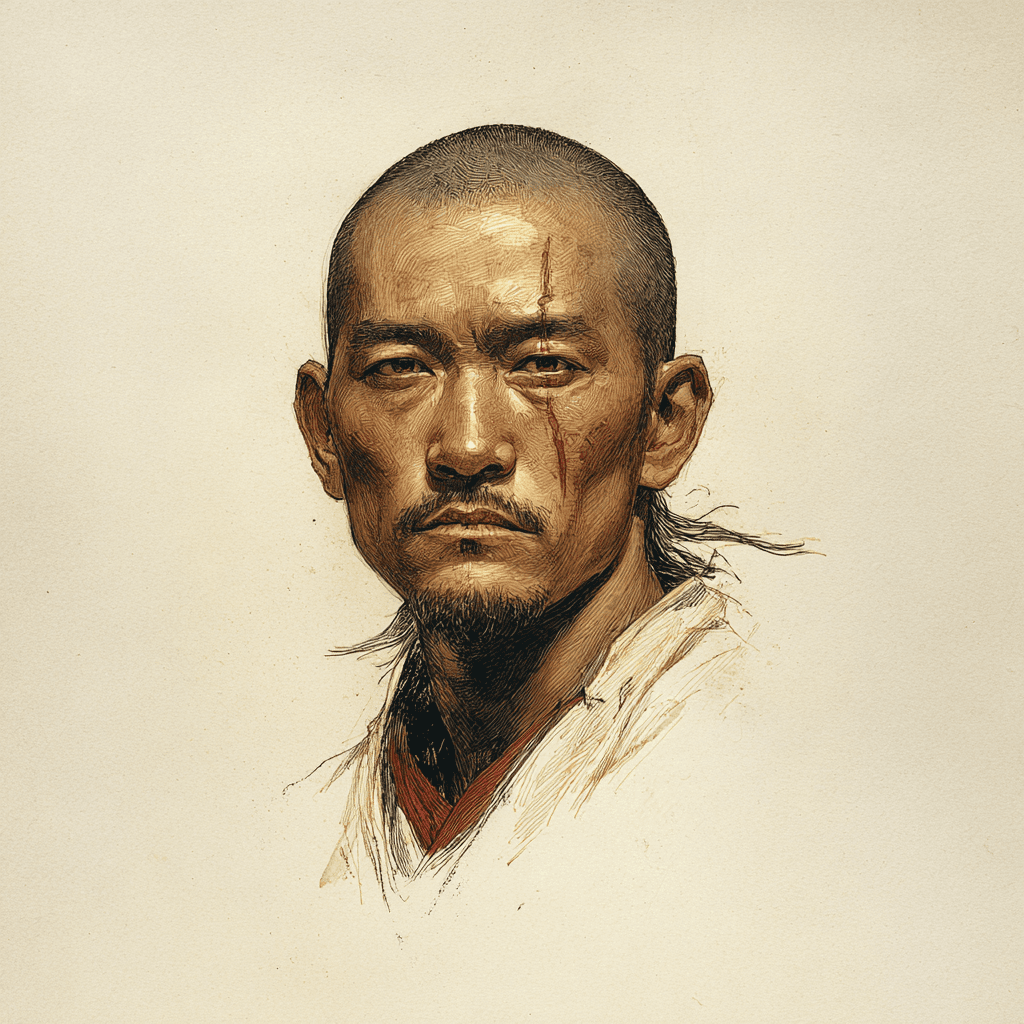
Cai Qian
Pirate King of the Black Ditch
Qing Dynasty
1761–1809
Cai Qian was the most renowned pirate king of the Qing maritime frontier during the Jiaqing era, born in 1761 to an impoverished fishing family on the coast of Tong'an in Fujian; orphaned as a child, he worked as a shoemaker's apprentice and a dock coolie in his youth. In the 1790s he turned to smuggling and piracy along the Fujian-Zhejiang coast, and through bold seamanship and a precise understanding of tides and monsoons he rapidly rose above his rivals, absorbing the other freebooter bands by the turn of the century to command a fleet of over a hundred ships and more than twenty thousand men. His flagship was enormous and equipped with bronze European cannon purchased from foreign smugglers, giving him firepower and range that outclassed the obsolete vessels of the imperial navy. He styled himself King of Zhenhai Weiwu, proclaimed the reign era Guangming, and instituted a protection-tax system that operated across the Fujian, Zhejiang, and Guangdong coasts. Every merchant ship crossing the strait was required to pay him a duty and receive his outbound tax certificate in order to pass the Black Ditch safely; those who refused were plundered or massacred, and in effect he operated a parallel maritime regime alongside the Qing. In 1804 the alarmed Qing court dispatched the Zhejiang admiral Li Changgeng to lead an elite naval force across the strait against him, and the two sides fought a years-long running campaign across the seas of Fujian, Zhejiang, and Taiwan with alternating victories. In 1807 Li Changgeng was killed in personal combat with him during a pursuit off the Zhejiang coast, sending shockwaves through the Qing coastal defenses and bringing his power to its peak. In 1806 he launched a large-scale raid against Lukang, the second-most prosperous commercial port of central Taiwan, hoping to seize grain and trade goods, but was driven off by a coordinated defense of Lukang's mercantile militia, the narrow alley-gate system of the town, and an imperial fire-ship counterattack. His wife, known to history simply as Madam Cai Qian, was a skilled warrior who fought beside him in many engagements, directing artillery and wielding a saber, an exceptionally rare female commander in his maritime kingdom. In 1809 the Qing court concentrated the combined naval forces of Fujian and Zhejiang under the new admiral Wang Delu, surrounding his remaining fleet in the open sea off Wenzhou in Zhejiang. With his ammunition exhausted and his ship overwhelmed he refused to surrender, personally setting fire to the powder magazine in the hold of his flagship and perishing in the blast with his wife at the age of forty-eight. Cai Qian is generally remembered as the gravest threat to Qing maritime security during the Jiaqing era, and his self-coronation, customs system, and raid on Lukang gave Taiwan a defining maritime dimension in the late imperial frontier narrative that complements its land-based history.
Raided Lukang in 1806; self-immolated on his flagship off Zhejiang in 1809
Pirate King of the Black Ditch
Cai Qian
Era
Qing Dynasty
Lifespan
1761–1809
Cai Qian was the most renowned pirate king of the Qing maritime frontier during the Jiaqing era, born in 1761 to an impoverished fishing family on the coast of Tong'an in Fujian; orphaned as a child, he worked as a shoemaker's apprentice and a dock coolie in his youth. In the 1790s he turned to smuggling and piracy along the Fujian-Zhejiang coast, and through bold seamanship and a precise understanding of tides and monsoons he rapidly rose above his rivals, absorbing the other freebooter bands by the turn of the century to command a fleet of over a hundred ships and more than twenty thousand men. His flagship was enormous and equipped with bronze European cannon purchased from foreign smugglers, giving him firepower and range that outclassed the obsolete vessels of the imperial navy. He styled himself King of Zhenhai Weiwu, proclaimed the reign era Guangming, and instituted a protection-tax system that operated across the Fujian, Zhejiang, and Guangdong coasts. Every merchant ship crossing the strait was required to pay him a duty and receive his outbound tax certificate in order to pass the Black Ditch safely; those who refused were plundered or massacred, and in effect he operated a parallel maritime regime alongside the Qing. In 1804 the alarmed Qing court dispatched the Zhejiang admiral Li Changgeng to lead an elite naval force across the strait against him, and the two sides fought a years-long running campaign across the seas of Fujian, Zhejiang, and Taiwan with alternating victories. In 1807 Li Changgeng was killed in personal combat with him during a pursuit off the Zhejiang coast, sending shockwaves through the Qing coastal defenses and bringing his power to its peak. In 1806 he launched a large-scale raid against Lukang, the second-most prosperous commercial port of central Taiwan, hoping to seize grain and trade goods, but was driven off by a coordinated defense of Lukang's mercantile militia, the narrow alley-gate system of the town, and an imperial fire-ship counterattack. His wife, known to history simply as Madam Cai Qian, was a skilled warrior who fought beside him in many engagements, directing artillery and wielding a saber, an exceptionally rare female commander in his maritime kingdom. In 1809 the Qing court concentrated the combined naval forces of Fujian and Zhejiang under the new admiral Wang Delu, surrounding his remaining fleet in the open sea off Wenzhou in Zhejiang. With his ammunition exhausted and his ship overwhelmed he refused to surrender, personally setting fire to the powder magazine in the hold of his flagship and perishing in the blast with his wife at the age of forty-eight. Cai Qian is generally remembered as the gravest threat to Qing maritime security during the Jiaqing era, and his self-coronation, customs system, and raid on Lukang gave Taiwan a defining maritime dimension in the late imperial frontier narrative that complements its land-based history.
Raided Lukang in 1806; self-immolated on his flagship off Zhejiang in 1809