

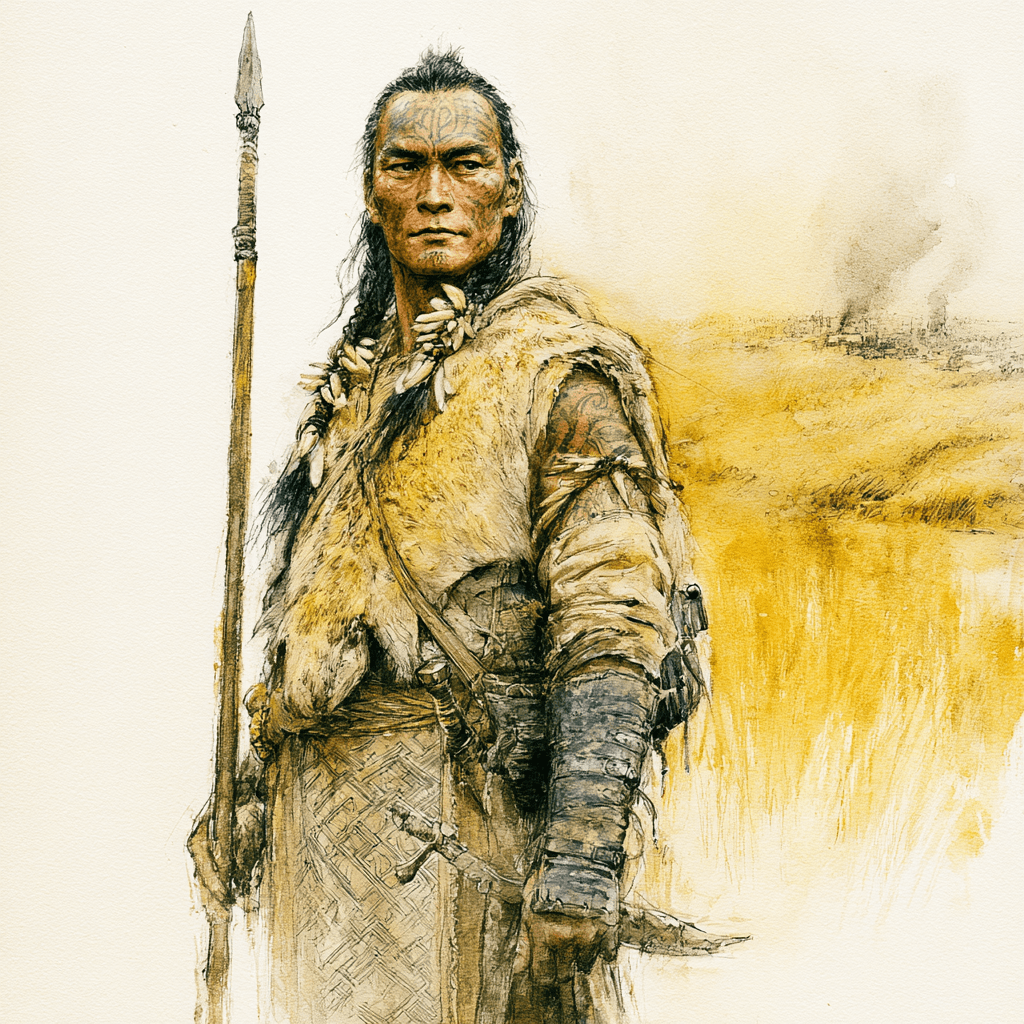
Camachat Aslamie
Paramount Chief of the Kingdom of Middag
Dutch Colonial / Tungning Kingdom
?–?
Camachat Aslamie was the paramount chief of the Kingdom of Middag in central Taiwan during the mid-seventeenth century; his dates of birth and death are not recorded, and the sources preserve Aslamie as a personal name in the Babuza language and Camachat as the lineage and political title of his ruling house. The Kingdom of Middag was not a kingdom in the Chinese imperial sense but a cross-ethnic political confederation of more than a dozen Babuza, Babusaga, Hoanya, and Pazeh villages spread across what are today the Taichung, Changhua, and Nantou plains. In Dutch sources the confederation was referred to as Middag or as the land of Quataong, and it remained throughout the Dutch period the principal indigenous power in central Taiwan that the VOC was never able to fully incorporate into its village-leasing system. Inheriting the title of King of Dadu around the 1640s, he governed the populous settlements from the basin of the Dadu and Dadu rivers north to the Dajia and south to the Zhuoshui. In his external relations he negotiated commerce with Dutch officials when convenient and mobilized the confederate villages by force when required to defend his people's hunting grounds and farmlands. Between 1644 and 1645 the VOC dispatched punitive expeditions to Sarcam and the Dadu region, after which he accepted the symbolic transfer of a staff of office at the annual landdag assembly held by the Dutch governor. He nominally acknowledged VOC suzerainty but in practice his autonomous authority over the confederation remained largely intact. After Koxinga's invasion of Taiwan and the Dutch withdrawal in 1661, his confederation faced a new adversary in the form of a Han Chinese settler regime whose project was no longer commercial colonization but systematic military colonization of the land. The Zheng policy of garrison-farming pushed tens of thousands of soldier-settlers into central Taiwan and provoked repeated clashes with confederate villages over land seizures and grain levies at Sarcam, Goema, and Taikia. In the 1670s the Zheng general Liu Guoxuan, on orders from Zheng Jing, led a campaign of suppression in central Taiwan in which the village of Sarcam was destroyed in a near-total massacre that broke the military strength of the Kingdom of Middag. Whether he was still in power during these events, and when he died, is not recorded in Dutch, Zheng, or later sources; only the rapid disintegration of the confederation's political structure during the 1680s and its complete collapse in the early Qing period is documented. Camachat Aslamie is generally remembered as one of the very few indigenous confederation leaders in early Taiwanese history capable of simultaneously holding off both European colonial power and Han Chinese settler-state expansion, and as a representative figure of how the lowland indigenous peoples of central Taiwan passed from relative autonomy into historical eclipse under the dual pressure of successive foreign regimes.
Led the Kingdom of Middag in resistance to both VOC and Zheng territorial expansion
Paramount Chief of the Kingdom of Middag
Camachat Aslamie
Era
Dutch Colonial / Tungning Kingdom
Lifespan
?–?
Camachat Aslamie was the paramount chief of the Kingdom of Middag in central Taiwan during the mid-seventeenth century; his dates of birth and death are not recorded, and the sources preserve Aslamie as a personal name in the Babuza language and Camachat as the lineage and political title of his ruling house. The Kingdom of Middag was not a kingdom in the Chinese imperial sense but a cross-ethnic political confederation of more than a dozen Babuza, Babusaga, Hoanya, and Pazeh villages spread across what are today the Taichung, Changhua, and Nantou plains. In Dutch sources the confederation was referred to as Middag or as the land of Quataong, and it remained throughout the Dutch period the principal indigenous power in central Taiwan that the VOC was never able to fully incorporate into its village-leasing system. Inheriting the title of King of Dadu around the 1640s, he governed the populous settlements from the basin of the Dadu and Dadu rivers north to the Dajia and south to the Zhuoshui. In his external relations he negotiated commerce with Dutch officials when convenient and mobilized the confederate villages by force when required to defend his people's hunting grounds and farmlands. Between 1644 and 1645 the VOC dispatched punitive expeditions to Sarcam and the Dadu region, after which he accepted the symbolic transfer of a staff of office at the annual landdag assembly held by the Dutch governor. He nominally acknowledged VOC suzerainty but in practice his autonomous authority over the confederation remained largely intact. After Koxinga's invasion of Taiwan and the Dutch withdrawal in 1661, his confederation faced a new adversary in the form of a Han Chinese settler regime whose project was no longer commercial colonization but systematic military colonization of the land. The Zheng policy of garrison-farming pushed tens of thousands of soldier-settlers into central Taiwan and provoked repeated clashes with confederate villages over land seizures and grain levies at Sarcam, Goema, and Taikia. In the 1670s the Zheng general Liu Guoxuan, on orders from Zheng Jing, led a campaign of suppression in central Taiwan in which the village of Sarcam was destroyed in a near-total massacre that broke the military strength of the Kingdom of Middag. Whether he was still in power during these events, and when he died, is not recorded in Dutch, Zheng, or later sources; only the rapid disintegration of the confederation's political structure during the 1680s and its complete collapse in the early Qing period is documented. Camachat Aslamie is generally remembered as one of the very few indigenous confederation leaders in early Taiwanese history capable of simultaneously holding off both European colonial power and Han Chinese settler-state expansion, and as a representative figure of how the lowland indigenous peoples of central Taiwan passed from relative autonomy into historical eclipse under the dual pressure of successive foreign regimes.
Led the Kingdom of Middag in resistance to both VOC and Zheng territorial expansion