

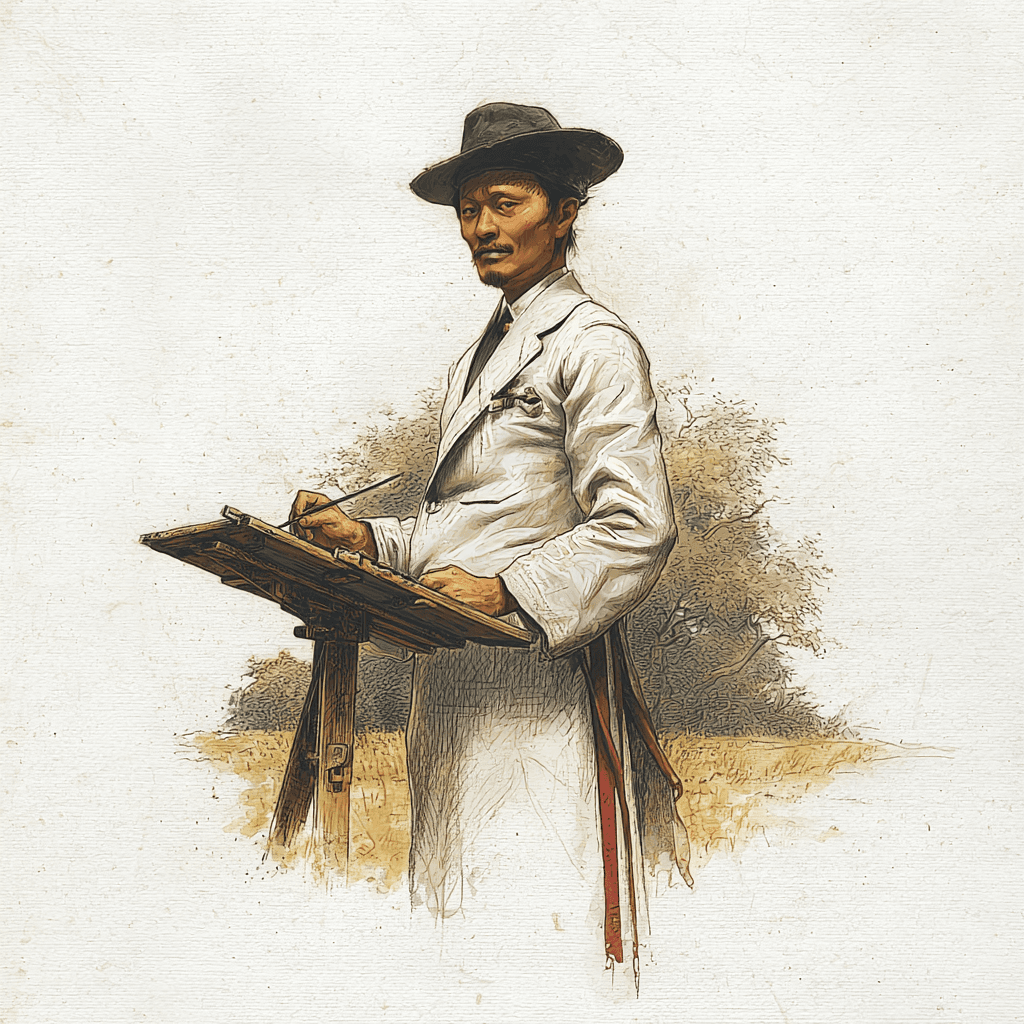
Chen Cheng-po
Painter & Civic Leader
Japanese Colonial / Post-War Transition
1895–1947
Chen Cheng-po, born in 1895 in Chiayi to the family of a struggling Confucian scholar, became one of the most accomplished modern painters of colonial Taiwan and a victim of the post-war crackdown who has come to symbolize the violence of the February 28 Incident. He graduated from Taipei Normal School in 1917 and taught for several years in his hometown before entering the Tokyo Fine Arts School in 1924, where he trained under Japanese exponents of Western-style oil painting. In 1926 his work Outside Chiayi (嘉義街外) became the first painting by a Taiwanese artist to be selected for the prestigious Imperial Art Exhibition in Tokyo, and he went on to make multiple appearances at both the Teiten and the Taiwan Exhibition (Taiten). Between 1929 and 1933 he taught at the Xinhua College of Art in Shanghai, where he absorbed modernist currents while exhibiting alongside leading Republican-era Chinese painters. He returned to Taiwan in 1933 and co-founded the Tai-Yang Art Society (臺陽美術協會) in 1934, an influential salon that nurtured a generation of Taiwanese painters working outside the official exhibition system. His mature work fused Post-Impressionist palette and brushwork with attentive landscapes of Chiayi, Tamsui, Sun Moon Lake, and Yushan, creating a distinctive vocabulary of native Taiwanese subject matter. After the Japanese surrender in 1945 he served briefly as a Chiayi city councilman, embracing the new Republican administration with the optimism shared by many Taiwanese intellectuals of his generation. When the February 28 Incident erupted in early 1947 and unrest spread to Chiayi, he volunteered as one of six civilian negotiators to approach the besieged KMT garrison at Chiayi Airport in the hope of preventing further bloodshed. He and his fellow negotiators were detained on arrival, and on 25 March 1947 he was paraded through the streets of Chiayi and publicly executed by firing squad outside the railway station without trial. His family retrieved the body and his widow Chang Chieh quietly preserved his works, correspondence, and the bloodstained clothing through four decades of martial law. Beginning in the 1990s his paintings and personal effects re-emerged in major retrospectives, and his work has since commanded record-setting prices at international auctions. Chen is now widely commemorated as a pioneer of Taiwanese modern art and as one of the most evocative individual emblems of the cultural and human losses inflicted by the events of 1947.
Executed during the February 28 Incident (1947)
Painter & Civic Leader
Chen Cheng-po
Era
Japanese Colonial / Post-War Transition
Lifespan
1895–1947
Chen Cheng-po, born in 1895 in Chiayi to the family of a struggling Confucian scholar, became one of the most accomplished modern painters of colonial Taiwan and a victim of the post-war crackdown who has come to symbolize the violence of the February 28 Incident. He graduated from Taipei Normal School in 1917 and taught for several years in his hometown before entering the Tokyo Fine Arts School in 1924, where he trained under Japanese exponents of Western-style oil painting. In 1926 his work Outside Chiayi (嘉義街外) became the first painting by a Taiwanese artist to be selected for the prestigious Imperial Art Exhibition in Tokyo, and he went on to make multiple appearances at both the Teiten and the Taiwan Exhibition (Taiten). Between 1929 and 1933 he taught at the Xinhua College of Art in Shanghai, where he absorbed modernist currents while exhibiting alongside leading Republican-era Chinese painters. He returned to Taiwan in 1933 and co-founded the Tai-Yang Art Society (臺陽美術協會) in 1934, an influential salon that nurtured a generation of Taiwanese painters working outside the official exhibition system. His mature work fused Post-Impressionist palette and brushwork with attentive landscapes of Chiayi, Tamsui, Sun Moon Lake, and Yushan, creating a distinctive vocabulary of native Taiwanese subject matter. After the Japanese surrender in 1945 he served briefly as a Chiayi city councilman, embracing the new Republican administration with the optimism shared by many Taiwanese intellectuals of his generation. When the February 28 Incident erupted in early 1947 and unrest spread to Chiayi, he volunteered as one of six civilian negotiators to approach the besieged KMT garrison at Chiayi Airport in the hope of preventing further bloodshed. He and his fellow negotiators were detained on arrival, and on 25 March 1947 he was paraded through the streets of Chiayi and publicly executed by firing squad outside the railway station without trial. His family retrieved the body and his widow Chang Chieh quietly preserved his works, correspondence, and the bloodstained clothing through four decades of martial law. Beginning in the 1990s his paintings and personal effects re-emerged in major retrospectives, and his work has since commanded record-setting prices at international auctions. Chen is now widely commemorated as a pioneer of Taiwanese modern art and as one of the most evocative individual emblems of the cultural and human losses inflicted by the events of 1947.
Executed during the February 28 Incident (1947)