

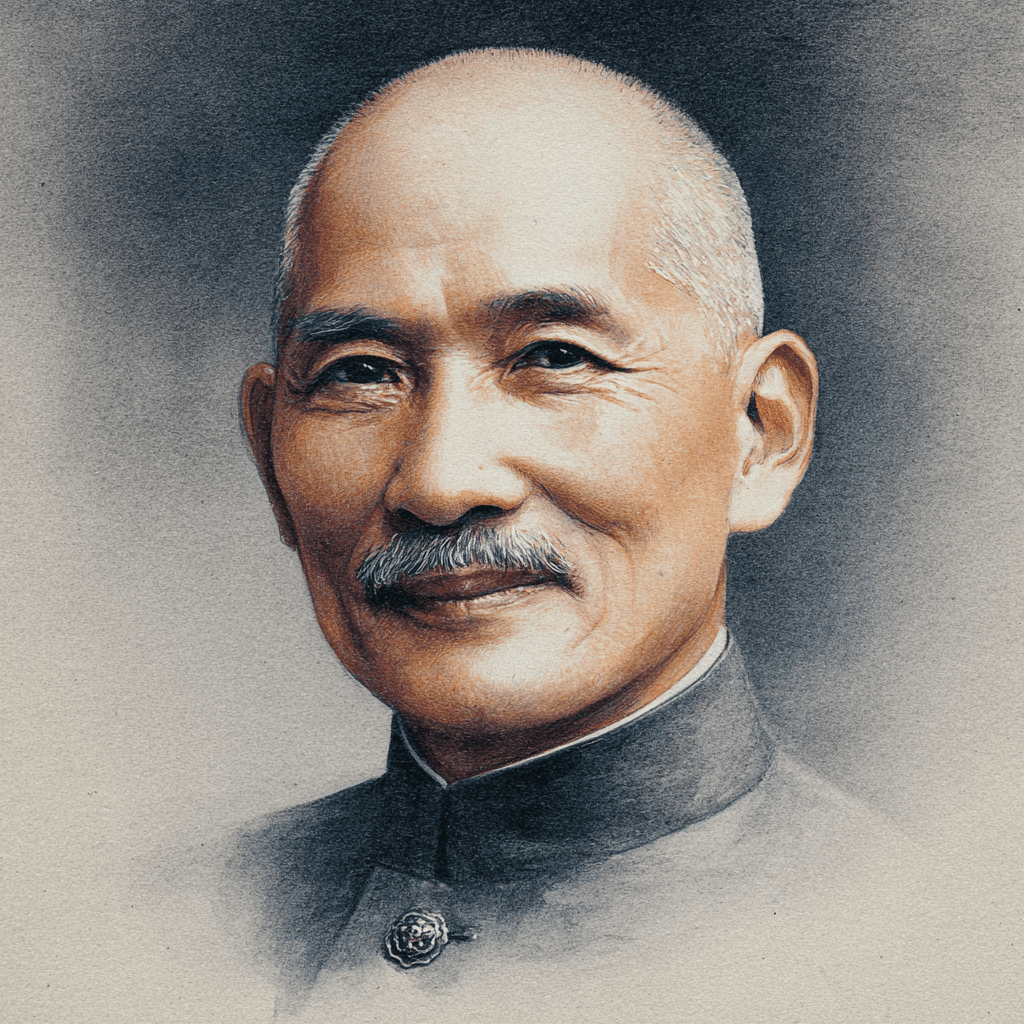
Chiang Kai-shek
President of the Republic of China
Post-War / Authoritarian Era
1887–1975
Chiang Kai-shek, born in 1887 in Xikou, Zhejiang, to a salt merchant family, was the dominant Chinese Nationalist leader of the mid-twentieth century and the man whose 1949 retreat to Taiwan reshaped the island's twentieth-century history. He received early military training in China and then in Japan, where he attended preparatory schools and briefly served in the Imperial Japanese Army and joined Sun Yat-sen's Tongmenghui revolutionary organization. After returning to China at the outbreak of the 1911 Revolution, he rose under Sun Yat-sen and was sent to Moscow in 1923 to study Soviet military organization, helping found the Whampoa Military Academy as its commandant the following year. He launched the Northern Expedition in 1926, broke with the Communists in the violent 1927 Shanghai Massacre, and by 1928 had nominally reunified China under the Nationalist Government in Nanjing. He married Soong Mei-ling in 1927, converting to Methodism in 1930, an alliance that bound him to the Soong family and to substantial Anglo-American sympathy in the next two decades. From 1937 he led the Republic of China through the eight-year War of Resistance against Japan, securing recognition as one of the Big Four Allied leaders and obtaining at the 1943 Cairo Conference the formal commitment that Taiwan would be returned to Chinese sovereignty after Japan's defeat. Following Japan's surrender he resumed the civil war against the Chinese Communist Party but was decisively defeated by 1949, retreating with the remnants of his government, army, and over a million civilians to Taiwan. He declared martial law on Taiwan in May 1949 and used the security apparatus, the Garrison Command, and the Taiwan Provincial Government to consolidate authoritarian rule, while officially maintaining the claim to represent all of China. He oversaw the White Terror — the prolonged campaign of political repression that arrested, imprisoned, or executed tens of thousands of suspected dissidents, mainlanders and islanders alike, throughout the 1950s and 1960s. With substantial U.S. military and economic support after the outbreak of the Korean War in 1950, he stabilized the regime, presided over a land reform program, and laid the institutional foundations for the export-led industrialization of the following decades. He suffered the major diplomatic blow of the Republic of China's expulsion from the United Nations in 1971 and the U.S. opening to Beijing in 1972, signaling the international community's gradual shift away from the ROC. He died of heart failure in Taipei in April 1975 at the age of 87, and his legacy remains deeply contested — a leader of the Chinese resistance to Japan and architect of post-war Taiwan's economic foundations, but also the central figure in a state-violence regime whose victims and survivors continue to shape Taiwanese transitional-justice politics.
Imposed martial law in Taiwan (1949)
Oversaw the White Terror period of political repression
President of the Republic of China
Chiang Kai-shek
Era
Post-War / Authoritarian Era
Lifespan
1887–1975
Chiang Kai-shek, born in 1887 in Xikou, Zhejiang, to a salt merchant family, was the dominant Chinese Nationalist leader of the mid-twentieth century and the man whose 1949 retreat to Taiwan reshaped the island's twentieth-century history. He received early military training in China and then in Japan, where he attended preparatory schools and briefly served in the Imperial Japanese Army and joined Sun Yat-sen's Tongmenghui revolutionary organization. After returning to China at the outbreak of the 1911 Revolution, he rose under Sun Yat-sen and was sent to Moscow in 1923 to study Soviet military organization, helping found the Whampoa Military Academy as its commandant the following year. He launched the Northern Expedition in 1926, broke with the Communists in the violent 1927 Shanghai Massacre, and by 1928 had nominally reunified China under the Nationalist Government in Nanjing. He married Soong Mei-ling in 1927, converting to Methodism in 1930, an alliance that bound him to the Soong family and to substantial Anglo-American sympathy in the next two decades. From 1937 he led the Republic of China through the eight-year War of Resistance against Japan, securing recognition as one of the Big Four Allied leaders and obtaining at the 1943 Cairo Conference the formal commitment that Taiwan would be returned to Chinese sovereignty after Japan's defeat. Following Japan's surrender he resumed the civil war against the Chinese Communist Party but was decisively defeated by 1949, retreating with the remnants of his government, army, and over a million civilians to Taiwan. He declared martial law on Taiwan in May 1949 and used the security apparatus, the Garrison Command, and the Taiwan Provincial Government to consolidate authoritarian rule, while officially maintaining the claim to represent all of China. He oversaw the White Terror — the prolonged campaign of political repression that arrested, imprisoned, or executed tens of thousands of suspected dissidents, mainlanders and islanders alike, throughout the 1950s and 1960s. With substantial U.S. military and economic support after the outbreak of the Korean War in 1950, he stabilized the regime, presided over a land reform program, and laid the institutional foundations for the export-led industrialization of the following decades. He suffered the major diplomatic blow of the Republic of China's expulsion from the United Nations in 1971 and the U.S. opening to Beijing in 1972, signaling the international community's gradual shift away from the ROC. He died of heart failure in Taipei in April 1975 at the age of 87, and his legacy remains deeply contested — a leader of the Chinese resistance to Japan and architect of post-war Taiwan's economic foundations, but also the central figure in a state-violence regime whose victims and survivors continue to shape Taiwanese transitional-justice politics.
Imposed martial law in Taiwan (1949)
Oversaw the White Terror period of political repression