

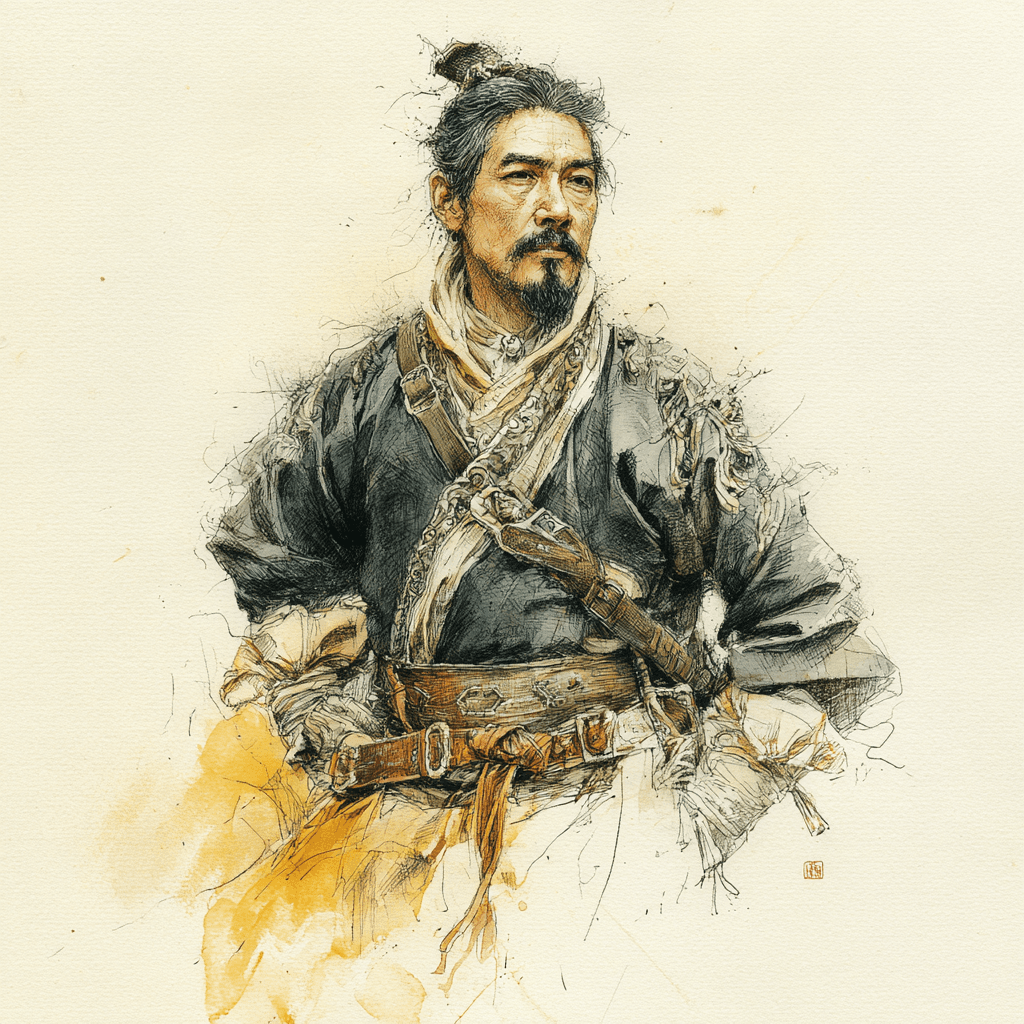
Dai Chaochun
Rebel Leader
Late Qing Frontier
?–1864
Dai Chaochun, a wealthy landlord from the Sishe district of Changhua County, was the leader of the third and last of the three major rebellions that punctuate the Qing imperial era in Taiwan, his birth year unrecorded. His family was prominent in the central Taiwan settler economy of the mid-nineteenth century, holding extensive sugarcane and rice land and patronizing a local mutual-defense and brotherhood association known as the Bagua Society (八卦會). The society, originally a network of armed retainers organized around family-based militias, gradually absorbed Tiandihui-style ritual and developed into an organized opposition to Qing magistrates accused of corruption. The opportunity for armed action came in early 1862, when Qing forces and military resources were heavily engaged in suppressing the Taiping civil war on the mainland and the colonial garrison on Taiwan was at its weakest. In March 1862 he led several thousand armed men into the walled city of Changhua, killed the magistrate, and proclaimed his own authority over the central plains. He adopted the reign title Yuantian (元天) and the royal style of Eastern King, issuing proclamations and reordering local government across the Changhua, Taichung, and Yunlin regions. The Wufeng Lin family, in particular Lin Wencha and Lin Wenming, raised loyalist Han militias from their estates, while Lugang merchants and Hakka villages of the Hsinchu region similarly armed themselves against the rebels. The Qing court, after considerable delay, sent the Taiwan Daotai (intendant) Ding Yuejian to coordinate military operations with the gentry militias from 1863 onward. Throughout 1863 the rebel positions on the central plains were ground down by combined gentry-militia and Qing forces, and Dai retreated into the hill country. He was captured at the end of 1863, transferred to Changhua for interrogation, and executed by slow slicing in early 1864; his immediate family was also extinguished. The rebellion's suppression confirmed the Wufeng Lin family as a dominant gentry house in central Taiwan and granted them official military rank and substantial estates. The Dai Chaochun affair exposed how thoroughly the Qing relied on Taiwanese Han gentry to maintain order on the frontier, and the gentry militia model it consolidated would shape the political ecology of Taiwan through to the Japanese annexation.
Led the Dai Chaochun Rebellion (1862–1865), one of the three great Qing-era uprisings
Rebel Leader
Dai Chaochun
Era
Late Qing Frontier
Lifespan
?–1864
Dai Chaochun, a wealthy landlord from the Sishe district of Changhua County, was the leader of the third and last of the three major rebellions that punctuate the Qing imperial era in Taiwan, his birth year unrecorded. His family was prominent in the central Taiwan settler economy of the mid-nineteenth century, holding extensive sugarcane and rice land and patronizing a local mutual-defense and brotherhood association known as the Bagua Society (八卦會). The society, originally a network of armed retainers organized around family-based militias, gradually absorbed Tiandihui-style ritual and developed into an organized opposition to Qing magistrates accused of corruption. The opportunity for armed action came in early 1862, when Qing forces and military resources were heavily engaged in suppressing the Taiping civil war on the mainland and the colonial garrison on Taiwan was at its weakest. In March 1862 he led several thousand armed men into the walled city of Changhua, killed the magistrate, and proclaimed his own authority over the central plains. He adopted the reign title Yuantian (元天) and the royal style of Eastern King, issuing proclamations and reordering local government across the Changhua, Taichung, and Yunlin regions. The Wufeng Lin family, in particular Lin Wencha and Lin Wenming, raised loyalist Han militias from their estates, while Lugang merchants and Hakka villages of the Hsinchu region similarly armed themselves against the rebels. The Qing court, after considerable delay, sent the Taiwan Daotai (intendant) Ding Yuejian to coordinate military operations with the gentry militias from 1863 onward. Throughout 1863 the rebel positions on the central plains were ground down by combined gentry-militia and Qing forces, and Dai retreated into the hill country. He was captured at the end of 1863, transferred to Changhua for interrogation, and executed by slow slicing in early 1864; his immediate family was also extinguished. The rebellion's suppression confirmed the Wufeng Lin family as a dominant gentry house in central Taiwan and granted them official military rank and substantial estates. The Dai Chaochun affair exposed how thoroughly the Qing relied on Taiwanese Han gentry to maintain order on the frontier, and the gentry militia model it consolidated would shape the political ecology of Taiwan through to the Japanese annexation.
Led the Dai Chaochun Rebellion (1862–1865), one of the three great Qing-era uprisings