

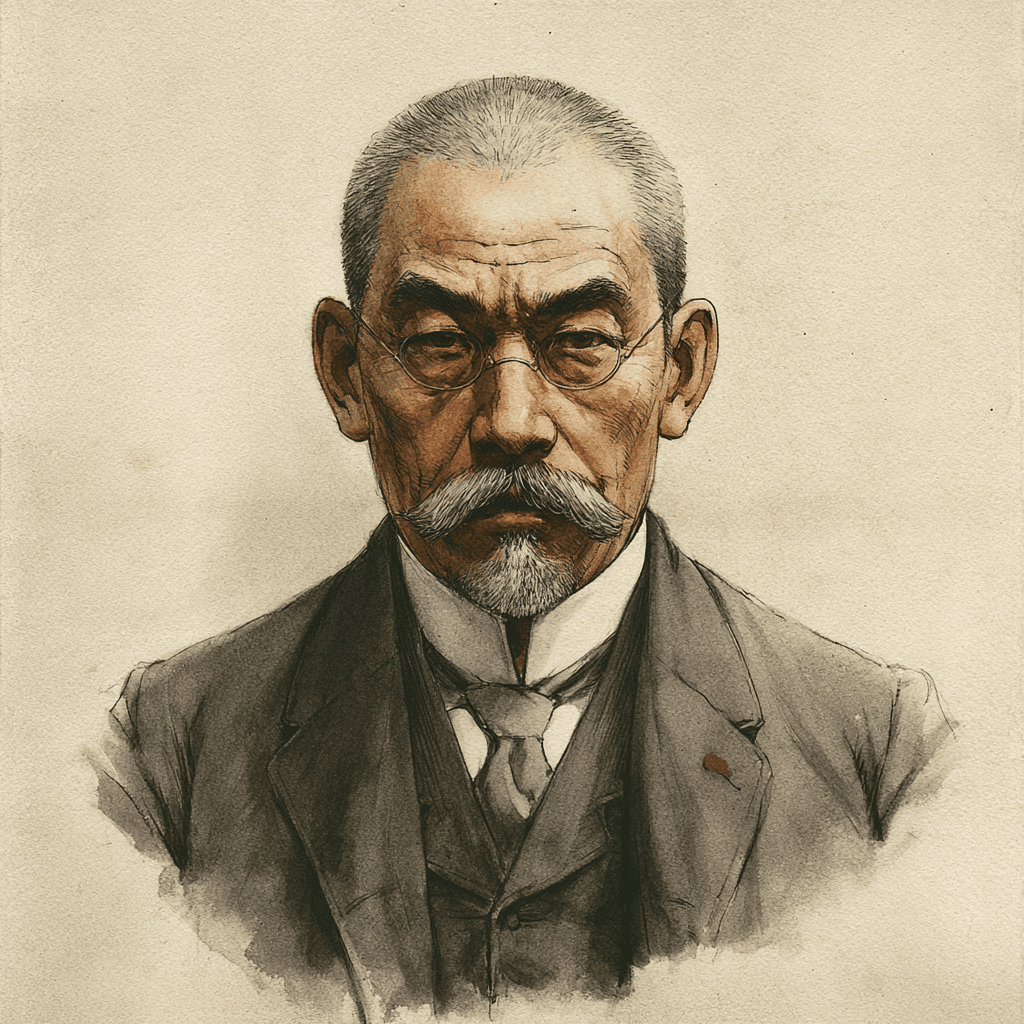
Goto Shinpei
Chief of Home Affairs, Taiwan Governor-General's Office
Japanese Colonial Period
1857–1929
Gotō Shinpei, born in 1857 in Mutsu Province (present-day Iwate Prefecture) to a former samurai family of the Date clan, served as Chief of Civil Affairs of Taiwan from 1898 to 1906 and is widely regarded as the principal architect of Japan's early colonial administration on the island. Trained as a physician, he studied medical hygiene in Germany and rose through Japan's home-affairs bureaucracy after organizing the celebrated quarantine of more than 230,000 returning soldiers at Hiroshima following the First Sino-Japanese War. Recommended to Taiwan by Governor-General Kodama Gentarō in 1898, Gotō wielded broad discretionary authority over civil governance while Kodama handled military and external affairs. He grounded his rule in what he called the biological principle, insisting that colonial policy be calibrated to existing local customs after rigorous empirical survey rather than imposed by abstract ideology. Under his direction the colony conducted comprehensive land surveys, established a household registration system, and built the police-and-headman (baojia) network that became the spine of social control in Taiwan for the next half century. He financed development through state monopolies on opium, camphor, salt, and tobacco, with the opium policy framed as gradual suppression rather than abrupt prohibition. His public works program built the north-south trunk railway, modernized the ports of Keelung and Kaohsiung, expanded irrigation, and introduced sanitary engineering that dramatically reduced bubonic plague and malaria mortality. He chartered the Bank of Taiwan, supported the modern sugar industry, and laid the institutional groundwork for the colony's transition from a security drain to a fiscal contributor of the Japanese empire. Pacification under his tenure combined the cooptation of local elites with harsh punitive expeditions against armed resisters, ending the chronic banditry of the 1890s but at a heavy human cost. After leaving Taiwan he served as the first president of the South Manchuria Railway Company, then as Communications Minister, Home Minister, and Mayor of Tokyo, leading the reconstruction of the capital after the Great Kantō Earthquake of 1923. He died in 1929 while on a speaking tour in Kyoto. Gotō is remembered as a controversial but transformative figure who built Taiwan's modern administrative, infrastructural, and public-health foundations while also entrenching colonial mechanisms of surveillance and exploitation.
Modernized Taiwan's public health and infrastructure as Chief of Home Affairs
Chief of Home Affairs, Taiwan Governor-General's Office
Goto Shinpei
Era
Japanese Colonial Period
Lifespan
1857–1929
Gotō Shinpei, born in 1857 in Mutsu Province (present-day Iwate Prefecture) to a former samurai family of the Date clan, served as Chief of Civil Affairs of Taiwan from 1898 to 1906 and is widely regarded as the principal architect of Japan's early colonial administration on the island. Trained as a physician, he studied medical hygiene in Germany and rose through Japan's home-affairs bureaucracy after organizing the celebrated quarantine of more than 230,000 returning soldiers at Hiroshima following the First Sino-Japanese War. Recommended to Taiwan by Governor-General Kodama Gentarō in 1898, Gotō wielded broad discretionary authority over civil governance while Kodama handled military and external affairs. He grounded his rule in what he called the biological principle, insisting that colonial policy be calibrated to existing local customs after rigorous empirical survey rather than imposed by abstract ideology. Under his direction the colony conducted comprehensive land surveys, established a household registration system, and built the police-and-headman (baojia) network that became the spine of social control in Taiwan for the next half century. He financed development through state monopolies on opium, camphor, salt, and tobacco, with the opium policy framed as gradual suppression rather than abrupt prohibition. His public works program built the north-south trunk railway, modernized the ports of Keelung and Kaohsiung, expanded irrigation, and introduced sanitary engineering that dramatically reduced bubonic plague and malaria mortality. He chartered the Bank of Taiwan, supported the modern sugar industry, and laid the institutional groundwork for the colony's transition from a security drain to a fiscal contributor of the Japanese empire. Pacification under his tenure combined the cooptation of local elites with harsh punitive expeditions against armed resisters, ending the chronic banditry of the 1890s but at a heavy human cost. After leaving Taiwan he served as the first president of the South Manchuria Railway Company, then as Communications Minister, Home Minister, and Mayor of Tokyo, leading the reconstruction of the capital after the Great Kantō Earthquake of 1923. He died in 1929 while on a speaking tour in Kyoto. Gotō is remembered as a controversial but transformative figure who built Taiwan's modern administrative, infrastructural, and public-health foundations while also entrenching colonial mechanisms of surveillance and exploitation.
Modernized Taiwan's public health and infrastructure as Chief of Home Affairs