

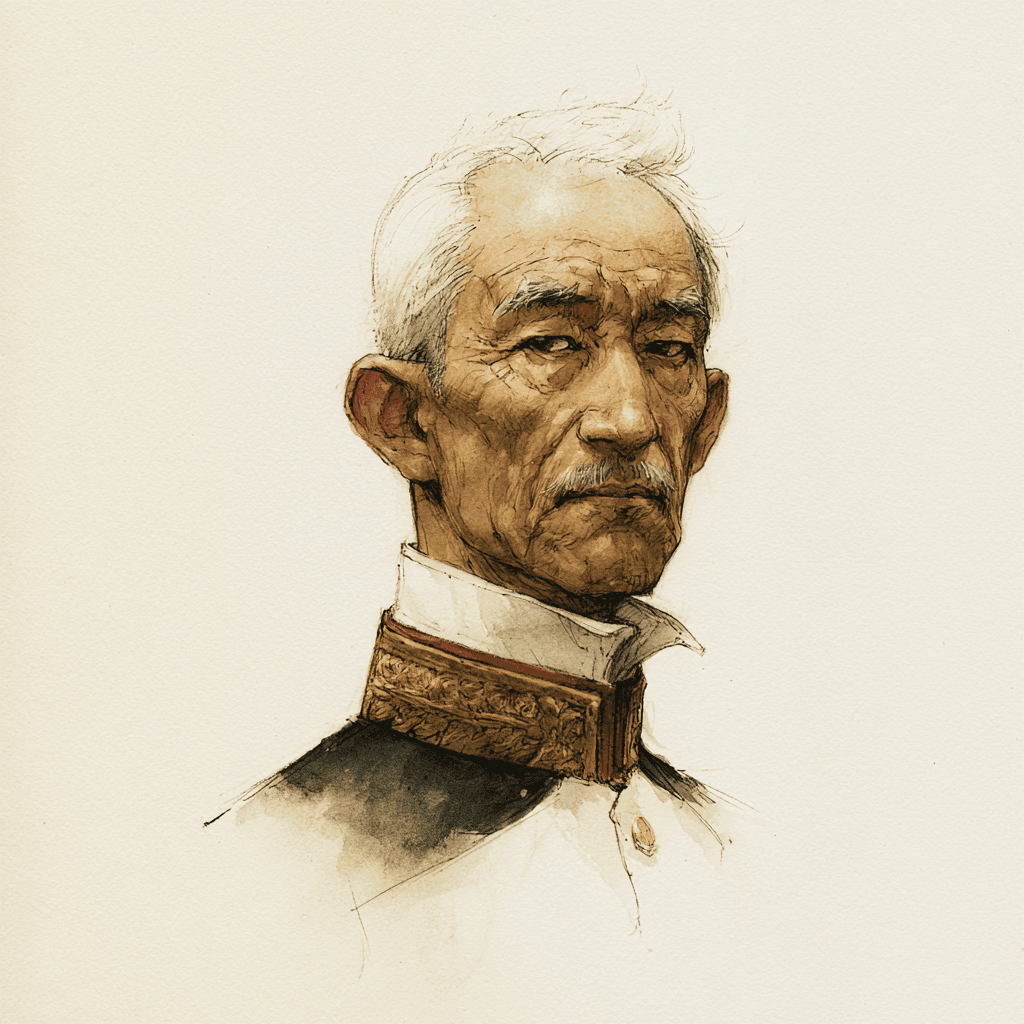
Hasegawa Kiyoshi
Wartime Mobilization Governor-General
Japanese Rule
1883–1970
Hasegawa Kiyoshi (1883–1970), a Japanese navy admiral by background, served as the eighteenth Governor-General of Taiwan from 1940 to 1944, in the crucial years when the Pacific War broke out in full and Taiwan was pushed onto a wartime footing. Inheriting his predecessor Kobayashi Seizo's governing line of 'imperialization, industrialization and use as a southward base,' he steered Taiwan fully toward war mobilization: he promoted the establishment of the Kominhokokai (Imperial Subjects Public Service Association), enrolling the whole island's population in a top-down service organization that mobilized manpower, materiel and spiritual energy in support of the front. During his tenure he introduced a volunteer-soldier system for Taiwanese, recruiting army and then navy volunteers and sending Taiwanese youth to the battlefields of the South Seas, and he conscripted large numbers of indigenous people into the 'Takasago Volunteer Units' for jungle warfare. Compared with his predecessor he took a somewhat more conciliatory cultural stance, easing some of the harsher measures of imperialization and courting the Taiwanese gentry, seeking through the slogan of 'Japan and Taiwan as one' to win Taiwanese cooperation with the war. The famous 'Bell of Sayun' was presented by the Governor-General's Office during his tenure to honour a so-called 'patriotic maiden,' becoming a representative case of wartime mobilization propaganda. Hasegawa Kiyoshi's governorship coincided exactly with the period when Taiwanese society was wholly swept into the war machine and its people and resources were devoted on a massive scale to the Japanese empire's war, profoundly reflecting the plight of a colony under a wartime regime.
1940 Became the eighteenth Governor-General of Taiwan
1941 Founded the Imperial Subjects Public Service Association and drove wartime mobilization
Wartime Mobilization Governor-General
Hasegawa Kiyoshi
Era
Japanese Rule
Lifespan
1883–1970
Hasegawa Kiyoshi (1883–1970), a Japanese navy admiral by background, served as the eighteenth Governor-General of Taiwan from 1940 to 1944, in the crucial years when the Pacific War broke out in full and Taiwan was pushed onto a wartime footing. Inheriting his predecessor Kobayashi Seizo's governing line of 'imperialization, industrialization and use as a southward base,' he steered Taiwan fully toward war mobilization: he promoted the establishment of the Kominhokokai (Imperial Subjects Public Service Association), enrolling the whole island's population in a top-down service organization that mobilized manpower, materiel and spiritual energy in support of the front. During his tenure he introduced a volunteer-soldier system for Taiwanese, recruiting army and then navy volunteers and sending Taiwanese youth to the battlefields of the South Seas, and he conscripted large numbers of indigenous people into the 'Takasago Volunteer Units' for jungle warfare. Compared with his predecessor he took a somewhat more conciliatory cultural stance, easing some of the harsher measures of imperialization and courting the Taiwanese gentry, seeking through the slogan of 'Japan and Taiwan as one' to win Taiwanese cooperation with the war. The famous 'Bell of Sayun' was presented by the Governor-General's Office during his tenure to honour a so-called 'patriotic maiden,' becoming a representative case of wartime mobilization propaganda. Hasegawa Kiyoshi's governorship coincided exactly with the period when Taiwanese society was wholly swept into the war machine and its people and resources were devoted on a massive scale to the Japanese empire's war, profoundly reflecting the plight of a colony under a wartime regime.
1940 Became the eighteenth Governor-General of Taiwan
1941 Founded the Imperial Subjects Public Service Association and drove wartime mobilization