

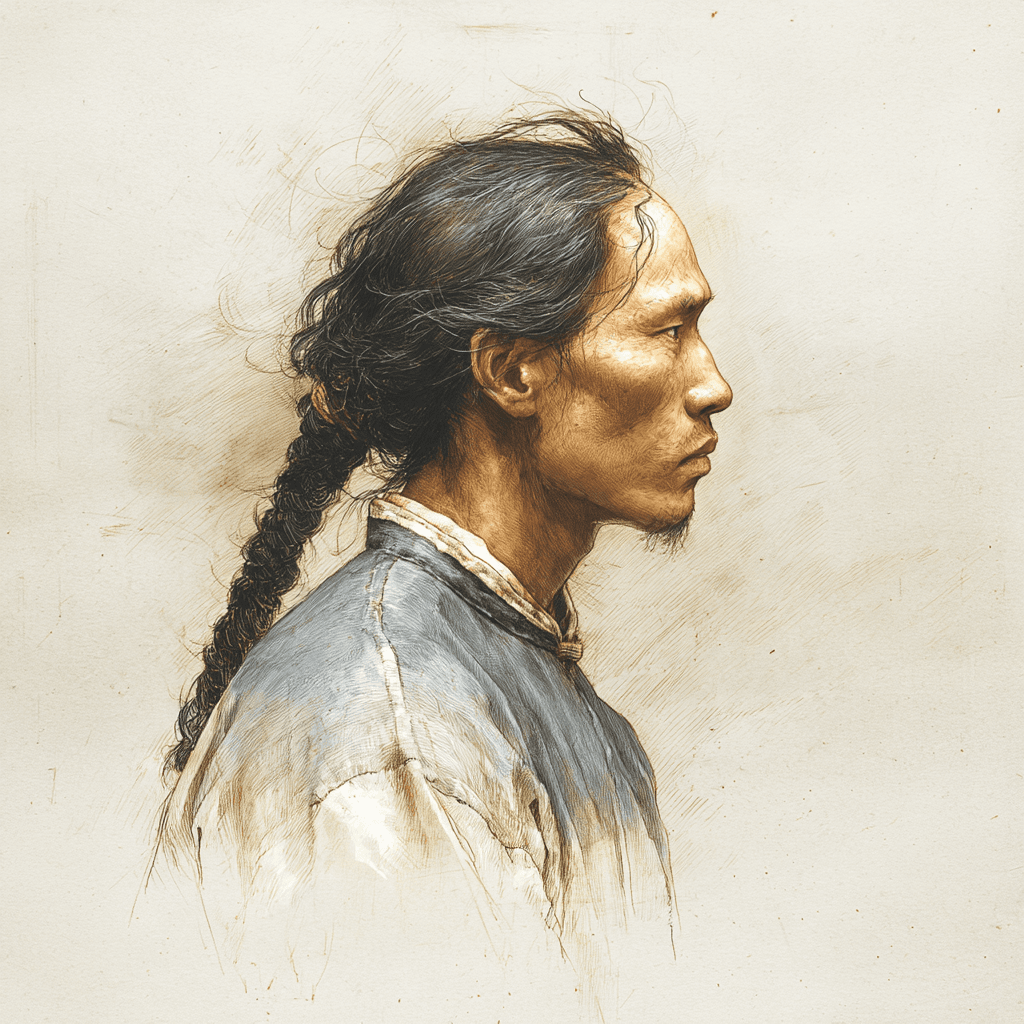
Jian Dashi
Leader of Anti-Japanese Resistance in Northern Taiwan
Armed Resistance / 1896–1915
1870–1900
Jian Dashi, born in 1870 in what is today greater Taipei, was the foremost armed anti-Japanese guerrilla leader of the northern mountains in the early Japanese colonial period and was grouped with Ke Tiehu and Lin Xiaomao as one of the so-called 'Three Fierce Anti-Japanese Leaders.' In his earlier years he operated as a local militia figure across the Datun Mountains, Shilin, and Tamsui, taking part in informal local security affairs. After the Yiwei War, members of his family were killed during the Japanese army's advance, prompting him to swear lifelong resistance and to organize a guerrilla force in the Datun range. From 1896 he repeatedly attacked Japanese garrisons, police substations, and communication lines, frustrating the Government-General's efforts to consolidate control across the Taipei periphery. His tactics relied on rapid raids and orderly withdrawals through the mountain forests, and on several occasions his forces approached the outskirts of Shilin and Yuanshan. From 1898 the Japanese intensified sweep operations and promulgated the so-called 'Bandit Surrender Regulations,' but he refused all amnesty offers and continued to fight. Eventually, under combined pressure from Japanese troops and police, his network was worn down, and he fled to Xiamen in 1899. In 1900 Qing authorities, responding to Japanese diplomatic pressure, arrested him and extradited him to Taiwan under treaty obligations. He was executed by the Japanese in Taipei in March of the same year, leaving a final statement that condemned the colonizers' conduct and reaffirmed his commitment to resistance. The statement was later widely circulated in popular memory and became one of the most symbolic pieces of writing in Taiwan's anti-Japanese tradition. His execution effectively dismantled the largest organized armed resistance network in the north. He is widely regarded as the figure whose death marked the close of large-scale northern Taiwanese armed resistance to Japanese rule.
1896 Took up arms in the Datun Mountains
1900 Extradited to Taiwan and executed
Leader of Anti-Japanese Resistance in Northern Taiwan
Jian Dashi
Era
Armed Resistance / 1896–1915
Lifespan
1870–1900
Jian Dashi, born in 1870 in what is today greater Taipei, was the foremost armed anti-Japanese guerrilla leader of the northern mountains in the early Japanese colonial period and was grouped with Ke Tiehu and Lin Xiaomao as one of the so-called 'Three Fierce Anti-Japanese Leaders.' In his earlier years he operated as a local militia figure across the Datun Mountains, Shilin, and Tamsui, taking part in informal local security affairs. After the Yiwei War, members of his family were killed during the Japanese army's advance, prompting him to swear lifelong resistance and to organize a guerrilla force in the Datun range. From 1896 he repeatedly attacked Japanese garrisons, police substations, and communication lines, frustrating the Government-General's efforts to consolidate control across the Taipei periphery. His tactics relied on rapid raids and orderly withdrawals through the mountain forests, and on several occasions his forces approached the outskirts of Shilin and Yuanshan. From 1898 the Japanese intensified sweep operations and promulgated the so-called 'Bandit Surrender Regulations,' but he refused all amnesty offers and continued to fight. Eventually, under combined pressure from Japanese troops and police, his network was worn down, and he fled to Xiamen in 1899. In 1900 Qing authorities, responding to Japanese diplomatic pressure, arrested him and extradited him to Taiwan under treaty obligations. He was executed by the Japanese in Taipei in March of the same year, leaving a final statement that condemned the colonizers' conduct and reaffirmed his commitment to resistance. The statement was later widely circulated in popular memory and became one of the most symbolic pieces of writing in Taiwan's anti-Japanese tradition. His execution effectively dismantled the largest organized armed resistance network in the north. He is widely regarded as the figure whose death marked the close of large-scale northern Taiwanese armed resistance to Japanese rule.
1896 Took up arms in the Datun Mountains
1900 Extradited to Taiwan and executed