

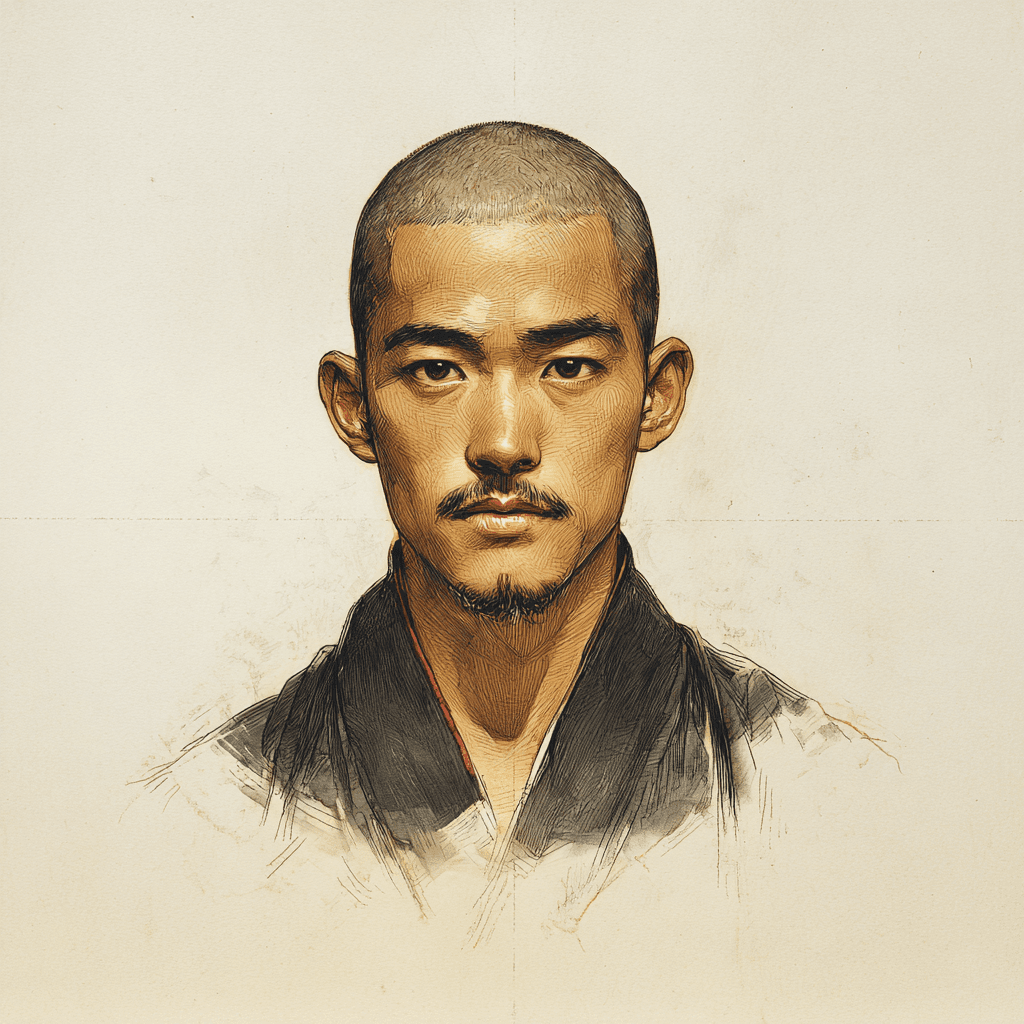
Chiang Shao-tsu
Young Hakka Volunteer Leader of Beipu, Hsinchu
First Sino-Japanese War / 1895
1876–1895
Chiang Shao-tsu, born in 1876 in Beipu, Hsinchu, into the powerful Hakka Chiang clan descended from the Beipu pioneer Chiang Hsiu-luan, grew up within the cultural and economic orbit of the family's Jinguangfu pioneer settlement enterprise. He received a classical education and martial training in his youth and at eighteen took over family affairs and local responsibilities. When news of the cession of Taiwan reached him in 1895 he was only twenty, yet he immediately expended his personal fortune, sold family land, and raised a volunteer unit drawn from his home villages. Operating from Beipu and the Hsinchu uplands, his force fought alongside the Hakka volunteers of Wu Tangxing and Hsu Hsiang and contested Japanese advances around Hsinchu. In July 1895 his unit was surrounded in fighting north of Hsinchu, and after attempting to break out he was captured in close combat. Brought into custody at Hsinchu, he refused to surrender or collaborate and took his own life in his cell by swallowing opium, at the age of twenty. His death made him the youngest and most poetically tragic martyr of the 1895 resistance, and news of it spread rapidly through the Hakka communities of the north. Traditional accounts and later literature have cast him as the archetypal 'young man of family and country,' and he is grouped with Wu Tangxing and Hsu Hsiang as one of the 'Three Heroes of the Yi-Wei War.' The Chiang clan compound at Beipu — the Jinguangfu Public House — preserves relics and memorial spaces dedicated to him and remains a central site in Hakka memory of the 1895 war. Chiang is widely commemorated in modern Taiwanese history as the emblem of Hakka youth gentry who gave themselves wholly to the defense of their homeland.
1895 Spent his family fortune to raise a volunteer army
1895 Took his own life in custody after capture
Young Hakka Volunteer Leader of Beipu, Hsinchu
Chiang Shao-tsu
Era
First Sino-Japanese War / 1895
Lifespan
1876–1895
Chiang Shao-tsu, born in 1876 in Beipu, Hsinchu, into the powerful Hakka Chiang clan descended from the Beipu pioneer Chiang Hsiu-luan, grew up within the cultural and economic orbit of the family's Jinguangfu pioneer settlement enterprise. He received a classical education and martial training in his youth and at eighteen took over family affairs and local responsibilities. When news of the cession of Taiwan reached him in 1895 he was only twenty, yet he immediately expended his personal fortune, sold family land, and raised a volunteer unit drawn from his home villages. Operating from Beipu and the Hsinchu uplands, his force fought alongside the Hakka volunteers of Wu Tangxing and Hsu Hsiang and contested Japanese advances around Hsinchu. In July 1895 his unit was surrounded in fighting north of Hsinchu, and after attempting to break out he was captured in close combat. Brought into custody at Hsinchu, he refused to surrender or collaborate and took his own life in his cell by swallowing opium, at the age of twenty. His death made him the youngest and most poetically tragic martyr of the 1895 resistance, and news of it spread rapidly through the Hakka communities of the north. Traditional accounts and later literature have cast him as the archetypal 'young man of family and country,' and he is grouped with Wu Tangxing and Hsu Hsiang as one of the 'Three Heroes of the Yi-Wei War.' The Chiang clan compound at Beipu — the Jinguangfu Public House — preserves relics and memorial spaces dedicated to him and remains a central site in Hakka memory of the 1895 war. Chiang is widely commemorated in modern Taiwanese history as the emblem of Hakka youth gentry who gave themselves wholly to the defense of their homeland.
1895 Spent his family fortune to raise a volunteer army
1895 Took his own life in custody after capture