

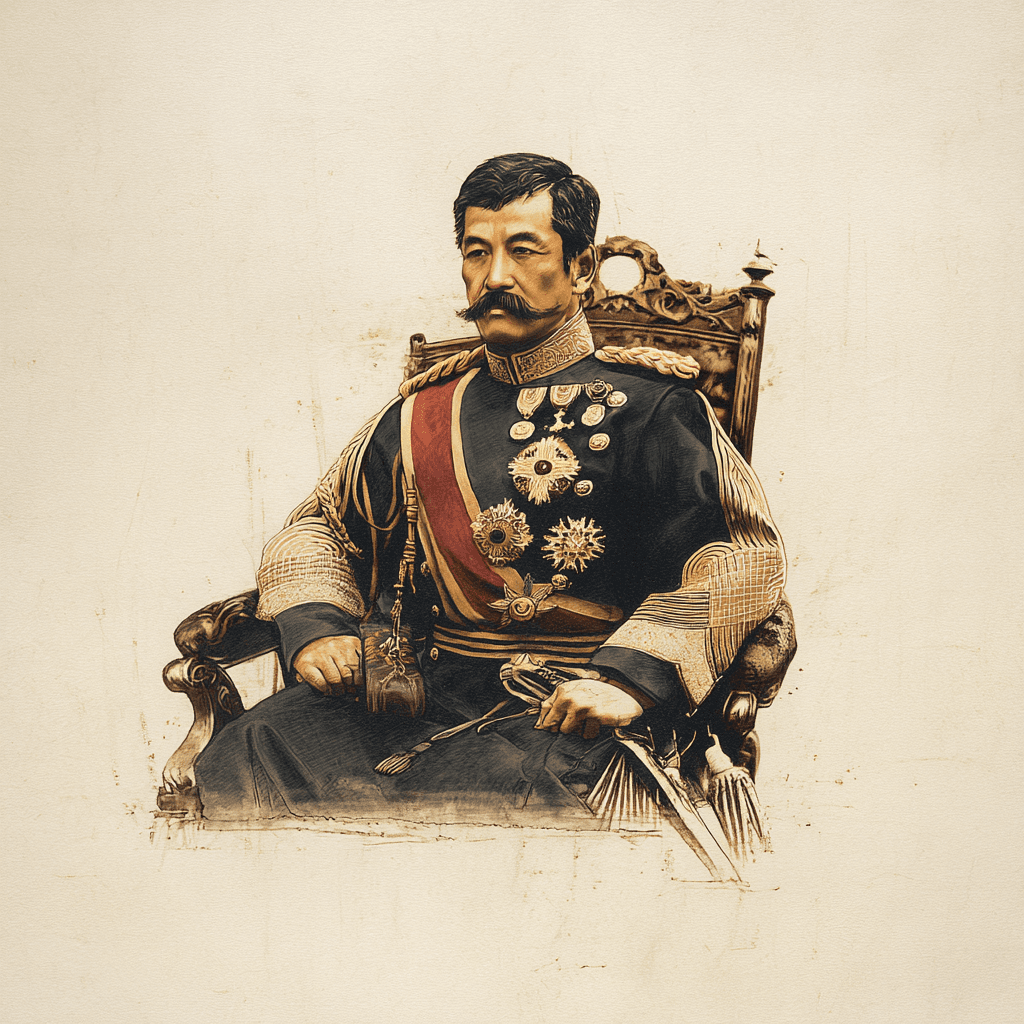
Prince Kitashirakawa Yoshihisa
Commander of the Imperial Guards Division
First Sino-Japanese War / 1895
1847–1895
Prince Kitashirakawa Yoshihisa, born in Kyoto in 1847 as the ninth son of Prince Fushimi-no-miya Kuniie and an uncle of Emperor Meiji, was a senior member of the Japanese imperial family. In early life he was named abbot of Rinnō-ji and during the Boshin War was briefly proclaimed by the Ōuetsu Reppan Domei coalition as the so-called Eastern Emperor in opposition to the new Meiji government before submitting to its terms. He was then sent to Prussia, where he received several years of training in the Royal Prussian Army; on returning to Japan he advanced through the new Imperial Japanese Army, rising to lieutenant general and commander of the Imperial Guards Division. After the signing of the Treaty of Shimonoseki in 1895 he was ordered to lead the Imperial Guards in the takeover of Taiwan and landed at Aodi on the northeast coast in late May. His division advanced southward, fighting the troops of the so-called Republic of Formosa and Taiwanese volunteer forces at Keelung, Taipei, Hsinchu, Miaoli, Changhua, Yunlin, Chiayi, and Tainan, and constituted the main Japanese force in the 1895 war. Prolonged marching and combat in subtropical conditions caused widespread malaria and dysentery among his troops, and he himself fell ill in the south — some accounts attribute his decline to an infected combat wound — and his condition deteriorated steadily. He died at Tainan in late October 1895, the first member of the Japanese imperial family to die on overseas service and the highest-ranking Japanese casualty of the 1895 war. His body was returned to Japan with state honors, he was posthumously promoted to full general, and after deification he was enshrined and commemorated at numerous sites in Japan and Taiwan, including the Taiwan Grand Shrine in Taipei. Throughout the period of Japanese rule colonial authorities promoted his memory as the heroic spirit of the conquest of Taiwan, making him one of the most symbolically charged Japanese figures in the historiography of colonial Taiwan.
1895 Led the Imperial Guards Division to take over Taiwan
1895 Died of illness in Tainan
Commander of the Imperial Guards Division
Prince Kitashirakawa Yoshihisa
Era
First Sino-Japanese War / 1895
Lifespan
1847–1895
Prince Kitashirakawa Yoshihisa, born in Kyoto in 1847 as the ninth son of Prince Fushimi-no-miya Kuniie and an uncle of Emperor Meiji, was a senior member of the Japanese imperial family. In early life he was named abbot of Rinnō-ji and during the Boshin War was briefly proclaimed by the Ōuetsu Reppan Domei coalition as the so-called Eastern Emperor in opposition to the new Meiji government before submitting to its terms. He was then sent to Prussia, where he received several years of training in the Royal Prussian Army; on returning to Japan he advanced through the new Imperial Japanese Army, rising to lieutenant general and commander of the Imperial Guards Division. After the signing of the Treaty of Shimonoseki in 1895 he was ordered to lead the Imperial Guards in the takeover of Taiwan and landed at Aodi on the northeast coast in late May. His division advanced southward, fighting the troops of the so-called Republic of Formosa and Taiwanese volunteer forces at Keelung, Taipei, Hsinchu, Miaoli, Changhua, Yunlin, Chiayi, and Tainan, and constituted the main Japanese force in the 1895 war. Prolonged marching and combat in subtropical conditions caused widespread malaria and dysentery among his troops, and he himself fell ill in the south — some accounts attribute his decline to an infected combat wound — and his condition deteriorated steadily. He died at Tainan in late October 1895, the first member of the Japanese imperial family to die on overseas service and the highest-ranking Japanese casualty of the 1895 war. His body was returned to Japan with state honors, he was posthumously promoted to full general, and after deification he was enshrined and commemorated at numerous sites in Japan and Taiwan, including the Taiwan Grand Shrine in Taipei. Throughout the period of Japanese rule colonial authorities promoted his memory as the heroic spirit of the conquest of Taiwan, making him one of the most symbolically charged Japanese figures in the historiography of colonial Taiwan.
1895 Led the Imperial Guards Division to take over Taiwan
1895 Died of illness in Tainan