

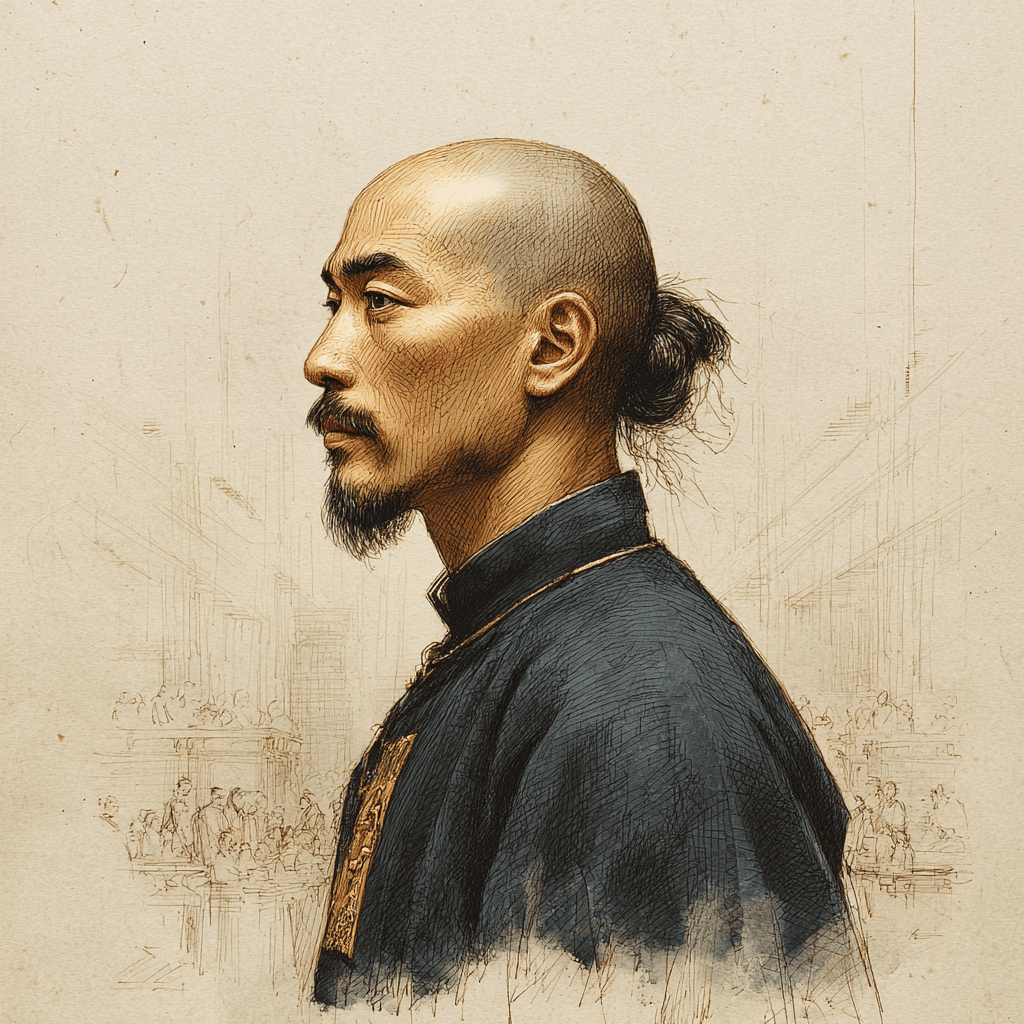
Lan Dingyuan
Qing Military Adviser and Taiwan Governance Scholar
Qing Dynasty
1680–1733
Lan Dingyuan, born in 1680 in Zhangpu County, Fujian, was a Qing military adviser, local official, and prolific writer who played a decisive role in suppressing the Zhu Yigui rebellion of 1721 and then produced the most comprehensive body of early eighteenth-century Chinese scholarship on the governance and society of Taiwan. He came from a scholarly family but took no formal examination degree, instead building his reputation through writing and service to powerful patrons, most notably his cousin Lan Tingzhen, the Qing commander dispatched to crush the Zhu Yigui uprising that had briefly expelled Qing authority from the entire island in 1721. Lan Dingyuan crossed to Taiwan in 1721 as an unofficial adviser attached to his cousin's expedition, observing the campaign at close range and documenting its operations in detail — an experience that gave him direct knowledge of Taiwan's geography, population, and social tensions that few mainland scholars possessed. After the rebellion was suppressed within months, he remained in Taiwan briefly and conducted a systematic survey of the island's settlement patterns, indigenous territories, administrative weaknesses, and economic conditions, which he compiled into two landmark works: the Record of the Eastern Expedition (東征集, 1721) and the Brief Account of the Pacification of Taiwan (平臺紀略, 1722). These texts constitute the most detailed first-hand account of early eighteenth-century Taiwan in Chinese, covering not only military events but also agriculture, indigenous customs, Han settler communities, administrative abuses, and strategic recommendations for long-term Qing governance. Lan's central argument — that Taiwan required more aggressive settlement promotion, stronger county-level administration, and a coherent indigenous policy rather than containment — anticipated the policy debates that would recur throughout the Qing period and beyond. He was particularly critical of the exploitative conduct of local officials and middlemen toward indigenous Taiwanese, documenting cases of land fraud and labor coercion that he argued were the structural causes of frontier unrest. On his return to the mainland, Lan Dingyuan served in several local official posts, eventually becoming prefectural magistrate of Chaoyang in Guangdong Province, where he applied similar reformist ideas to local administration before dying in 1733. His advocacy for Taiwan was taken seriously enough that the Yongzheng Emperor reviewed and partially implemented some of his governance recommendations, making him one of the few non-official commentators of his era to influence imperial Taiwan policy. He is regarded today as the founding figure of systematic Chinese scholarship on Taiwan — the first writer to treat the island as a subject worthy of comprehensive empirical study rather than a distant administrative problem. Lan Dingyuan's work remains an indispensable primary source for historians of Qing Taiwan, and his insight that Taiwan's social stability depended on integrating rather than isolating its diverse population proved to be one of the most prescient analyses of the island's colonial condition.
Served as military adviser in the suppression of the Zhu Yigui rebellion (1721) and compiled its first systematic account
Wrote Record of the Eastern Expedition (東征集) and Brief Account of the Pacification of Taiwan (平臺紀略), the most comprehensive Chinese scholarship on early eighteenth-century Taiwan
Qing Military Adviser and Taiwan Governance Scholar
Lan Dingyuan
Era
Qing Dynasty
Lifespan
1680–1733
Lan Dingyuan, born in 1680 in Zhangpu County, Fujian, was a Qing military adviser, local official, and prolific writer who played a decisive role in suppressing the Zhu Yigui rebellion of 1721 and then produced the most comprehensive body of early eighteenth-century Chinese scholarship on the governance and society of Taiwan. He came from a scholarly family but took no formal examination degree, instead building his reputation through writing and service to powerful patrons, most notably his cousin Lan Tingzhen, the Qing commander dispatched to crush the Zhu Yigui uprising that had briefly expelled Qing authority from the entire island in 1721. Lan Dingyuan crossed to Taiwan in 1721 as an unofficial adviser attached to his cousin's expedition, observing the campaign at close range and documenting its operations in detail — an experience that gave him direct knowledge of Taiwan's geography, population, and social tensions that few mainland scholars possessed. After the rebellion was suppressed within months, he remained in Taiwan briefly and conducted a systematic survey of the island's settlement patterns, indigenous territories, administrative weaknesses, and economic conditions, which he compiled into two landmark works: the Record of the Eastern Expedition (東征集, 1721) and the Brief Account of the Pacification of Taiwan (平臺紀略, 1722). These texts constitute the most detailed first-hand account of early eighteenth-century Taiwan in Chinese, covering not only military events but also agriculture, indigenous customs, Han settler communities, administrative abuses, and strategic recommendations for long-term Qing governance. Lan's central argument — that Taiwan required more aggressive settlement promotion, stronger county-level administration, and a coherent indigenous policy rather than containment — anticipated the policy debates that would recur throughout the Qing period and beyond. He was particularly critical of the exploitative conduct of local officials and middlemen toward indigenous Taiwanese, documenting cases of land fraud and labor coercion that he argued were the structural causes of frontier unrest. On his return to the mainland, Lan Dingyuan served in several local official posts, eventually becoming prefectural magistrate of Chaoyang in Guangdong Province, where he applied similar reformist ideas to local administration before dying in 1733. His advocacy for Taiwan was taken seriously enough that the Yongzheng Emperor reviewed and partially implemented some of his governance recommendations, making him one of the few non-official commentators of his era to influence imperial Taiwan policy. He is regarded today as the founding figure of systematic Chinese scholarship on Taiwan — the first writer to treat the island as a subject worthy of comprehensive empirical study rather than a distant administrative problem. Lan Dingyuan's work remains an indispensable primary source for historians of Qing Taiwan, and his insight that Taiwan's social stability depended on integrating rather than isolating its diverse population proved to be one of the most prescient analyses of the island's colonial condition.
Served as military adviser in the suppression of the Zhu Yigui rebellion (1721) and compiled its first systematic account
Wrote Record of the Eastern Expedition (東征集) and Brief Account of the Pacification of Taiwan (平臺紀略), the most comprehensive Chinese scholarship on early eighteenth-century Taiwan