

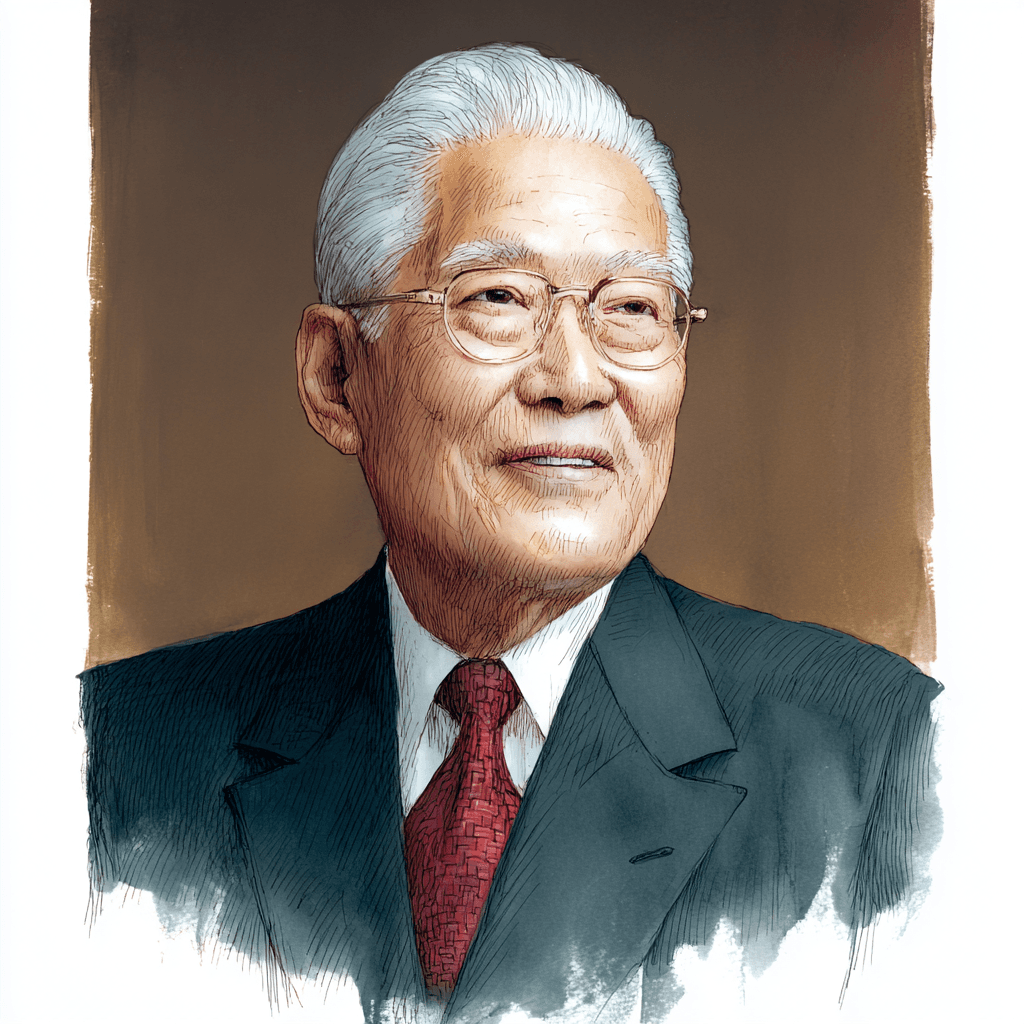
Lee Teng-hui
President of the Republic of China
Democratic Transition / Modern Taiwan
1923–2020
Lee Teng-hui, born in 1923 in Sanzhi, Taipei Prefecture, to a Hoklo-Hakka mixed family during the Japanese colonial period, served from 1988 to 2000 as the first native Taiwanese president of the Republic of China and is widely credited as the principal architect of Taiwan's democratic transition. Educated under the Japanese colonial system, he attended Kyoto Imperial University before wartime evacuation and then completed his undergraduate studies in agricultural economics at the post-war National Taiwan University. He briefly joined the Chinese Communist Party in 1946–47 before quitting in disillusionment and later went to the United States, earning a master's degree at Iowa State University and a doctorate in agricultural economics at Cornell University in 1968. He returned to Taiwan as a leading agricultural policy specialist and was recruited into the KMT in 1971 by Chiang Ching-kuo, who saw native Taiwanese technocrats as essential to the regime's long-term legitimacy. He rose rapidly under Chiang's patronage as Minister without Portfolio, Taipei mayor, Governor of Taiwan Province, and Vice President from 1984, succeeding to the presidency on Chiang's death in January 1988. He moved cautiously but decisively to consolidate his power within the KMT, sidelining the mainlander old guard and securing his election as both KMT Chairman and full-term President by the early 1990s. Between 1991 and 1992 he ended the Period of Mobilization Against Communist Rebellion, retired the elderly mainland-era legislators of the Legislative Yuan and National Assembly, and supervised the first fully direct elections to both bodies. His unprecedented 1995 alumni visit to Cornell University provoked the Third Taiwan Strait Crisis, during which the People's Liberation Army fired missiles into waters near Taiwan in an attempt to intimidate voters before the upcoming election. In March 1996 he won Taiwan's first direct presidential election with 54 percent of the vote against three other candidates, decisively legitimizing the new constitutional order. In 1999 he characterized cross-strait relations as a special state-to-state relationship, a formulation that infuriated Beijing and that became a foundational reference point for subsequent Taiwanese diplomatic positioning. He left office in 2000 after the DPP's Chen Shui-bian won the presidency, was expelled from the KMT in 2001 after openly supporting the new Taiwan Solidarity Union, and remained a vocal advocate of Taiwanese identity until his death. He died in 2020 at the age of 97 and is now widely regarded as Mr. Democracy, the most consequential single architect of Taiwan's transformation from one-party authoritarianism to a consolidated competitive democracy.
Led Taiwan's first direct presidential election (1996)
Abolished the Temporary Provisions and ended the Period of National Mobilization
President of the Republic of China
Lee Teng-hui
Era
Democratic Transition / Modern Taiwan
Lifespan
1923–2020
Lee Teng-hui, born in 1923 in Sanzhi, Taipei Prefecture, to a Hoklo-Hakka mixed family during the Japanese colonial period, served from 1988 to 2000 as the first native Taiwanese president of the Republic of China and is widely credited as the principal architect of Taiwan's democratic transition. Educated under the Japanese colonial system, he attended Kyoto Imperial University before wartime evacuation and then completed his undergraduate studies in agricultural economics at the post-war National Taiwan University. He briefly joined the Chinese Communist Party in 1946–47 before quitting in disillusionment and later went to the United States, earning a master's degree at Iowa State University and a doctorate in agricultural economics at Cornell University in 1968. He returned to Taiwan as a leading agricultural policy specialist and was recruited into the KMT in 1971 by Chiang Ching-kuo, who saw native Taiwanese technocrats as essential to the regime's long-term legitimacy. He rose rapidly under Chiang's patronage as Minister without Portfolio, Taipei mayor, Governor of Taiwan Province, and Vice President from 1984, succeeding to the presidency on Chiang's death in January 1988. He moved cautiously but decisively to consolidate his power within the KMT, sidelining the mainlander old guard and securing his election as both KMT Chairman and full-term President by the early 1990s. Between 1991 and 1992 he ended the Period of Mobilization Against Communist Rebellion, retired the elderly mainland-era legislators of the Legislative Yuan and National Assembly, and supervised the first fully direct elections to both bodies. His unprecedented 1995 alumni visit to Cornell University provoked the Third Taiwan Strait Crisis, during which the People's Liberation Army fired missiles into waters near Taiwan in an attempt to intimidate voters before the upcoming election. In March 1996 he won Taiwan's first direct presidential election with 54 percent of the vote against three other candidates, decisively legitimizing the new constitutional order. In 1999 he characterized cross-strait relations as a special state-to-state relationship, a formulation that infuriated Beijing and that became a foundational reference point for subsequent Taiwanese diplomatic positioning. He left office in 2000 after the DPP's Chen Shui-bian won the presidency, was expelled from the KMT in 2001 after openly supporting the new Taiwan Solidarity Union, and remained a vocal advocate of Taiwanese identity until his death. He died in 2020 at the age of 97 and is now widely regarded as Mr. Democracy, the most consequential single architect of Taiwan's transformation from one-party authoritarianism to a consolidated competitive democracy.
Led Taiwan's first direct presidential election (1996)
Abolished the Temporary Provisions and ended the Period of National Mobilization