

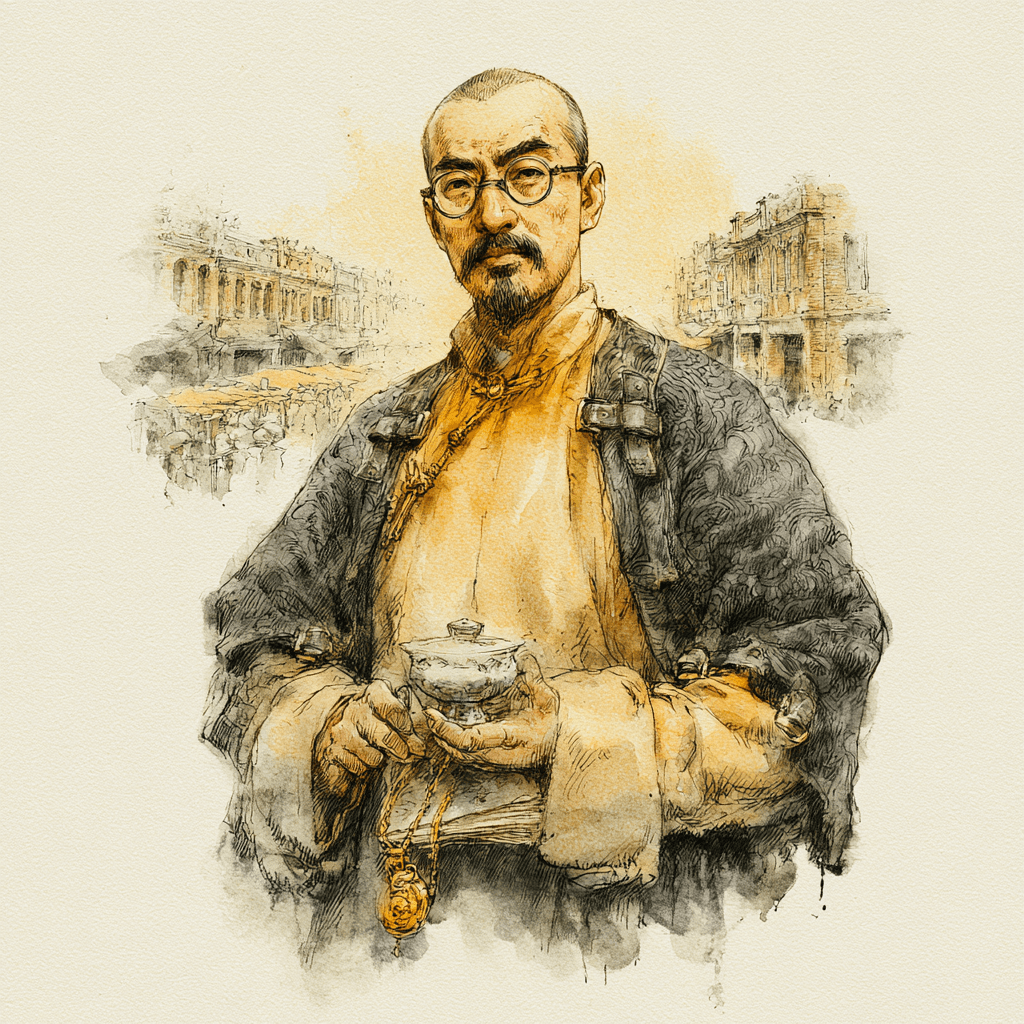
Li Chunsheng
Tea Magnate of Dadaocheng & Modernization Patron of Northern Taiwan
Late Qing to Early Japanese Colonial Era
1838–1924
Li Chunsheng was one of the most influential Taiwanese-Chinese industrialists of the late nineteenth century, whose career spanned the closing decades of Qing rule and the opening years of Japanese colonization, born in 1838 in Xiamen in Fujian. Baptized as a Christian in his youth, he served for more than a decade with the British firm Elles and Co. in Xiamen, acquiring a deep familiarity with international trade and Western commercial institutions. Around 1865 he was recruited by the British merchant John Dodd of Dent and Co. to cross to Taiwan, initially based at Tamsui to assist in the experimental cultivation and export of oolong tea from the northern hills. After Dodd introduced Anxi tea seedlings to Sanxia and Wenshan in 1866, he assumed the role of compradore — purchasing leaf from Chinese farmers, extending interest-free loans, and organizing the sorting and firing operations — and quickly built a working partnership that bridged Han Chinese settlers and Western capital. After the first direct shipment of Formosa Oolong to New York in 1869 transformed Dadaocheng into the richest commercial quarter on the island, he co-founded several tea firms with Dodd, acquired property along Dihua Street, built Western-style mansions and refining plants, and rose to become the foremost native merchant leader of Dadaocheng. As tea profits grew he diversified into real estate, coal mining, and shipping, and underwrote Liu Mingchuan's modernization projects in railways, telegraphy, and waterworks, becoming after Taiwan's elevation to a province in 1885 the most important native economic pillar of the new administration. Culturally, in 1875 he assisted George Leslie Mackay in establishing a church in Dadaocheng and funded Presbyterian missionary work, hospitals, and Western-style schools across northern Taiwan. Under his patronage northern Taiwan acquired by the late nineteenth century an urban infrastructure of a modernity exceptional anywhere in East Asia at the time. After the cession of Taiwan to Japan under the Treaty of Shimonoseki in 1895, when many leading merchants chose to return to the mainland, he remained out of a sense of responsibility to the local population and personally negotiated the peaceful transfer of Taipei to advancing Japanese forces, sparing the city from a destructive entry. In the early colonial period he was invited by the Government-General to visit Japan, where he met Goto Shinpei and the Meiji Emperor; on his return he wrote his sixty-four-day travel journal and several volumes of Christian theology. He was respectfully referred to by Japanese contemporaries as the philosopher of Taiwan, and died at his Dadaocheng residence in 1924 at the age of eighty-six, buried in Sanzhi. Li Chunsheng is generally regarded as the most important Taiwanese-Chinese figure bridging the agricultural society of late Qing Taiwan and the modern capitalist society that followed, whose contributions in tea, urban development, and cultural transition made Dadaocheng one of the principal cradles of Taiwanese modernization.
Built the Dadaocheng tea empire with John Dodd; brokered the peaceful transfer of Taipei in 1895
Tea Magnate of Dadaocheng & Modernization Patron of Northern Taiwan
Li Chunsheng
Era
Late Qing to Early Japanese Colonial Era
Lifespan
1838–1924
Li Chunsheng was one of the most influential Taiwanese-Chinese industrialists of the late nineteenth century, whose career spanned the closing decades of Qing rule and the opening years of Japanese colonization, born in 1838 in Xiamen in Fujian. Baptized as a Christian in his youth, he served for more than a decade with the British firm Elles and Co. in Xiamen, acquiring a deep familiarity with international trade and Western commercial institutions. Around 1865 he was recruited by the British merchant John Dodd of Dent and Co. to cross to Taiwan, initially based at Tamsui to assist in the experimental cultivation and export of oolong tea from the northern hills. After Dodd introduced Anxi tea seedlings to Sanxia and Wenshan in 1866, he assumed the role of compradore — purchasing leaf from Chinese farmers, extending interest-free loans, and organizing the sorting and firing operations — and quickly built a working partnership that bridged Han Chinese settlers and Western capital. After the first direct shipment of Formosa Oolong to New York in 1869 transformed Dadaocheng into the richest commercial quarter on the island, he co-founded several tea firms with Dodd, acquired property along Dihua Street, built Western-style mansions and refining plants, and rose to become the foremost native merchant leader of Dadaocheng. As tea profits grew he diversified into real estate, coal mining, and shipping, and underwrote Liu Mingchuan's modernization projects in railways, telegraphy, and waterworks, becoming after Taiwan's elevation to a province in 1885 the most important native economic pillar of the new administration. Culturally, in 1875 he assisted George Leslie Mackay in establishing a church in Dadaocheng and funded Presbyterian missionary work, hospitals, and Western-style schools across northern Taiwan. Under his patronage northern Taiwan acquired by the late nineteenth century an urban infrastructure of a modernity exceptional anywhere in East Asia at the time. After the cession of Taiwan to Japan under the Treaty of Shimonoseki in 1895, when many leading merchants chose to return to the mainland, he remained out of a sense of responsibility to the local population and personally negotiated the peaceful transfer of Taipei to advancing Japanese forces, sparing the city from a destructive entry. In the early colonial period he was invited by the Government-General to visit Japan, where he met Goto Shinpei and the Meiji Emperor; on his return he wrote his sixty-four-day travel journal and several volumes of Christian theology. He was respectfully referred to by Japanese contemporaries as the philosopher of Taiwan, and died at his Dadaocheng residence in 1924 at the age of eighty-six, buried in Sanzhi. Li Chunsheng is generally regarded as the most important Taiwanese-Chinese figure bridging the agricultural society of late Qing Taiwan and the modern capitalist society that followed, whose contributions in tea, urban development, and cultural transition made Dadaocheng one of the principal cradles of Taiwanese modernization.
Built the Dadaocheng tea empire with John Dodd; brokered the peaceful transfer of Taipei in 1895