

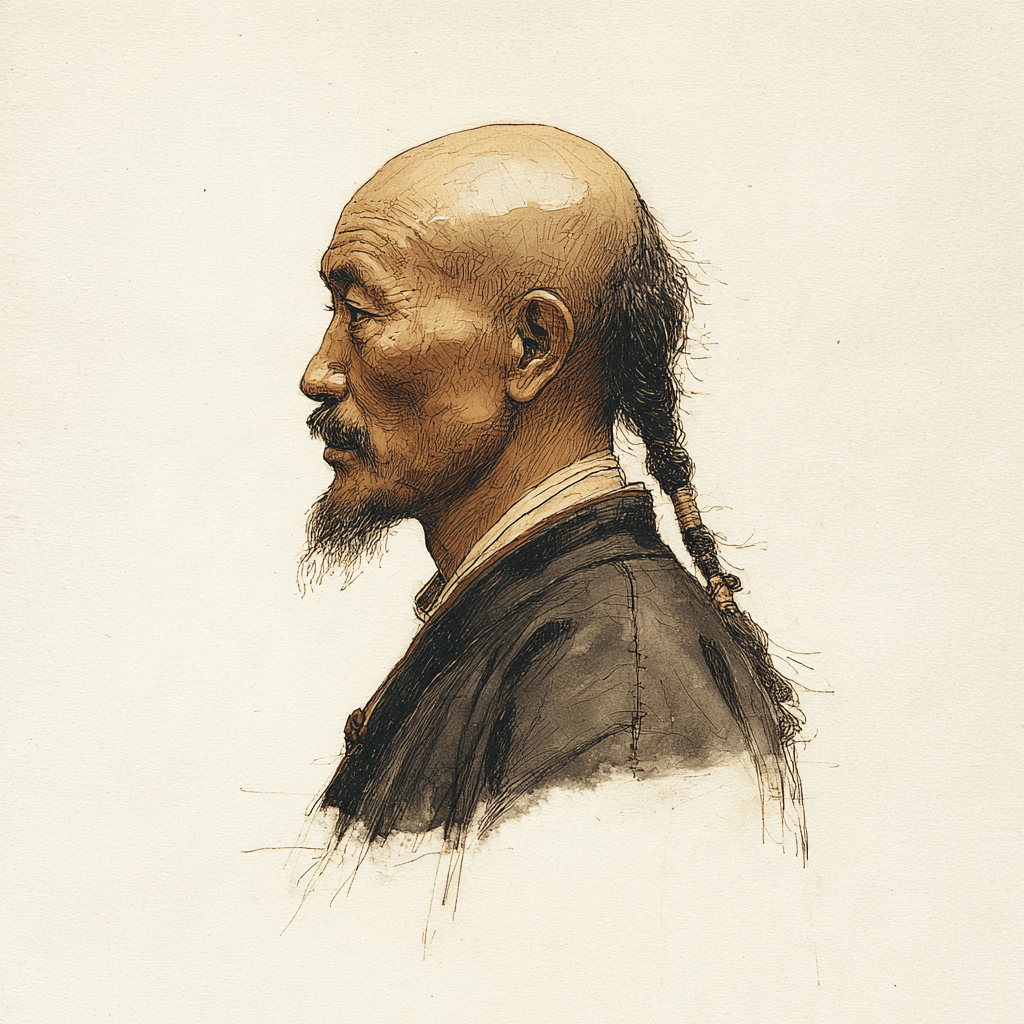
Li Zhisan
First Chief Headman of the Liudui
Qing Dynasty
?–?
Li Zhisan's dates are unknown, and no reliable record survives of where he came from or what family he belonged to. His name appears in the summer of 1721 and then stops there.
On the twelfth of the sixth month that year, more than twenty thousand of Zhu Yigui's followers reached the west bank of the Lower Tamsui River. The east bank was a belt of Hakka villages, their settlers mostly from Tingzhou, Zhenping, Pingyuan and Chengxiang, with a few Plains Indigenous villages among them. Thirteen large villages and sixty-four small ones met at the Shangdi temple in Wandan, raised more than ten thousand men, divided them into seven camps — front, rear, left, right, centre, patrol and vanguard — and chose him as chief headman with Hou Guande as his deputy, holding a line along the east bank. On the eighteenth and nineteenth the two sides fought across the water.
After the rising was put down, he and six others — Hou Guande, Qiu Yongyue, Liu Gengfu, Chen Zhanyu, Zhong Muhua and Zhong Muchun — were promoted to the rank of qianzong, with 950 taels of silver, 300 shi of rice and 100 bolts of silk, and the district where they lived was named Huaizhong, "Cherishing Loyalty." The patrol camp was then dropped and the remaining six were renamed dui, "units," to set them apart from the camps of the regular army. That is where the name Liudui, the Six Units, begins.
Of the man himself almost nothing else remains: a name, a rank, a list of rewards. Ten chief headmen of the Liudui followed him, and the way he is remembered is the way the system itself remembered people — not by a life, but by which year, which river and which bank he stood on.
Chosen in 1721 as the first chief headman of the Liudui, holding the east bank of the Lower Tamsui River with seven camps
Promoted to qianzong with six others afterwards, fixing the structure of the Six Units
Li Zhisan
First Chief Headman of the Liudui
Era
Qing Dynasty
Lifespan
?–?
Li Zhisan's dates are unknown, and no reliable record survives of where he came from or what family he belonged to. His name appears in the summer of 1721 and then stops there.
On the twelfth of the sixth month that year, more than twenty thousand of Zhu Yigui's followers reached the west bank of the Lower Tamsui River. The east bank was a belt of Hakka villages, their settlers mostly from Tingzhou, Zhenping, Pingyuan and Chengxiang, with a few Plains Indigenous villages among them. Thirteen large villages and sixty-four small ones met at the Shangdi temple in Wandan, raised more than ten thousand men, divided them into seven camps — front, rear, left, right, centre, patrol and vanguard — and chose him as chief headman with Hou Guande as his deputy, holding a line along the east bank. On the eighteenth and nineteenth the two sides fought across the water.
After the rising was put down, he and six others — Hou Guande, Qiu Yongyue, Liu Gengfu, Chen Zhanyu, Zhong Muhua and Zhong Muchun — were promoted to the rank of qianzong, with 950 taels of silver, 300 shi of rice and 100 bolts of silk, and the district where they lived was named Huaizhong, "Cherishing Loyalty." The patrol camp was then dropped and the remaining six were renamed dui, "units," to set them apart from the camps of the regular army. That is where the name Liudui, the Six Units, begins.
Of the man himself almost nothing else remains: a name, a rank, a list of rewards. Ten chief headmen of the Liudui followed him, and the way he is remembered is the way the system itself remembered people — not by a life, but by which year, which river and which bank he stood on.
Chosen in 1721 as the first chief headman of the Liudui, holding the east bank of the Lower Tamsui River with seven camps
Promoted to qianzong with six others afterwards, fixing the structure of the Six Units