

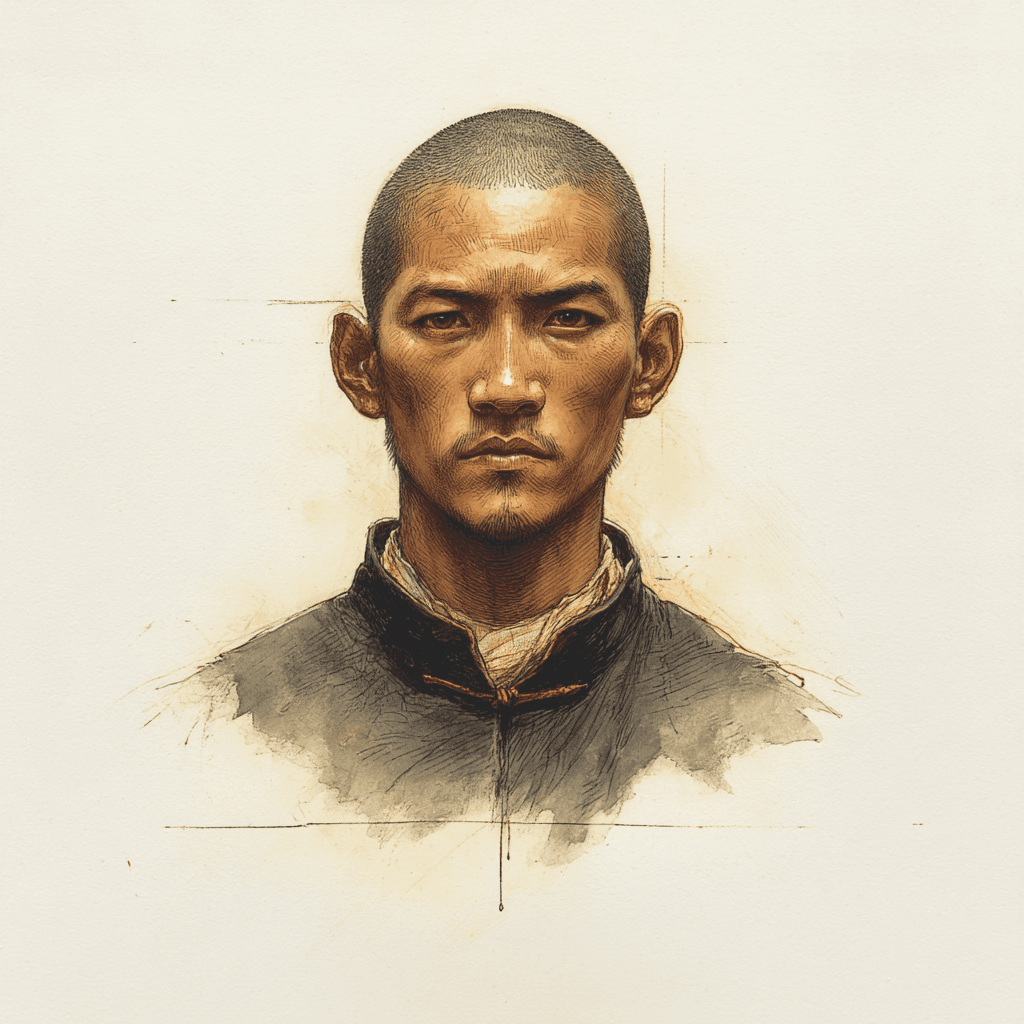
Lin Xiaomao
Leader of Anti-Japanese Resistance in Southern Taiwan
Armed Resistance / 1896–1915
1865–1902
Lin Xiaomao, born in 1865 in the Fengshan area, was the most prominent armed anti-Japanese leader in southern Taiwan during the early Japanese colonial period and was counted with Ke Tiehu and Jian Dashi as one of the so-called 'Three Fierce Anti-Japanese Leaders.' A locally powerful figure from the start, he commanded substantial personal networks and landholdings across Fengshan, Pingtung, and Donggang, and refused to accept the Japanese takeover after the Yiwei War, taking up arms instead. By around 1898 his influence extended along the lower Tamsui River basin and into Akō (Pingtung) and northern Hengchun, making his force the largest single armed resistance in the south during the early colonial years. He clashed repeatedly with Japanese troops and police and at one point attacked the administrative outposts at Chaozhou and Donggang, prompting the Government-General to dispatch reinforcements south. In 1899 the colonial government shifted to the so-called pacification-by-amnesty policy promoted by Goto Shimpei, mediated by local gentry, and Lin Xiaomao accepted Japanese terms that allowed him to manage farmland and local security around what is today Houbilin in Kaohsiung. Outwardly disarmed, he in practice retained a private armed retinue and an autonomous sphere of influence that the Japanese came to regard as a latent threat to southern stability. In 1902 the colonial authorities ruled that he had violated the terms of his surrender and launched a surprise assault on Houbilin that May. Lin Xiaomao was shot dead in the ensuing battle, much of his family and retinue were killed, and the largest armed resistance force in southern Taiwan was thus destroyed. His campaign closed the chapter of large-scale armed resistance organized around landed strongmen in the southern lowlands. Later opposition to Japanese rule would persist mainly as scattered actions or, eventually, as nationally inflected revolutionary movements. He is widely regarded as the figure whose downfall marked the end of large-scale armed resistance in lowland Taiwan.
1898 Led the largest armed resistance in the south
1902 Killed in the Houbilin assault
Leader of Anti-Japanese Resistance in Southern Taiwan
Lin Xiaomao
Era
Armed Resistance / 1896–1915
Lifespan
1865–1902
Lin Xiaomao, born in 1865 in the Fengshan area, was the most prominent armed anti-Japanese leader in southern Taiwan during the early Japanese colonial period and was counted with Ke Tiehu and Jian Dashi as one of the so-called 'Three Fierce Anti-Japanese Leaders.' A locally powerful figure from the start, he commanded substantial personal networks and landholdings across Fengshan, Pingtung, and Donggang, and refused to accept the Japanese takeover after the Yiwei War, taking up arms instead. By around 1898 his influence extended along the lower Tamsui River basin and into Akō (Pingtung) and northern Hengchun, making his force the largest single armed resistance in the south during the early colonial years. He clashed repeatedly with Japanese troops and police and at one point attacked the administrative outposts at Chaozhou and Donggang, prompting the Government-General to dispatch reinforcements south. In 1899 the colonial government shifted to the so-called pacification-by-amnesty policy promoted by Goto Shimpei, mediated by local gentry, and Lin Xiaomao accepted Japanese terms that allowed him to manage farmland and local security around what is today Houbilin in Kaohsiung. Outwardly disarmed, he in practice retained a private armed retinue and an autonomous sphere of influence that the Japanese came to regard as a latent threat to southern stability. In 1902 the colonial authorities ruled that he had violated the terms of his surrender and launched a surprise assault on Houbilin that May. Lin Xiaomao was shot dead in the ensuing battle, much of his family and retinue were killed, and the largest armed resistance force in southern Taiwan was thus destroyed. His campaign closed the chapter of large-scale armed resistance organized around landed strongmen in the southern lowlands. Later opposition to Japanese rule would persist mainly as scattered actions or, eventually, as nationally inflected revolutionary movements. He is widely regarded as the figure whose downfall marked the end of large-scale armed resistance in lowland Taiwan.
1898 Led the largest armed resistance in the south
1902 Killed in the Houbilin assault