

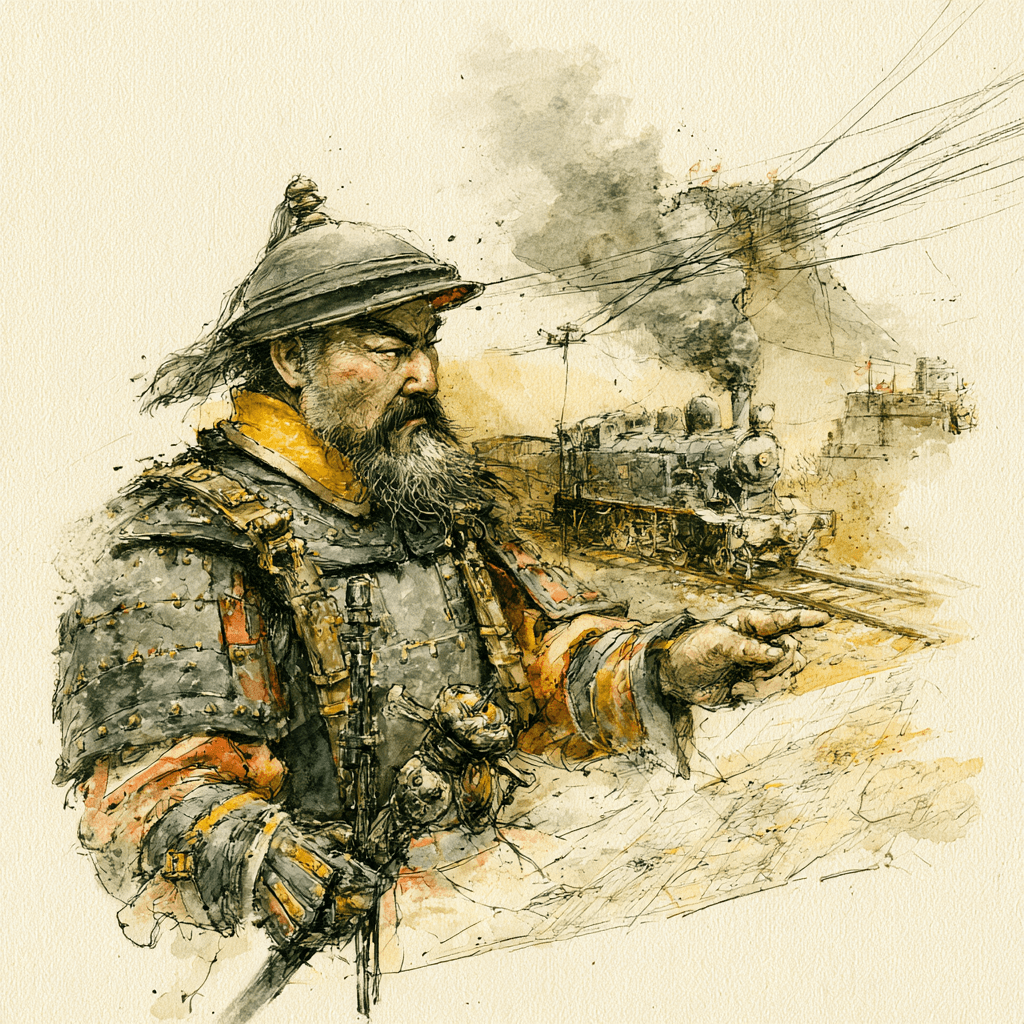
Liu Mingchuan
First Governor of Taiwan Province
Qing Dynasty
1836–1896
Liu Ming-chuan, born in 1836 to a poor farming family in Hefei, Anhui, was a self-made military officer of the Huai Army who later served as the first Governor of Taiwan Province and the foremost architect of late-Qing modernization on the island. He joined a local militia as a teenager and rose through the Huai Army under Li Hongzhang, distinguishing himself in major battles against the Taiping rebels in the lower Yangzi region in the 1860s. After the Taiping War he led campaigns in the north against the Nian rebels and was eventually ennobled as an earl of the first rank, before retiring to his estates in the late 1870s as factional politics turned against him. The Sino-French War of 1884 returned him to active service: appointed to defend Taiwan against the French Far East Squadron, he arrived in July 1884 with broad authority over military and civil affairs. He withdrew from indefensible Keelung after heavy French bombardment but held Tamsui in October 1884, beating off a French landing in the famous Battle of Hobe (滬尾大捷) — the only significant Chinese land victory of the war. After the truce of 1885, the Qing court upgraded Taiwan from a prefecture under Fujian to a full province, with Liu as its inaugural governor and a sweeping mandate for self-strengthening reform. Between 1885 and 1891 he built Taiwan's first railway from Keelung toward Hsinchu, strung telegraph lines across the western corridor and to Penghu, and inaugurated a postal service that issued the island's earliest stamps. He oversaw the comprehensive land survey known as the Qingfu (清賦), modernized customs administration, opened coal mines at Keelung, and installed gas street lighting in Dadaocheng. He attempted ambitious institutional reforms, including a Western-style academy in Taipei, integration of indigenous polities into the tax system, and the development of Taipei as a new administrative center. Many of these programs ran into stiff opposition from elite landowners disliking the new survey and tax burdens, as well as from court conservatives reluctant to underwrite their expense. He resigned in 1891 amid these political pressures and a tax revolt in Changhua, and his successor Shao Youlian let several of his initiatives lapse before Taiwan's cession to Japan in 1895. Liu died in 1896 in Hefei at the age of 60, his legacy mixed — a visionary modernizer who in six years gave Taiwan its first modern infrastructure but whose programs were incomplete and unevenly absorbed by the time of the Qing exit from the island.
Established Taiwan as a province and modernized its infrastructure (1885–1891)
First Governor of Taiwan Province
Liu Mingchuan
Era
Qing Dynasty
Lifespan
1836–1896
Liu Ming-chuan, born in 1836 to a poor farming family in Hefei, Anhui, was a self-made military officer of the Huai Army who later served as the first Governor of Taiwan Province and the foremost architect of late-Qing modernization on the island. He joined a local militia as a teenager and rose through the Huai Army under Li Hongzhang, distinguishing himself in major battles against the Taiping rebels in the lower Yangzi region in the 1860s. After the Taiping War he led campaigns in the north against the Nian rebels and was eventually ennobled as an earl of the first rank, before retiring to his estates in the late 1870s as factional politics turned against him. The Sino-French War of 1884 returned him to active service: appointed to defend Taiwan against the French Far East Squadron, he arrived in July 1884 with broad authority over military and civil affairs. He withdrew from indefensible Keelung after heavy French bombardment but held Tamsui in October 1884, beating off a French landing in the famous Battle of Hobe (滬尾大捷) — the only significant Chinese land victory of the war. After the truce of 1885, the Qing court upgraded Taiwan from a prefecture under Fujian to a full province, with Liu as its inaugural governor and a sweeping mandate for self-strengthening reform. Between 1885 and 1891 he built Taiwan's first railway from Keelung toward Hsinchu, strung telegraph lines across the western corridor and to Penghu, and inaugurated a postal service that issued the island's earliest stamps. He oversaw the comprehensive land survey known as the Qingfu (清賦), modernized customs administration, opened coal mines at Keelung, and installed gas street lighting in Dadaocheng. He attempted ambitious institutional reforms, including a Western-style academy in Taipei, integration of indigenous polities into the tax system, and the development of Taipei as a new administrative center. Many of these programs ran into stiff opposition from elite landowners disliking the new survey and tax burdens, as well as from court conservatives reluctant to underwrite their expense. He resigned in 1891 amid these political pressures and a tax revolt in Changhua, and his successor Shao Youlian let several of his initiatives lapse before Taiwan's cession to Japan in 1895. Liu died in 1896 in Hefei at the age of 60, his legacy mixed — a visionary modernizer who in six years gave Taiwan its first modern infrastructure but whose programs were incomplete and unevenly absorbed by the time of the Qing exit from the island.
Established Taiwan as a province and modernized its infrastructure (1885–1891)