

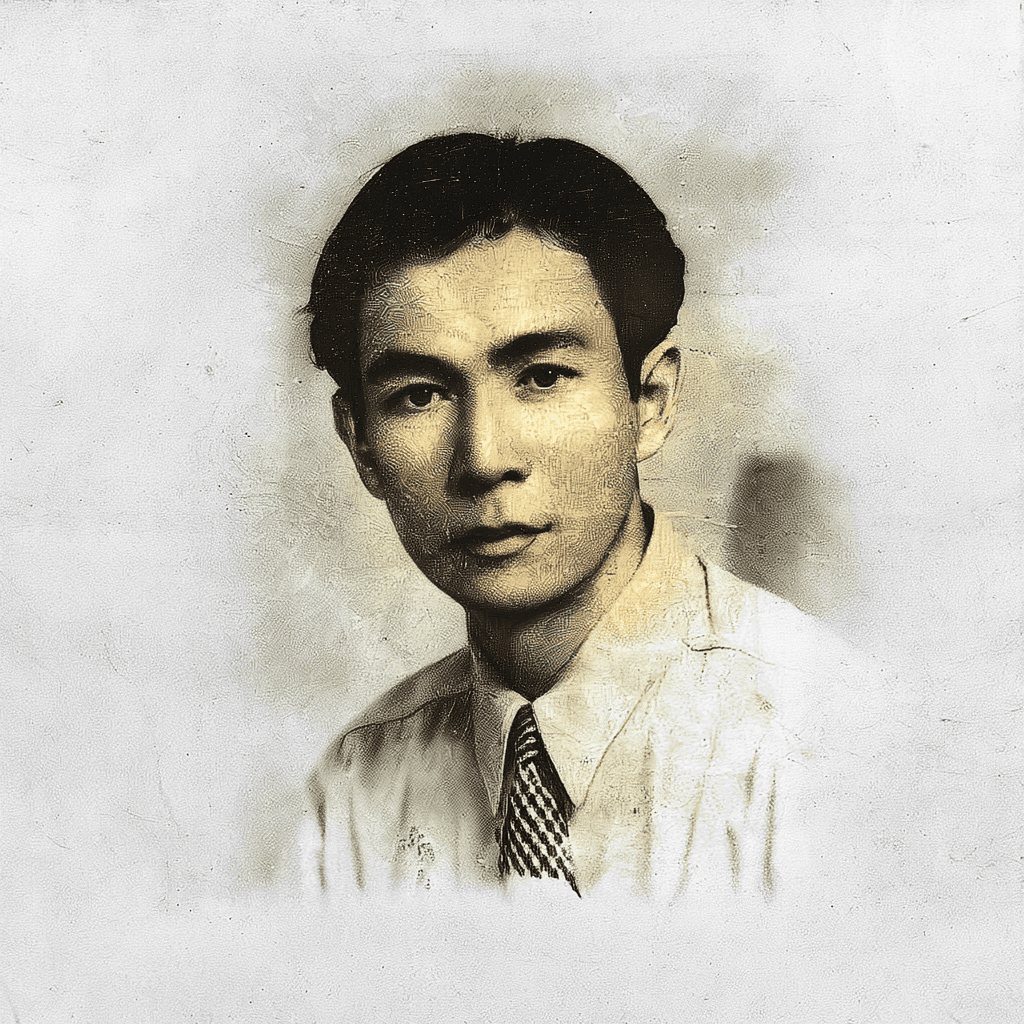
Lu Heruo
Writer and Baritone
Japanese Colonial / Post-War
1914–1951
Lu Heruo was born Lu Shih-tui in 1914 in Tanzi, Taichung, into a landowning family, and grew into one of the most dazzling talents of his generation — so gifted that admirers called him 'Taiwan's finest genius.' Trained as a teacher, he made his literary debut in 1935 when his story The Oxcart was published in a leading Tokyo magazine, a searing portrait of a peasant family crushed by modernisation. Not content with the pen alone, he travelled to Japan to train as a baritone and performed on the operatic stage, moving between literature and music with rare ease. His fiction, including the celebrated Clear Autumn, probed the tensions of family, tradition and colonial modernity. After the war his idealism drew him leftward, and amid the gathering White Terror he went underground, joining an armed base in the hills of Luku. It was there, around 1951, that he died — by most accounts from a venomous snakebite while in hiding — his brilliant life cut short at thirty-six. His grave was never found, and his finest works were long suppressed before Taiwan reclaimed him as a master of colonial-era fiction.
Debuted with The Oxcart in a Tokyo literary magazine (1935)
Died around 1951 while hiding at the Luku armed base
Writer and Baritone
Lu Heruo
Era
Japanese Colonial / Post-War
Lifespan
1914–1951
Lu Heruo was born Lu Shih-tui in 1914 in Tanzi, Taichung, into a landowning family, and grew into one of the most dazzling talents of his generation — so gifted that admirers called him 'Taiwan's finest genius.' Trained as a teacher, he made his literary debut in 1935 when his story The Oxcart was published in a leading Tokyo magazine, a searing portrait of a peasant family crushed by modernisation. Not content with the pen alone, he travelled to Japan to train as a baritone and performed on the operatic stage, moving between literature and music with rare ease. His fiction, including the celebrated Clear Autumn, probed the tensions of family, tradition and colonial modernity. After the war his idealism drew him leftward, and amid the gathering White Terror he went underground, joining an armed base in the hills of Luku. It was there, around 1951, that he died — by most accounts from a venomous snakebite while in hiding — his brilliant life cut short at thirty-six. His grave was never found, and his finest works were long suppressed before Taiwan reclaimed him as a master of colonial-era fiction.
Debuted with The Oxcart in a Tokyo literary magazine (1935)
Died around 1951 while hiding at the Luku armed base