

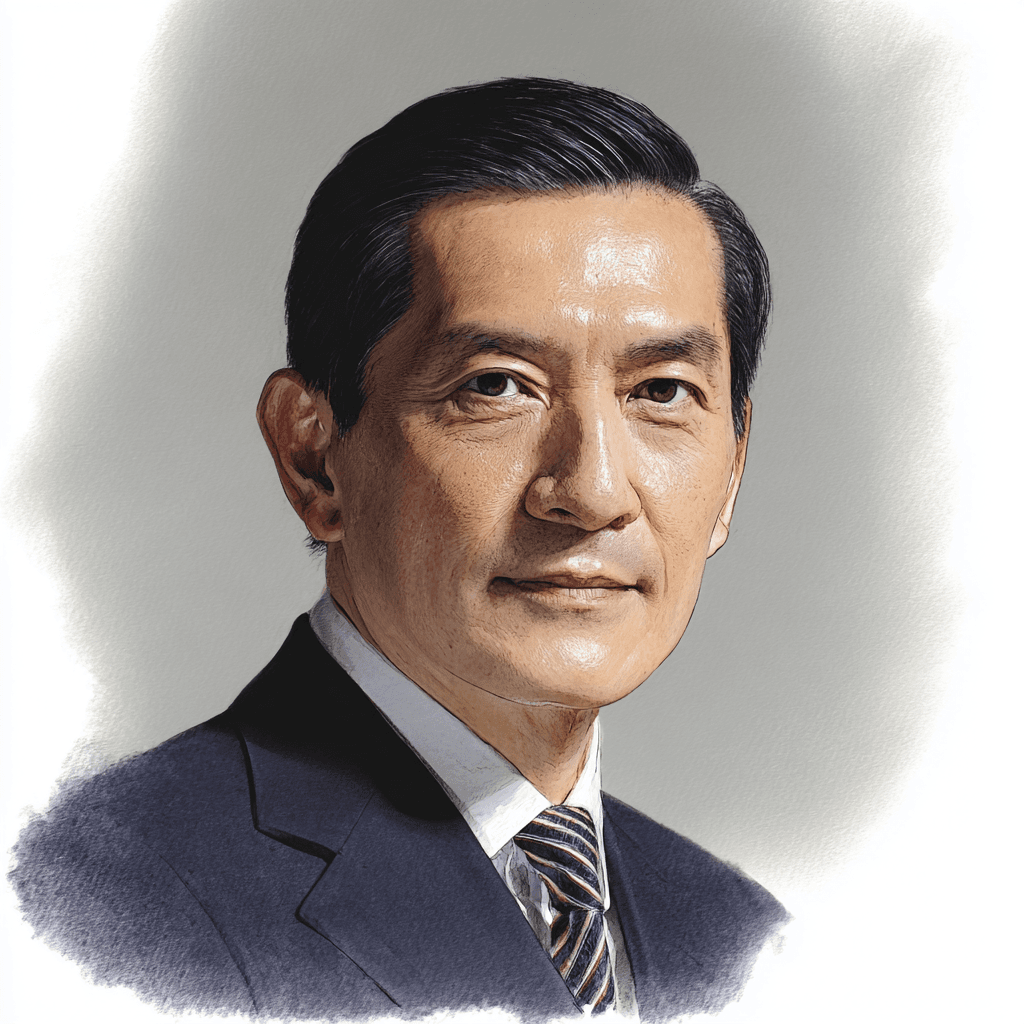
Ma Ying-jeou
President of the Republic of China
Modern Taiwan
1950–
Ma Ying-jeou, born in 1950 in Hong Kong to KMT-aligned mainlander parents who had recently fled the civil war, was brought to Taiwan as a small child and rose through the ROC bureaucratic and party hierarchy to serve two terms as President of the Republic of China from 2008 to 2016. He graduated from the law department of National Taiwan University and pursued advanced legal studies at New York University and at Harvard Law School, where he received his doctoral degree in 1981. Returning to Taiwan he served as English-language secretary to President Chiang Ching-kuo and as deputy secretary-general of the KMT, establishing himself as a rising mainlander star within the post-Chiang reform generation. He served as Justice Minister from 1993 to 1996, winning a reputation as an anti-corruption advocate during his prosecution-led campaign against vote-buying in local elections. He was twice elected mayor of Taipei from 1998 and 2002, ousting Chen Shui-bian in the first contest and establishing the foundation for his national-level career. As KMT chairman from 2005, he repositioned the party as a credible governing alternative after years of identity crisis under Lien Chan, and won the 2008 presidential election in a landslide against the DPP's Frank Hsieh. His first term emphasized cross-strait rapprochement: direct passenger and cargo flights between Taiwan and mainland China were opened in 2008–2009, mainland tourist arrivals were liberalized, and the Economic Cooperation Framework Agreement (ECFA) was signed in 2010. He was reelected in 2012 with 51.6 percent against the DPP's Tsai Ing-wen and continued an unprecedented expansion of cross-strait economic ties, ultimately concluding twenty-three formal cross-strait agreements. His proposed Cross-Strait Service Trade Agreement triggered the March 2014 Sunflower Movement, in which student protesters occupied the Legislative Yuan for twenty-four days and forced the suspension of the pact. In November 2015 he met with PRC President Xi Jinping in Singapore in the first direct face-to-face encounter between the heads of the ROC and PRC governments since 1945, an event celebrated in some quarters and criticized in others. He left office in 2016 after the DPP's landslide return to power and has pursued an active post-presidency, including several high-profile visits to mainland China in 2023 and 2024. Ma is widely credited with completing the institutional infrastructure of cross-strait economic engagement, though the political backlash to that engagement reshaped Taiwanese identity politics and contributed to the DPP's subsequent decade of national dominance.
Second party turnover — elected president (2008)
Historic Ma–Xi meeting in Singapore (2015)
President of the Republic of China
Ma Ying-jeou
Era
Modern Taiwan
Lifespan
1950–
Ma Ying-jeou, born in 1950 in Hong Kong to KMT-aligned mainlander parents who had recently fled the civil war, was brought to Taiwan as a small child and rose through the ROC bureaucratic and party hierarchy to serve two terms as President of the Republic of China from 2008 to 2016. He graduated from the law department of National Taiwan University and pursued advanced legal studies at New York University and at Harvard Law School, where he received his doctoral degree in 1981. Returning to Taiwan he served as English-language secretary to President Chiang Ching-kuo and as deputy secretary-general of the KMT, establishing himself as a rising mainlander star within the post-Chiang reform generation. He served as Justice Minister from 1993 to 1996, winning a reputation as an anti-corruption advocate during his prosecution-led campaign against vote-buying in local elections. He was twice elected mayor of Taipei from 1998 and 2002, ousting Chen Shui-bian in the first contest and establishing the foundation for his national-level career. As KMT chairman from 2005, he repositioned the party as a credible governing alternative after years of identity crisis under Lien Chan, and won the 2008 presidential election in a landslide against the DPP's Frank Hsieh. His first term emphasized cross-strait rapprochement: direct passenger and cargo flights between Taiwan and mainland China were opened in 2008–2009, mainland tourist arrivals were liberalized, and the Economic Cooperation Framework Agreement (ECFA) was signed in 2010. He was reelected in 2012 with 51.6 percent against the DPP's Tsai Ing-wen and continued an unprecedented expansion of cross-strait economic ties, ultimately concluding twenty-three formal cross-strait agreements. His proposed Cross-Strait Service Trade Agreement triggered the March 2014 Sunflower Movement, in which student protesters occupied the Legislative Yuan for twenty-four days and forced the suspension of the pact. In November 2015 he met with PRC President Xi Jinping in Singapore in the first direct face-to-face encounter between the heads of the ROC and PRC governments since 1945, an event celebrated in some quarters and criticized in others. He left office in 2016 after the DPP's landslide return to power and has pursued an active post-presidency, including several high-profile visits to mainland China in 2023 and 2024. Ma is widely credited with completing the institutional infrastructure of cross-strait economic engagement, though the political backlash to that engagement reshaped Taiwanese identity politics and contributed to the DPP's subsequent decade of national dominance.
Second party turnover — elected president (2008)
Historic Ma–Xi meeting in Singapore (2015)