

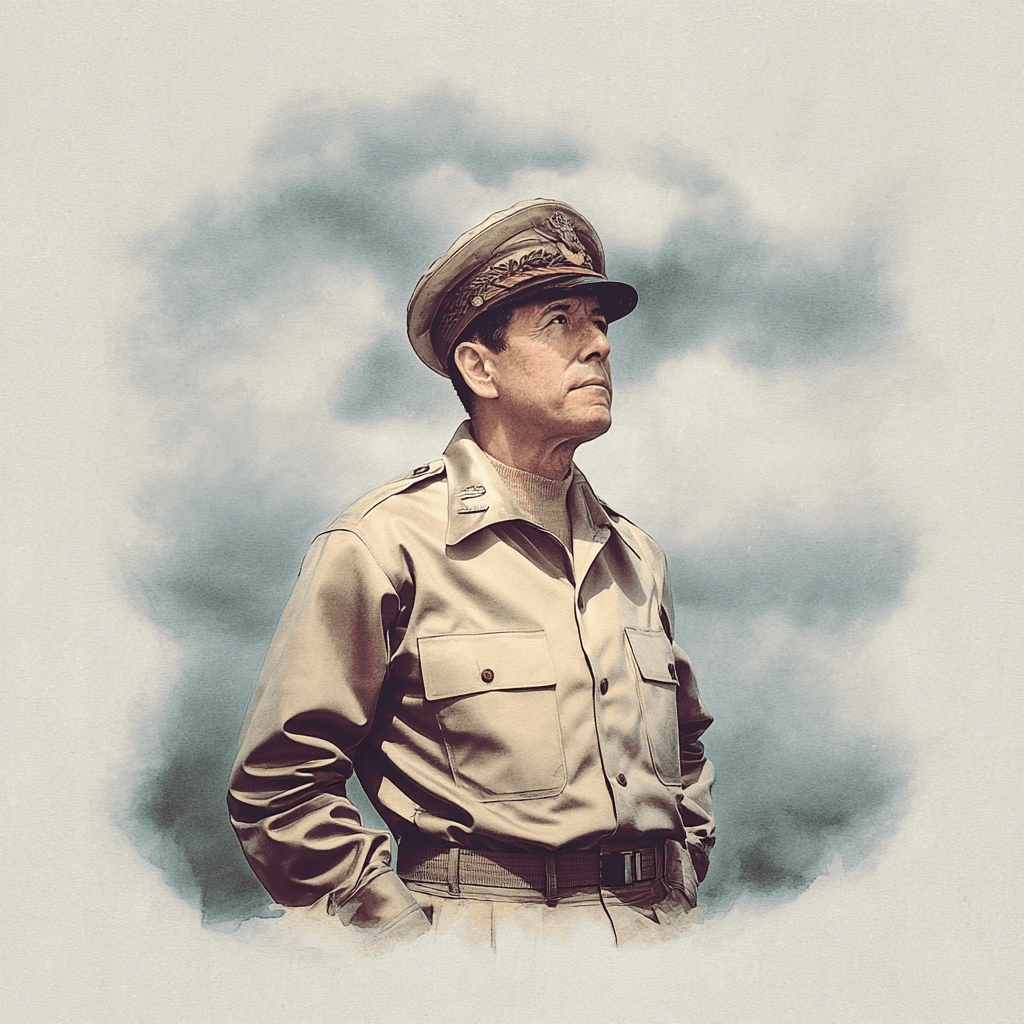
Douglas MacArthur
Supreme Commander of the Allied Powers
Post-War Taiwan
1880–1964
Douglas MacArthur, born in 1880 in Little Rock, Arkansas, into a distinguished American military family, was one of only five U.S. five-star Generals of the Army and the senior American military figure whose post-1945 directives directly shaped the trajectory of Taiwan in the aftermath of the Second World War. He graduated first in the West Point class of 1903 and served with distinction in the Philippine pacification campaigns, in Mexico, and in France during the First World War, where he commanded the Rainbow Division. He served as Superintendent of West Point from 1919 to 1922 and as Army Chief of Staff from 1930 to 1935 before accepting an appointment as Field Marshal of the Commonwealth of the Philippines. After the Japanese invasion of the Philippines in 1941 he led the doomed defense of Bataan and Corregidor before being ordered by President Roosevelt to evacuate to Australia, where he famously pledged 'I shall return.' He commanded Allied forces in the Southwest Pacific Area for the remainder of the war, conducting the island-hopping campaign that closed in on the Japanese home islands by 1945. He accepted the formal Japanese surrender aboard the USS Missouri in Tokyo Bay on 2 September 1945 in his capacity as Supreme Commander for the Allied Powers (SCAP). On the same day, in his SCAP General Order No. 1, he directed which Allied forces would receive the surrender of Japanese troops in each theater, specifying that the Republic of China would accept the surrender of Japanese forces in China proper north of Indochina, including Formosa and the Pescadores. This directive made the Republic of China the receiver of the Japanese administration in Taiwan in October 1945, an instruction whose legal interpretation continues to shape debates over Taiwan's international status into the twenty-first century. From late 1945 through 1951 he served as the de facto American proconsul of occupied Japan, overseeing demilitarization, the drafting of the post-war Japanese constitution, land reform, and the rebuilding of the Japanese economy. He returned to active field command during the Korean War from 1950, executing the strategically brilliant Inchon landings before being relieved by President Truman in April 1951 for publicly disputing the president's strategy of limited war against the People's Republic of China. He returned to the United States to a hero's welcome and delivered the famous Old Soldiers Never Die farewell address to a joint session of Congress before retiring from public life. He died in 1964 at the age of 84, and his General Order No. 1 remains one of the foundational legal acts shaping Taiwan's modern history, although his personal involvement with the island during his lifetime was limited.
Issued General Order No. 1 (1945), directing the ROC to accept Japan's surrender in Taiwan
Supreme Commander of the Allied Powers
Douglas MacArthur
Era
Post-War Taiwan
Lifespan
1880–1964
Douglas MacArthur, born in 1880 in Little Rock, Arkansas, into a distinguished American military family, was one of only five U.S. five-star Generals of the Army and the senior American military figure whose post-1945 directives directly shaped the trajectory of Taiwan in the aftermath of the Second World War. He graduated first in the West Point class of 1903 and served with distinction in the Philippine pacification campaigns, in Mexico, and in France during the First World War, where he commanded the Rainbow Division. He served as Superintendent of West Point from 1919 to 1922 and as Army Chief of Staff from 1930 to 1935 before accepting an appointment as Field Marshal of the Commonwealth of the Philippines. After the Japanese invasion of the Philippines in 1941 he led the doomed defense of Bataan and Corregidor before being ordered by President Roosevelt to evacuate to Australia, where he famously pledged 'I shall return.' He commanded Allied forces in the Southwest Pacific Area for the remainder of the war, conducting the island-hopping campaign that closed in on the Japanese home islands by 1945. He accepted the formal Japanese surrender aboard the USS Missouri in Tokyo Bay on 2 September 1945 in his capacity as Supreme Commander for the Allied Powers (SCAP). On the same day, in his SCAP General Order No. 1, he directed which Allied forces would receive the surrender of Japanese troops in each theater, specifying that the Republic of China would accept the surrender of Japanese forces in China proper north of Indochina, including Formosa and the Pescadores. This directive made the Republic of China the receiver of the Japanese administration in Taiwan in October 1945, an instruction whose legal interpretation continues to shape debates over Taiwan's international status into the twenty-first century. From late 1945 through 1951 he served as the de facto American proconsul of occupied Japan, overseeing demilitarization, the drafting of the post-war Japanese constitution, land reform, and the rebuilding of the Japanese economy. He returned to active field command during the Korean War from 1950, executing the strategically brilliant Inchon landings before being relieved by President Truman in April 1951 for publicly disputing the president's strategy of limited war against the People's Republic of China. He returned to the United States to a hero's welcome and delivered the famous Old Soldiers Never Die farewell address to a joint session of Congress before retiring from public life. He died in 1964 at the age of 84, and his General Order No. 1 remains one of the foundational legal acts shaping Taiwan's modern history, although his personal involvement with the island during his lifetime was limited.
Issued General Order No. 1 (1945), directing the ROC to accept Japan's surrender in Taiwan