

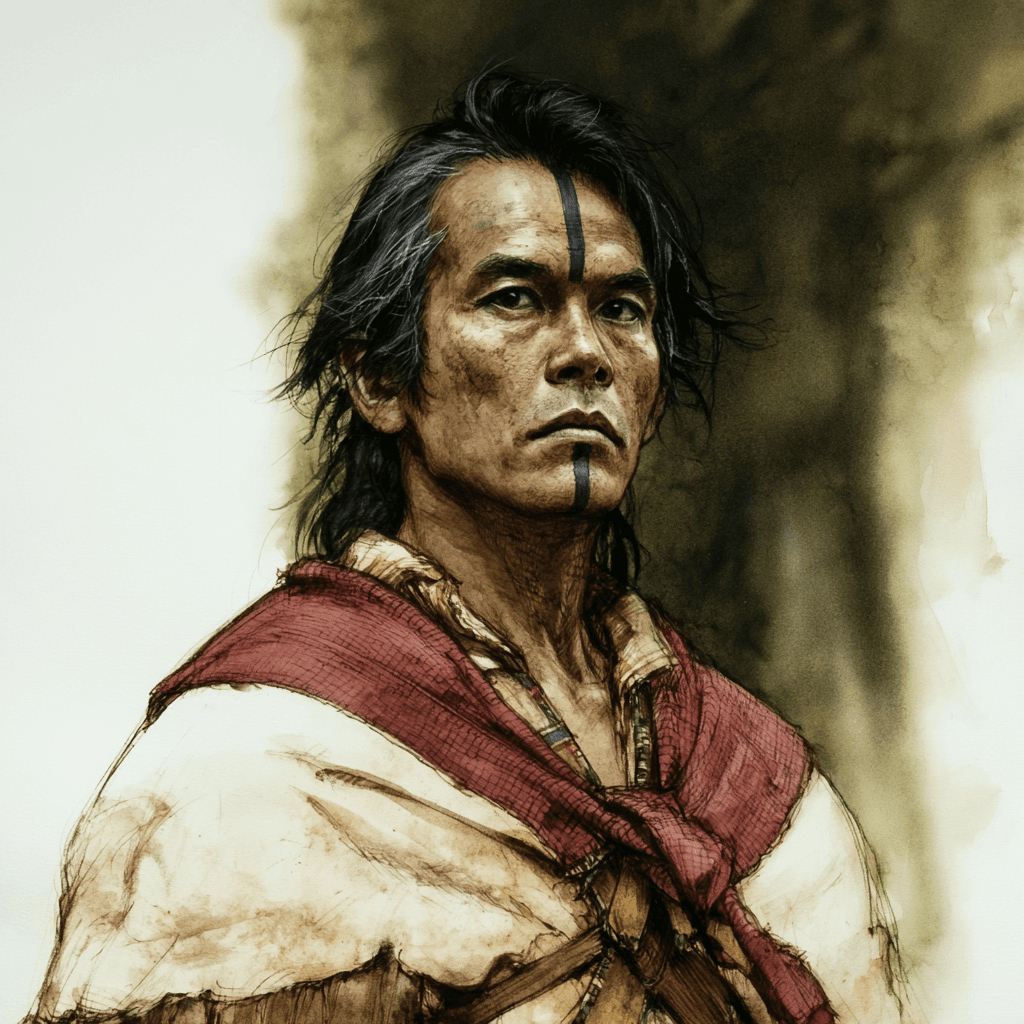
Mona Rudao
Seediq Chief & Resistance Leader
Japanese Colonial Period
1882–1930
Mona Rudao, born around 1882 in Mehebu village in the highlands of central Taiwan, was the hereditary chief of the Mehebu community within the Tgdaya subgroup of the Seediq people and the most renowned indigenous leader of armed resistance during the Japanese colonial era. As a young man he was brought to Japan in 1911 on a colonial tour designed to impress indigenous leaders with imperial power, an experience that gave him an unusually clear-eyed view of the empire he would eventually challenge. The colonial government in the 1920s extracted ever more forced labor from the Wushe (Musha) highlands for timber felling, dormitory construction, and road work, often without pay and under brutal supervision. Cultural suppression compounded the grievances, including bans on facial tattooing, restrictions on traditional hunting, and the imposition of political marriages between Japanese policemen and indigenous women that frequently ended in abandonment. The immediate trigger came in October 1930, when his son Tado Mona scuffled with a Japanese constable named Yoshimura at a wedding feast, an incident that left the family fearing severe reprisal. On 27 October 1930, during the annual sports day at Wushe Public School, Mona Rudao led an alliance of six Tgdaya villages, totaling roughly three hundred fighters, in a coordinated attack that killed 134 Japanese, an event known as the Wushe Incident. The colonial response mobilized over three thousand troops and police backed by aircraft, artillery, and aerial drops of poison gas, in one of the few documented uses of chemical weapons against a civilian-allied population in the inter-war period. The authorities also armed rival Seediq factions, particularly the Toda group, as friendly aborigines to track down survivors in the Second Wushe Incident of April 1931, which all but annihilated the rebelling communities. Refusing surrender, Mona Rudao retreated into the mountains with a remnant of his fighters and is believed to have shot himself in a cave near Mount Maxibu in early December 1930. His remains were discovered by hunters four years later and eventually returned to Wushe for burial after the Second World War. Following the war the surviving Tgdaya populations were forcibly resettled in Qingliu (Chuanzhongdao), and indigenous communities continue to commemorate the uprising annually. Mona Rudao is today widely honored as a symbol of indigenous resistance and Taiwanese collective memory, depicted on the NT$20 coin and lionized in the film Warriors of the Rainbow: Seediq Bale.
Led the Wushe Incident (1930)
Seediq Chief & Resistance Leader
Mona Rudao
Era
Japanese Colonial Period
Lifespan
1882–1930
Mona Rudao, born around 1882 in Mehebu village in the highlands of central Taiwan, was the hereditary chief of the Mehebu community within the Tgdaya subgroup of the Seediq people and the most renowned indigenous leader of armed resistance during the Japanese colonial era. As a young man he was brought to Japan in 1911 on a colonial tour designed to impress indigenous leaders with imperial power, an experience that gave him an unusually clear-eyed view of the empire he would eventually challenge. The colonial government in the 1920s extracted ever more forced labor from the Wushe (Musha) highlands for timber felling, dormitory construction, and road work, often without pay and under brutal supervision. Cultural suppression compounded the grievances, including bans on facial tattooing, restrictions on traditional hunting, and the imposition of political marriages between Japanese policemen and indigenous women that frequently ended in abandonment. The immediate trigger came in October 1930, when his son Tado Mona scuffled with a Japanese constable named Yoshimura at a wedding feast, an incident that left the family fearing severe reprisal. On 27 October 1930, during the annual sports day at Wushe Public School, Mona Rudao led an alliance of six Tgdaya villages, totaling roughly three hundred fighters, in a coordinated attack that killed 134 Japanese, an event known as the Wushe Incident. The colonial response mobilized over three thousand troops and police backed by aircraft, artillery, and aerial drops of poison gas, in one of the few documented uses of chemical weapons against a civilian-allied population in the inter-war period. The authorities also armed rival Seediq factions, particularly the Toda group, as friendly aborigines to track down survivors in the Second Wushe Incident of April 1931, which all but annihilated the rebelling communities. Refusing surrender, Mona Rudao retreated into the mountains with a remnant of his fighters and is believed to have shot himself in a cave near Mount Maxibu in early December 1930. His remains were discovered by hunters four years later and eventually returned to Wushe for burial after the Second World War. Following the war the surviving Tgdaya populations were forcibly resettled in Qingliu (Chuanzhongdao), and indigenous communities continue to commemorate the uprising annually. Mona Rudao is today widely honored as a symbol of indigenous resistance and Taiwanese collective memory, depicted on the NT$20 coin and lionized in the film Warriors of the Rainbow: Seediq Bale.
Led the Wushe Incident (1930)