

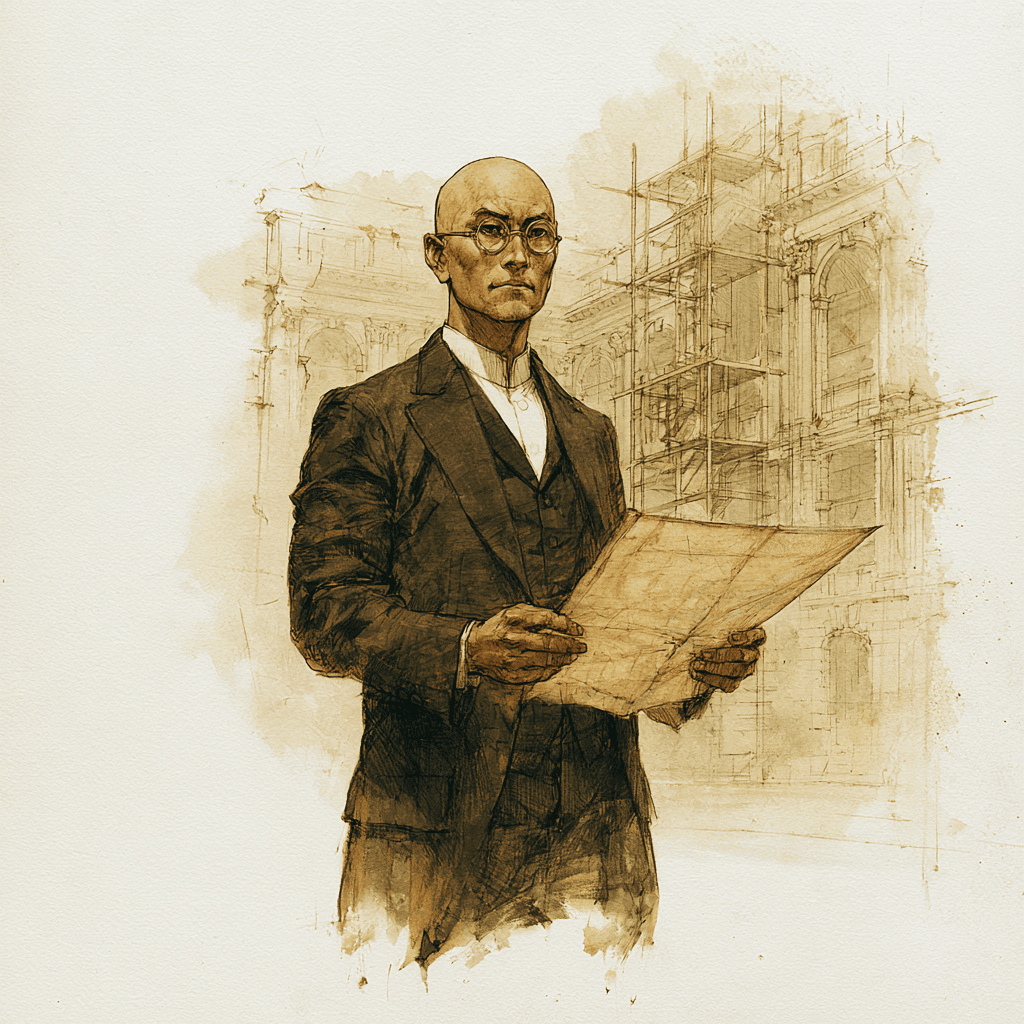
Moriyama Matsunosuke
Architect of Government Buildings
Japanese Rule
1869–1949
Moriyama Matsunosuke (1869–1949) was a Japanese architect who graduated from the architecture department of Tokyo Imperial University as a pupil of the renowned Tatsuno Kingo. During the Japanese period he was employed in the construction section of the Taiwan Governor-General's Office, becoming one of the most important official architects of his day in Taiwan and leading the design of a great many representative government and public buildings. He excelled at shaping the authority of the colonial government through ornate European historicist styles—drawing on Baroque, Renaissance and other elements—and his works include the Monopoly Bureau of the Governor-General's Office, the Taipei, Tainan and Taichung prefectural halls, and the Taipei waterworks pump house, many of which remain landmark monuments in their cities today. With symmetrical and dignified façades, elaborate ornament, domes and towers, these buildings conveyed the grandeur and order of colonial modernization and profoundly shaped the official architecture and streetscapes of Taiwan's cities under Japanese rule. Moriyama's designs not only displayed the most advanced building techniques and aesthetics of the time but also became important models for the development of Taiwan's modern architecture. He continued to practise after returning to Japan, but the many works he left in Taiwan make him an indispensable figure for understanding the island's modern architectural history.
1900s–20s Designed many of Taiwan's government buildings
1910s Completed the Tainan and Taichung prefectural halls and other major works
Architect of Government Buildings
Moriyama Matsunosuke
Era
Japanese Rule
Lifespan
1869–1949
Moriyama Matsunosuke (1869–1949) was a Japanese architect who graduated from the architecture department of Tokyo Imperial University as a pupil of the renowned Tatsuno Kingo. During the Japanese period he was employed in the construction section of the Taiwan Governor-General's Office, becoming one of the most important official architects of his day in Taiwan and leading the design of a great many representative government and public buildings. He excelled at shaping the authority of the colonial government through ornate European historicist styles—drawing on Baroque, Renaissance and other elements—and his works include the Monopoly Bureau of the Governor-General's Office, the Taipei, Tainan and Taichung prefectural halls, and the Taipei waterworks pump house, many of which remain landmark monuments in their cities today. With symmetrical and dignified façades, elaborate ornament, domes and towers, these buildings conveyed the grandeur and order of colonial modernization and profoundly shaped the official architecture and streetscapes of Taiwan's cities under Japanese rule. Moriyama's designs not only displayed the most advanced building techniques and aesthetics of the time but also became important models for the development of Taiwan's modern architecture. He continued to practise after returning to Japan, but the many works he left in Taiwan make him an indispensable figure for understanding the island's modern architectural history.
1900s–20s Designed many of Taiwan's government buildings
1910s Completed the Tainan and Taichung prefectural halls and other major works