

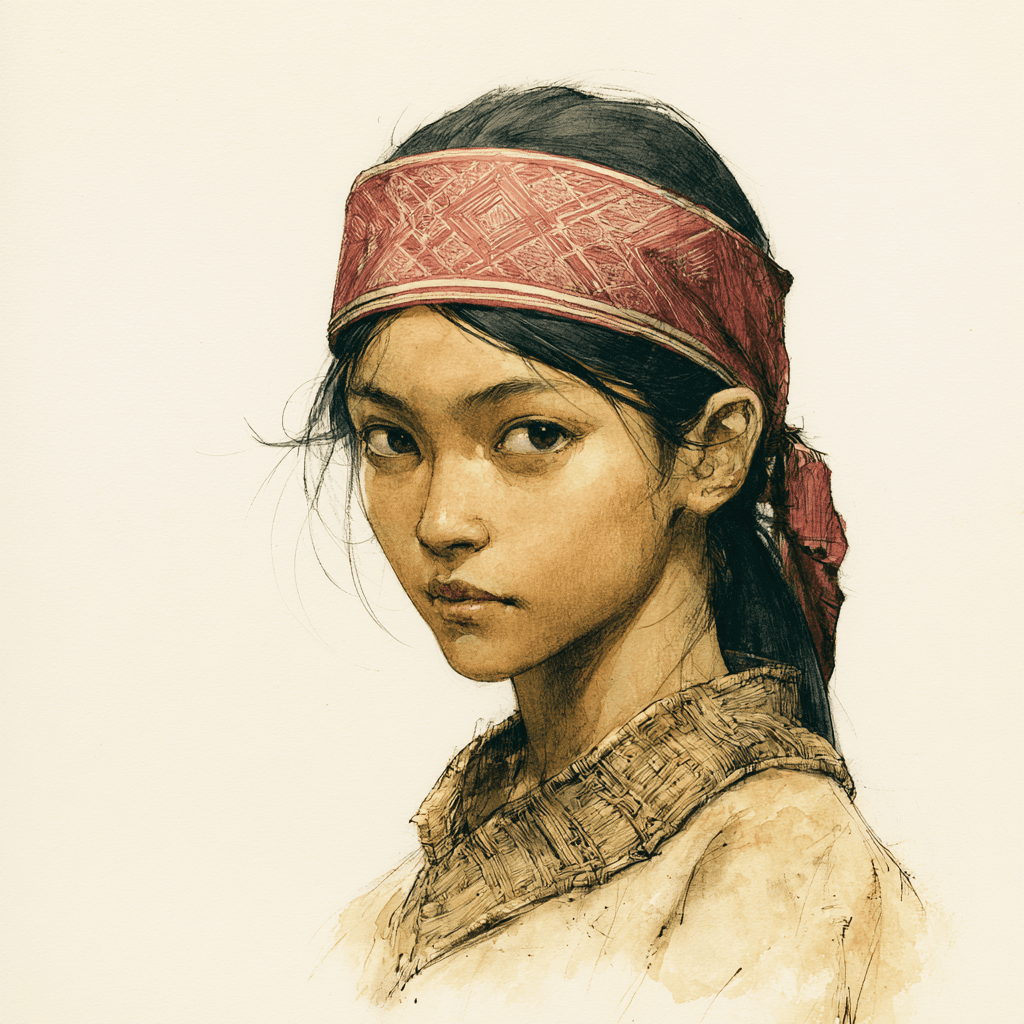
Sayun
The Girl Behind the 'Bell of Sayun'
Japanese Rule
1921–1938
Sayun, in full Sayun Hayung (1921–1938), was an Atayal girl from the South'ao area of Yilan. In 1938 the Japanese teacher stationed there, Tabei Masaki, was called up for military service amid wartime mobilization, and Sayun joined other villagers in helping to carry his luggage and see him off down the mountain. On the way the weather suddenly turned and a storm struck; while fording a stream she lost her footing, fell into the water and disappeared, only seventeen years old. This was in itself an ordinary mountain accident, yet in the atmosphere of wartime imperialization and mobilization propaganda the colonial authorities greatly embellished the event, casting her as a model 'patriotic maiden' who had devoted herself to the nation and helped a teacher off to war. In 1941 Governor-General Hasegawa Kiyoshi presented a bronze bell inscribed with the words 'Bell of the patriotic maiden Sayun' in her honour, known as the 'Bell of Sayun.' Her story was thereafter adapted into songs and paintings and made into the film The Bell of Sayun, a Man'ei–Shochiku co-production starring the popular actress Li Xianglan, becoming a propaganda model to rouse indigenous people and Taiwanese to loyalty and devoted service to Japan in wartime. Sayun's brief life, an innocent accident, was swept into the flood of colonial propaganda, and it stands as an important case for understanding how late-colonial imperialization and wartime mobilization manipulated personal stories.
1938 Carried luggage for a teacher going to war and was lost in a stream
1941 The Governor-General's Office presented the 'Bell of Sayun,' promoting a patriotic image
The Girl Behind the 'Bell of Sayun'
Sayun
Era
Japanese Rule
Lifespan
1921–1938
Sayun, in full Sayun Hayung (1921–1938), was an Atayal girl from the South'ao area of Yilan. In 1938 the Japanese teacher stationed there, Tabei Masaki, was called up for military service amid wartime mobilization, and Sayun joined other villagers in helping to carry his luggage and see him off down the mountain. On the way the weather suddenly turned and a storm struck; while fording a stream she lost her footing, fell into the water and disappeared, only seventeen years old. This was in itself an ordinary mountain accident, yet in the atmosphere of wartime imperialization and mobilization propaganda the colonial authorities greatly embellished the event, casting her as a model 'patriotic maiden' who had devoted herself to the nation and helped a teacher off to war. In 1941 Governor-General Hasegawa Kiyoshi presented a bronze bell inscribed with the words 'Bell of the patriotic maiden Sayun' in her honour, known as the 'Bell of Sayun.' Her story was thereafter adapted into songs and paintings and made into the film The Bell of Sayun, a Man'ei–Shochiku co-production starring the popular actress Li Xianglan, becoming a propaganda model to rouse indigenous people and Taiwanese to loyalty and devoted service to Japan in wartime. Sayun's brief life, an innocent accident, was swept into the flood of colonial propaganda, and it stands as an important case for understanding how late-colonial imperialization and wartime mobilization manipulated personal stories.
1938 Carried luggage for a teacher going to war and was lost in a stream
1941 The Governor-General's Office presented the 'Bell of Sayun,' promoting a patriotic image