

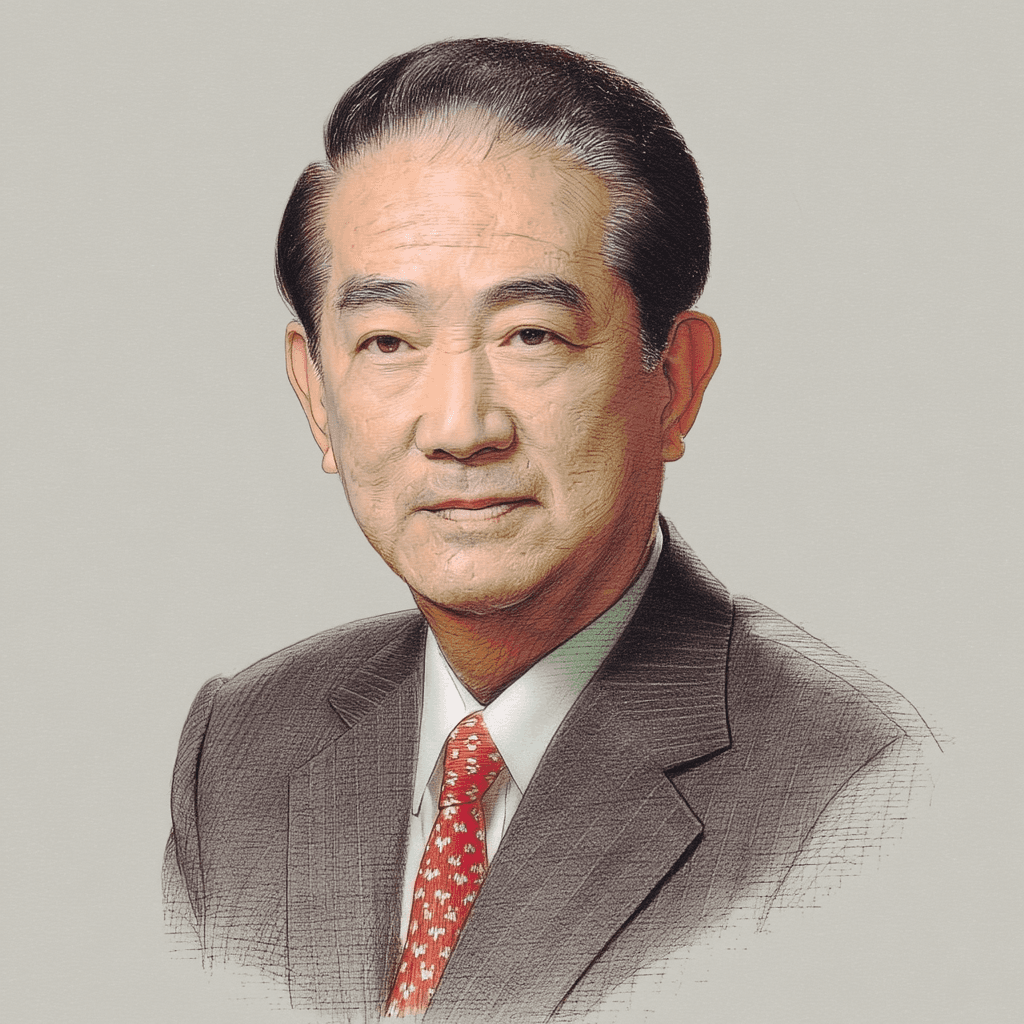
James Soong
Governor of Taiwan Province & PFP Chairman
Democratic Transition / Modern Taiwan
1942–
James Soong Chu-yu, born in 1942 in Xiangtan, Hunan, was brought to Taiwan as a young child with his KMT-officer father and rose through the party's elite as one of the most capable mainlander administrators of his generation. He earned a master's degree at the Catholic University of America and a doctorate from Georgetown University before returning to Taiwan to serve as English-language secretary to President Chiang Ching-kuo from 1974. He directed the Government Information Office during the politically critical years of 1979–1984, controlling media policy through the Kaohsiung Incident, the lead-up to the lifting of martial law, and the Lin Family Massacre. He served as Secretary-General of the KMT from 1989 to 1993, helping Lee Teng-hui consolidate his hold over the party during the most delicate transitional years. Appointed Governor of Taiwan Province in 1993, he won the office in the first direct provincial election in 1994 with 56 percent of the vote, building an effective province-wide patronage and constituency network through frequent grassroots travel. The 1998 constitutional freeze of the provincial government — engineered with Lee Teng-hui's support to consolidate administrative authority at the central level — ended his post and ruptured his relationship with Lee. He ran for the presidency in 2000 as an independent after the KMT nominated Lien Chan, finishing a close second with 36.84 percent to Chen Shui-bian's 39.3 percent and ahead of the official KMT nominee. He founded the People First Party (親民黨) shortly after the election, drawing many former KMT voters and legislators and establishing himself as the head of a third force on the pan-Blue side of Taiwanese politics. He ran as Lien Chan's vice-presidential candidate in 2004, narrowly losing to the re-elected Chen Shui-bian and Annette Lu, and made unsuccessful presidential bids again in 2012, 2016, and 2020. He led a People First Party delegation to mainland China in 2005, a controversial trip that paralleled Lien Chan's earlier KMT visit and brought him into direct dialogue with the CCP leadership. He served as a special envoy to APEC summits under both the Ma Ying-jeou and Tsai Ing-wen administrations, an unusual cross-party diplomatic role reflecting his broad international network. Soong remains the most enduring example of an elite mainlander politician who shaped Taiwan's transition both as an authoritarian-era functionary and as a competitive electoral figure, his career a barometer of how the post-1990 KMT-PFP split reconfigured pan-Blue politics.
Independent presidential candidacy split the pan-Blue vote (2000)
Governor of Taiwan Province & PFP Chairman
James Soong
Era
Democratic Transition / Modern Taiwan
Lifespan
1942–
James Soong Chu-yu, born in 1942 in Xiangtan, Hunan, was brought to Taiwan as a young child with his KMT-officer father and rose through the party's elite as one of the most capable mainlander administrators of his generation. He earned a master's degree at the Catholic University of America and a doctorate from Georgetown University before returning to Taiwan to serve as English-language secretary to President Chiang Ching-kuo from 1974. He directed the Government Information Office during the politically critical years of 1979–1984, controlling media policy through the Kaohsiung Incident, the lead-up to the lifting of martial law, and the Lin Family Massacre. He served as Secretary-General of the KMT from 1989 to 1993, helping Lee Teng-hui consolidate his hold over the party during the most delicate transitional years. Appointed Governor of Taiwan Province in 1993, he won the office in the first direct provincial election in 1994 with 56 percent of the vote, building an effective province-wide patronage and constituency network through frequent grassroots travel. The 1998 constitutional freeze of the provincial government — engineered with Lee Teng-hui's support to consolidate administrative authority at the central level — ended his post and ruptured his relationship with Lee. He ran for the presidency in 2000 as an independent after the KMT nominated Lien Chan, finishing a close second with 36.84 percent to Chen Shui-bian's 39.3 percent and ahead of the official KMT nominee. He founded the People First Party (親民黨) shortly after the election, drawing many former KMT voters and legislators and establishing himself as the head of a third force on the pan-Blue side of Taiwanese politics. He ran as Lien Chan's vice-presidential candidate in 2004, narrowly losing to the re-elected Chen Shui-bian and Annette Lu, and made unsuccessful presidential bids again in 2012, 2016, and 2020. He led a People First Party delegation to mainland China in 2005, a controversial trip that paralleled Lien Chan's earlier KMT visit and brought him into direct dialogue with the CCP leadership. He served as a special envoy to APEC summits under both the Ma Ying-jeou and Tsai Ing-wen administrations, an unusual cross-party diplomatic role reflecting his broad international network. Soong remains the most enduring example of an elite mainlander politician who shaped Taiwan's transition both as an authoritarian-era functionary and as a competitive electoral figure, his career a barometer of how the post-1990 KMT-PFP split reconfigured pan-Blue politics.
Independent presidential candidacy split the pan-Blue vote (2000)