

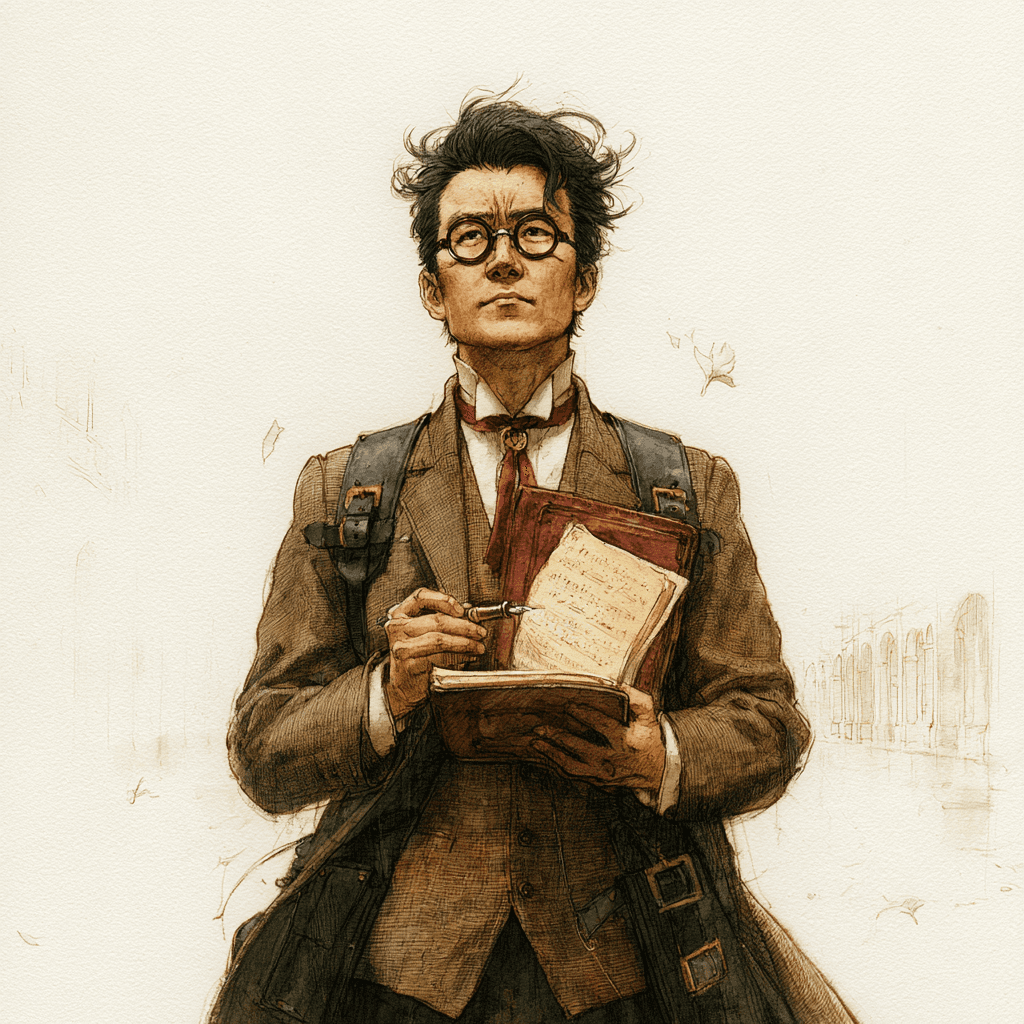
Teng Yu-hsien
Composer
Japanese Colonial Period
1906–1944
Teng Yu-hsien, born in 1906 in Longtan, Hsinchu Prefecture, into a Hakka family of scholar-teachers, became the most celebrated composer of Taiwanese popular songs in the colonial period and is remembered as the Father of Taiwanese folk song. His family moved to Taipei in his early childhood, where his father taught classical Chinese in the colonial school system, giving Teng an unusually bilingual cultural grounding. He graduated from Taipei Normal School in 1925 and briefly taught at Daitōtei Public School, where he absorbed both the Hokkien-speaking urban culture of the city and Western and Japanese musical training. In 1929 he travelled to Tokyo to study composition formally, returning to a Taiwan in which the new gramophone industry was just beginning to create a Hokkien-language popular music market. He joined the Columbia Records Taiwan branch as a staff composer in 1933, where he collaborated with lyricists such as Lee Lin-chiu and Chou Tien-wang to produce a series of defining songs. Within a few years he had composed the four works later canonized as the Four Months — Hope, Rain, Spring, Sorrow (四月望雨) — namely Moonlit Sorrow (月夜愁), Bāng Chhun-hong / Longing for the Spring Breeze (望春風), Rain Night Flower (雨夜花), and Four Seasons Red (四季紅). These songs, sung most famously by Chun Chun, fused pentatonic Hokkien melody, jazz-age instrumentation, and lyrics depicting working-class courtship and sorrow, and quickly became the soundtrack of urban Taiwan. After the outbreak of the Second Sino-Japanese War in 1937, the colonial authorities increasingly pressured popular music into wartime mobilization, forcibly rewriting his works into Japanese-language military songs such as Honourable Soldiers Going to the Front (誉れの軍夫). Disenchanted with the imposed conversion, he resigned from Columbia in 1940 and retreated to teach music at a small public school in Chuhuangkeng (now part of Zhudong, Hsinchu). Weakened by chronic heart and lung disease and the austerity of the late war years, he died there in 1944 at the age of 38, before his songs were freed from wartime Japanese substitutions. After the war his original Hokkien lyrics were restored and his compositions resumed a central place in Taiwanese popular memory, performed across regimes and generations. Teng is now honored not only as Taiwan's pre-eminent pre-war composer but as a cultural figure whose melodies have outlasted every political reorganization of the island they emerged from.
Composed 'Rain Night Flower' and 'Bāng Chhun-hong' (1933–1934)
Composer
Teng Yu-hsien
Era
Japanese Colonial Period
Lifespan
1906–1944
Teng Yu-hsien, born in 1906 in Longtan, Hsinchu Prefecture, into a Hakka family of scholar-teachers, became the most celebrated composer of Taiwanese popular songs in the colonial period and is remembered as the Father of Taiwanese folk song. His family moved to Taipei in his early childhood, where his father taught classical Chinese in the colonial school system, giving Teng an unusually bilingual cultural grounding. He graduated from Taipei Normal School in 1925 and briefly taught at Daitōtei Public School, where he absorbed both the Hokkien-speaking urban culture of the city and Western and Japanese musical training. In 1929 he travelled to Tokyo to study composition formally, returning to a Taiwan in which the new gramophone industry was just beginning to create a Hokkien-language popular music market. He joined the Columbia Records Taiwan branch as a staff composer in 1933, where he collaborated with lyricists such as Lee Lin-chiu and Chou Tien-wang to produce a series of defining songs. Within a few years he had composed the four works later canonized as the Four Months — Hope, Rain, Spring, Sorrow (四月望雨) — namely Moonlit Sorrow (月夜愁), Bāng Chhun-hong / Longing for the Spring Breeze (望春風), Rain Night Flower (雨夜花), and Four Seasons Red (四季紅). These songs, sung most famously by Chun Chun, fused pentatonic Hokkien melody, jazz-age instrumentation, and lyrics depicting working-class courtship and sorrow, and quickly became the soundtrack of urban Taiwan. After the outbreak of the Second Sino-Japanese War in 1937, the colonial authorities increasingly pressured popular music into wartime mobilization, forcibly rewriting his works into Japanese-language military songs such as Honourable Soldiers Going to the Front (誉れの軍夫). Disenchanted with the imposed conversion, he resigned from Columbia in 1940 and retreated to teach music at a small public school in Chuhuangkeng (now part of Zhudong, Hsinchu). Weakened by chronic heart and lung disease and the austerity of the late war years, he died there in 1944 at the age of 38, before his songs were freed from wartime Japanese substitutions. After the war his original Hokkien lyrics were restored and his compositions resumed a central place in Taiwanese popular memory, performed across regimes and generations. Teng is now honored not only as Taiwan's pre-eminent pre-war composer but as a cultural figure whose melodies have outlasted every political reorganization of the island they emerged from.
Composed 'Rain Night Flower' and 'Bāng Chhun-hong' (1933–1934)