

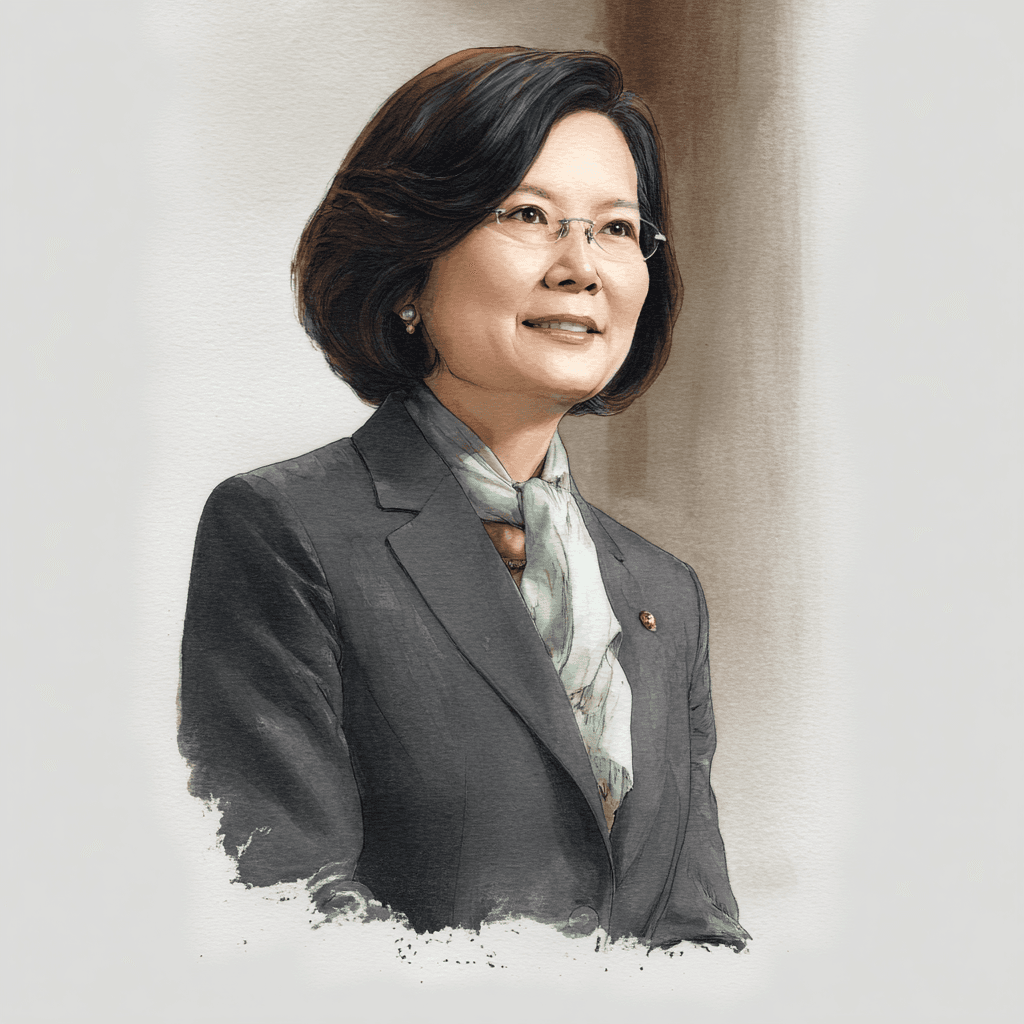
Tsai Ing-wen
President of the Republic of China
Modern Taiwan
1956–
Tsai Ing-wen, born in 1956 in Taipei with Hakka and Paiwan indigenous heritage on her father's side traceable to Pingtung, served as President of the Republic of China (Taiwan) from 2016 to 2024 and is the first woman to hold the office. Trained as a legal scholar, she earned a law degree from National Taiwan University, a master of laws from Cornell University, and a doctorate in law from the London School of Economics, before returning home to teach trade law at Soochow University and National Chengchi University. She entered public service in the 1990s as a key negotiator for Taiwan's accession to the World Trade Organization, drawing on her expertise in international trade law. Under President Chen Shui-bian, she chaired the Mainland Affairs Council from 2000 to 2004 and later served as Vice Premier, becoming a central architect of cross-strait policy. She joined the Democratic Progressive Party in 2004 and rose rapidly, taking the party chair in 2008 to rebuild it after the corruption scandals of the late Chen era. After narrowly losing the 2012 presidential election to Ma Ying-jeou, she won a landslide victory in 2016 against the backdrop of the Sunflower Movement, becoming the first president in Taiwanese history elected without having previously held an elected office. Her presidency advanced a series of landmark domestic reforms, including pension restructuring, transitional justice legislation, a formal apology to the indigenous peoples, and — in May 2019 — the legalization of same-sex marriage, the first such law in Asia. She pursued a New Southbound Policy to diversify economic ties beyond China and presided over Taiwan's globally lauded response to the COVID-19 pandemic. In cross-strait relations, her refusal to accept the so-called 1992 Consensus led Beijing to suspend official communications and to escalate military and economic pressure, culminating in large-scale PLA exercises around Taiwan after U.S. House Speaker Nancy Pelosi's visit in August 2022. She strengthened defense capabilities by extending compulsory military service, accelerating investment in asymmetric warfare, and deepening security cooperation with the United States, Japan, and European partners. Re-elected in 2020 with a record 8.17 million votes, she completed her second term in May 2024 and handed power to her vice president Lai Ching-te in a peaceful democratic transition. Tsai is widely credited with consolidating Taiwan's democratic identity, raising the island's international profile, and reshaping global perceptions of Taiwan as a frontline democracy in the contest between democratic and authoritarian systems.
Chaired the Mainland Affairs Council, a central architect of cross-strait policy (2000)
Took the DPP chair, rebuilding the party (2008)
Third party turnover — elected as Taiwan's first female president (2016)
Legalization of same-sex marriage, first in Asia (2019)
Re-elected with a record 8.17 million votes (2020)
Globally praised "Taiwan model" COVID-19 response (2020)
Completed her term, peaceful transfer of power to Lai Ching-te (2024)
President of the Republic of China
Tsai Ing-wen
Era
Modern Taiwan
Lifespan
1956–
Tsai Ing-wen, born in 1956 in Taipei with Hakka and Paiwan indigenous heritage on her father's side traceable to Pingtung, served as President of the Republic of China (Taiwan) from 2016 to 2024 and is the first woman to hold the office. Trained as a legal scholar, she earned a law degree from National Taiwan University, a master of laws from Cornell University, and a doctorate in law from the London School of Economics, before returning home to teach trade law at Soochow University and National Chengchi University. She entered public service in the 1990s as a key negotiator for Taiwan's accession to the World Trade Organization, drawing on her expertise in international trade law. Under President Chen Shui-bian, she chaired the Mainland Affairs Council from 2000 to 2004 and later served as Vice Premier, becoming a central architect of cross-strait policy. She joined the Democratic Progressive Party in 2004 and rose rapidly, taking the party chair in 2008 to rebuild it after the corruption scandals of the late Chen era. After narrowly losing the 2012 presidential election to Ma Ying-jeou, she won a landslide victory in 2016 against the backdrop of the Sunflower Movement, becoming the first president in Taiwanese history elected without having previously held an elected office. Her presidency advanced a series of landmark domestic reforms, including pension restructuring, transitional justice legislation, a formal apology to the indigenous peoples, and — in May 2019 — the legalization of same-sex marriage, the first such law in Asia. She pursued a New Southbound Policy to diversify economic ties beyond China and presided over Taiwan's globally lauded response to the COVID-19 pandemic. In cross-strait relations, her refusal to accept the so-called 1992 Consensus led Beijing to suspend official communications and to escalate military and economic pressure, culminating in large-scale PLA exercises around Taiwan after U.S. House Speaker Nancy Pelosi's visit in August 2022. She strengthened defense capabilities by extending compulsory military service, accelerating investment in asymmetric warfare, and deepening security cooperation with the United States, Japan, and European partners. Re-elected in 2020 with a record 8.17 million votes, she completed her second term in May 2024 and handed power to her vice president Lai Ching-te in a peaceful democratic transition. Tsai is widely credited with consolidating Taiwan's democratic identity, raising the island's international profile, and reshaping global perceptions of Taiwan as a frontline democracy in the contest between democratic and authoritarian systems.
Chaired the Mainland Affairs Council, a central architect of cross-strait policy (2000)
Took the DPP chair, rebuilding the party (2008)
Third party turnover — elected as Taiwan's first female president (2016)
Legalization of same-sex marriage, first in Asia (2019)
Re-elected with a record 8.17 million votes (2020)
Globally praised "Taiwan model" COVID-19 response (2020)
Completed her term, peaceful transfer of power to Lai Ching-te (2024)