

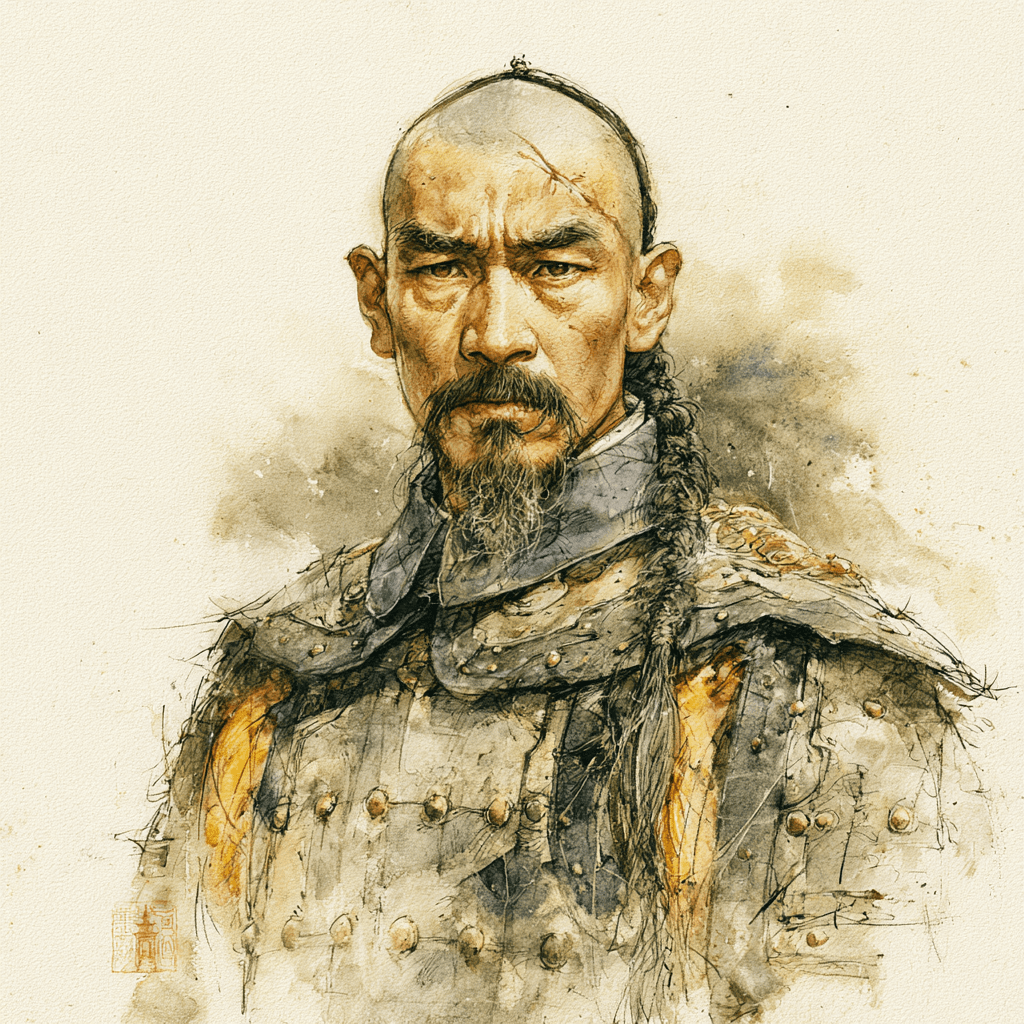
Wu Sangui
Prince of Pingxi & Leader of the Three Feudatories Revolt
Ming-Qing Transition
1612–1678
Wu Sangui was a pivotal military figure of the late Ming and early Qing transition, born in 1612 into a Liaodong military lineage and trained from boyhood by his father Wu Xiang to become one of the most renowned cavalry commanders of the northern Ming frontier army. When the rebel leader Li Zicheng captured Beijing in 1644 and the Chongzhen Emperor hanged himself, he was the regional commander of Shanhai Pass and found himself caught between three competing powers: Li Zicheng's Shun forces, the Manchu armies under Dorgon, and the remnants of the Southern Ming. In April 1644 he opened the pass to Dorgon's Qing armies and led them through Shanhai Pass to crush Li Zicheng's rebels at Beijing, an act that earned him an enduring reputation as the man who let the Qing into China. He subsequently led the Qing pursuit of the Southern Ming southwards, conquering Yunnan in the 1660s and personally executing the last Southern Ming emperor, the Yongli Emperor, at Kunming, thereby extinguishing Ming loyalist resistance on the mainland. For these services the Qing court enfeoffed him as Prince of Pingxi and assigned him perpetual rule over Yunnan, including the right to raise his own armies, collect his own taxes, and appoint his own officials, effectively making his fief an independent kingdom within the Qing empire. When the young Kangxi Emperor came of age and moved to abolish the feudatories in 1673, he raised the banner of revolt in Yunnan and quickly drew the Jingnan Prince Geng Jingzhong of Fujian and the Pingnan Prince Shang Zhixin of Guangdong into a coordinated rebellion known as the Revolt of the Three Feudatories. The early phase of the rebellion proved devastatingly successful, sweeping across Hunan and Sichuan and reaching the middle Yangtze, throwing the southern half of the Qing empire into crisis. From Taiwan the Tungning ruler Zheng Jing seized the opportunity to launch his own seaborne westward campaign in concert with Geng Jingzhong, making the Three Feudatories Revolt the last historical opening for a Ming-loyalist counterattack on the mainland. In 1678 he proclaimed himself emperor at Hengzhou in Hunan, declaring a new dynasty styled the Great Zhou with the reign title Zhaowu, in open repudiation of the Qing. He died of illness at Hengzhou only five months after his coronation, at the age of sixty-six. His grandson Wu Shifan inherited the throne but quickly lost momentum, and the Great Zhou regime was crushed by Qing armies in 1681, ending the Three Feudatories Revolt. Wu Sangui is generally regarded as a deeply ambivalent figure who united in himself both the man who let the Qing into China and the man who later sought to break it apart, and whose revolt provided the historical opening for Zheng Jing's westward expedition and decisively shaped the final decade of the Tungning Kingdom.
Launched the Revolt of the Three Feudatories in 1673, the historical opening for Zheng Jing's westward campaign
Prince of Pingxi & Leader of the Three Feudatories Revolt
Wu Sangui
Era
Ming-Qing Transition
Lifespan
1612–1678
Wu Sangui was a pivotal military figure of the late Ming and early Qing transition, born in 1612 into a Liaodong military lineage and trained from boyhood by his father Wu Xiang to become one of the most renowned cavalry commanders of the northern Ming frontier army. When the rebel leader Li Zicheng captured Beijing in 1644 and the Chongzhen Emperor hanged himself, he was the regional commander of Shanhai Pass and found himself caught between three competing powers: Li Zicheng's Shun forces, the Manchu armies under Dorgon, and the remnants of the Southern Ming. In April 1644 he opened the pass to Dorgon's Qing armies and led them through Shanhai Pass to crush Li Zicheng's rebels at Beijing, an act that earned him an enduring reputation as the man who let the Qing into China. He subsequently led the Qing pursuit of the Southern Ming southwards, conquering Yunnan in the 1660s and personally executing the last Southern Ming emperor, the Yongli Emperor, at Kunming, thereby extinguishing Ming loyalist resistance on the mainland. For these services the Qing court enfeoffed him as Prince of Pingxi and assigned him perpetual rule over Yunnan, including the right to raise his own armies, collect his own taxes, and appoint his own officials, effectively making his fief an independent kingdom within the Qing empire. When the young Kangxi Emperor came of age and moved to abolish the feudatories in 1673, he raised the banner of revolt in Yunnan and quickly drew the Jingnan Prince Geng Jingzhong of Fujian and the Pingnan Prince Shang Zhixin of Guangdong into a coordinated rebellion known as the Revolt of the Three Feudatories. The early phase of the rebellion proved devastatingly successful, sweeping across Hunan and Sichuan and reaching the middle Yangtze, throwing the southern half of the Qing empire into crisis. From Taiwan the Tungning ruler Zheng Jing seized the opportunity to launch his own seaborne westward campaign in concert with Geng Jingzhong, making the Three Feudatories Revolt the last historical opening for a Ming-loyalist counterattack on the mainland. In 1678 he proclaimed himself emperor at Hengzhou in Hunan, declaring a new dynasty styled the Great Zhou with the reign title Zhaowu, in open repudiation of the Qing. He died of illness at Hengzhou only five months after his coronation, at the age of sixty-six. His grandson Wu Shifan inherited the throne but quickly lost momentum, and the Great Zhou regime was crushed by Qing armies in 1681, ending the Three Feudatories Revolt. Wu Sangui is generally regarded as a deeply ambivalent figure who united in himself both the man who let the Qing into China and the man who later sought to break it apart, and whose revolt provided the historical opening for Zheng Jing's westward expedition and decisively shaped the final decade of the Tungning Kingdom.
Launched the Revolt of the Three Feudatories in 1673, the historical opening for Zheng Jing's westward campaign