

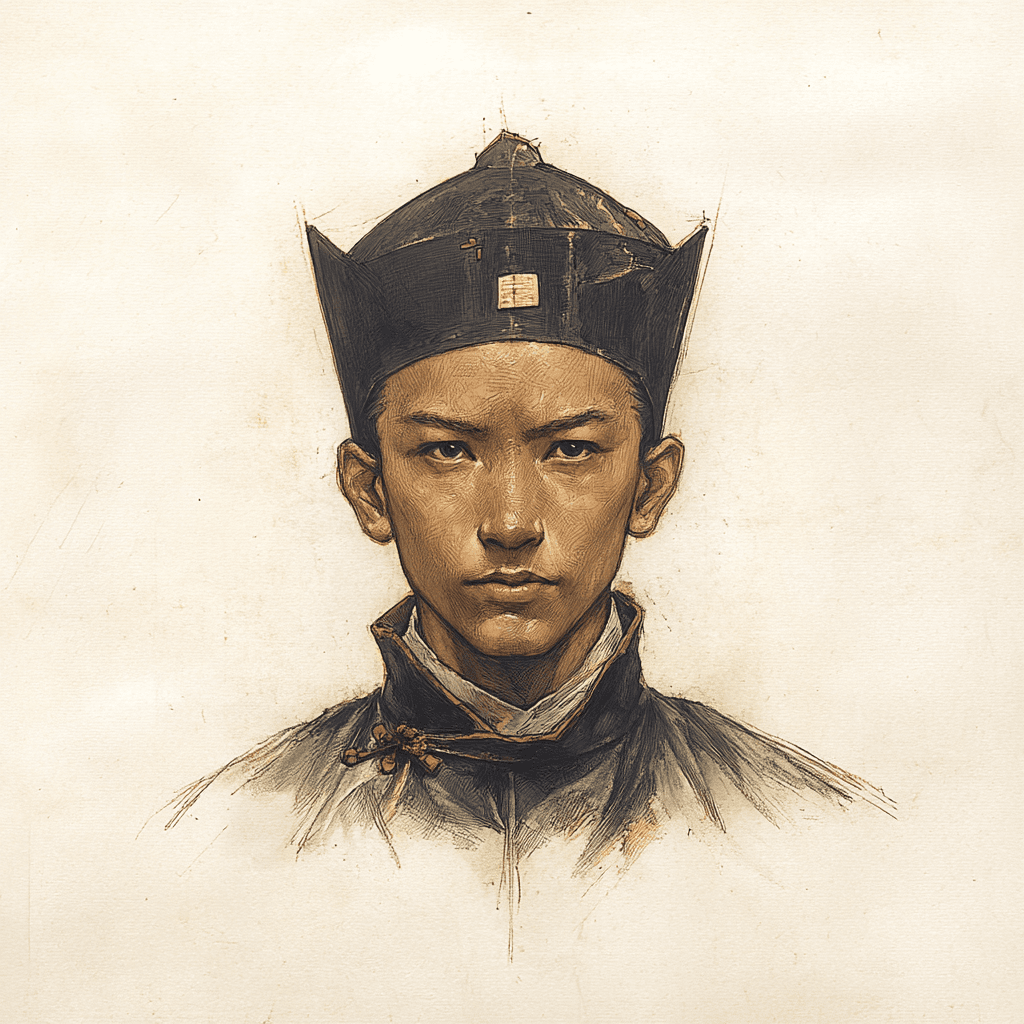
Wu Tangxing
Hakka Volunteer Leader of Miaoli
First Sino-Japanese War / 1895
1860–1895
Wu Tangxing, born in 1860 in Tongluo, Miaoli, into a Hakka farming family, earned the lowest imperial examination degree as a young man and combined teaching in his home village with martial training and local self-defense. When the Treaty of Shimonoseki ceded Taiwan to Japan in 1895, he was among the first in the Miaoli region to answer the call of the so-called Republic of Formosa, expending his family's resources to recruit a Hakka volunteer force. Using the hill country of Hsinchu and Miaoli as a base, he fought alongside other Hakka leaders such as Hsu Hsiang and Chiang Shao-tsu, engaging the advancing Japanese Imperial Guards Division in skirmishes and pitched battles at Niu-pu, Ta-ko-ham, and Hsinchu. Japanese firepower and discipline were overwhelming, but Hakka villages organized by lineage supplied food and intelligence that enabled the volunteers to delay the advance for months. In August 1895 his forces joined the climactic Battle of Baguashan near Changhua, the largest and bloodiest engagement of the 1895 war, in which casualties on both sides were severe. He is recorded as having directed his troops at the front and was killed in action at the age of thirty-five. His death marked the high point and effective end of organized central-Taiwan resistance, while surviving volunteers retreated south under Hsu Hsiang to continue the struggle. After the war his story was preserved in the Hakka communities of Miaoli and Hsinchu, and a memorial was later erected at Tongluo. Wu is remembered as one of the foremost martyrs of Hakka volunteer resistance in 1895 and is grouped with Hsu Hsiang and Chiang Shao-tsu as one of the 'Three Heroes of the Yi-Wei War.'
1895 Raised Hakka volunteer forces in Miaoli
1895 Killed in action at the Battle of Baguashan
Hakka Volunteer Leader of Miaoli
Wu Tangxing
Era
First Sino-Japanese War / 1895
Lifespan
1860–1895
Wu Tangxing, born in 1860 in Tongluo, Miaoli, into a Hakka farming family, earned the lowest imperial examination degree as a young man and combined teaching in his home village with martial training and local self-defense. When the Treaty of Shimonoseki ceded Taiwan to Japan in 1895, he was among the first in the Miaoli region to answer the call of the so-called Republic of Formosa, expending his family's resources to recruit a Hakka volunteer force. Using the hill country of Hsinchu and Miaoli as a base, he fought alongside other Hakka leaders such as Hsu Hsiang and Chiang Shao-tsu, engaging the advancing Japanese Imperial Guards Division in skirmishes and pitched battles at Niu-pu, Ta-ko-ham, and Hsinchu. Japanese firepower and discipline were overwhelming, but Hakka villages organized by lineage supplied food and intelligence that enabled the volunteers to delay the advance for months. In August 1895 his forces joined the climactic Battle of Baguashan near Changhua, the largest and bloodiest engagement of the 1895 war, in which casualties on both sides were severe. He is recorded as having directed his troops at the front and was killed in action at the age of thirty-five. His death marked the high point and effective end of organized central-Taiwan resistance, while surviving volunteers retreated south under Hsu Hsiang to continue the struggle. After the war his story was preserved in the Hakka communities of Miaoli and Hsinchu, and a memorial was later erected at Tongluo. Wu is remembered as one of the foremost martyrs of Hakka volunteer resistance in 1895 and is grouped with Hsu Hsiang and Chiang Shao-tsu as one of the 'Three Heroes of the Yi-Wei War.'
1895 Raised Hakka volunteer forces in Miaoli
1895 Killed in action at the Battle of Baguashan