

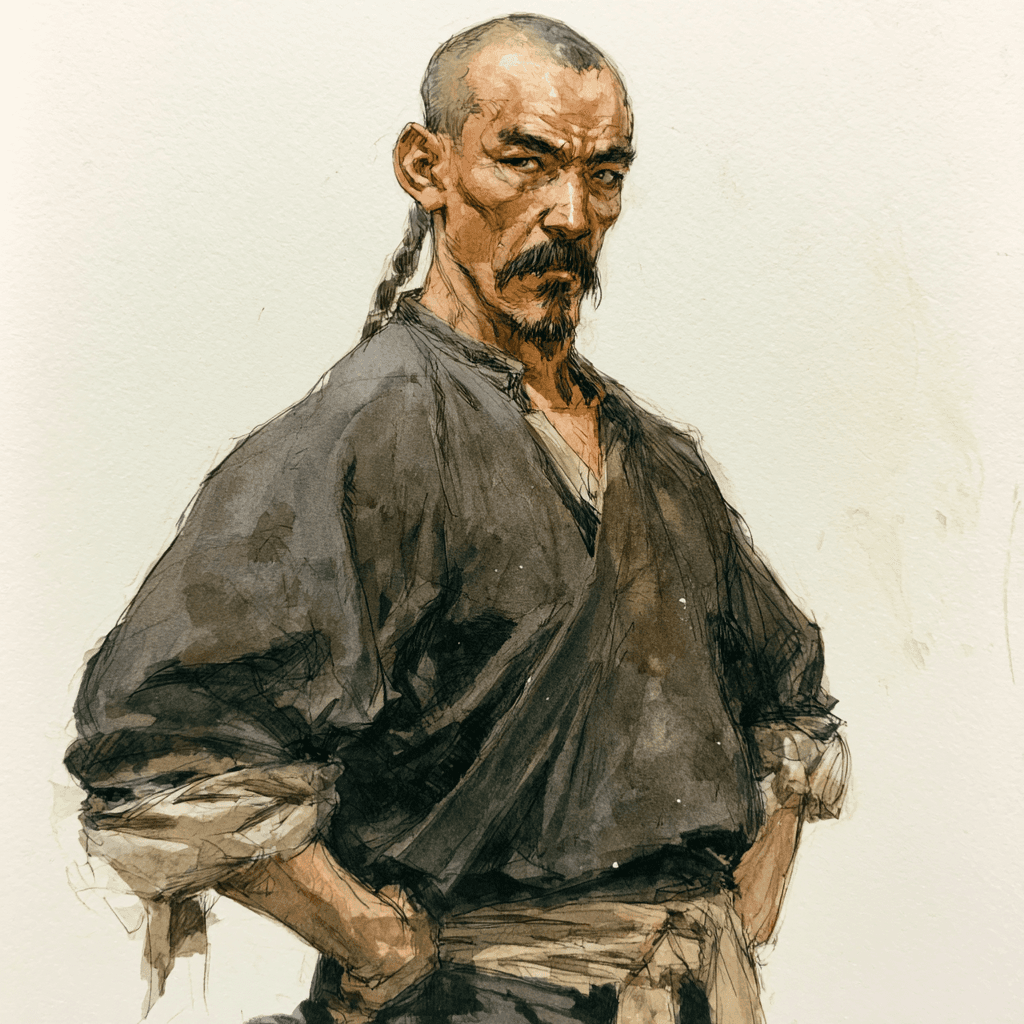
Hsu Hsiang
Hakka Volunteer Leader
First Sino-Japanese War / 1895
1860–1895
Hsu Hsiang, born in 1860 in Toufen, Miaoli, into a Hakka family in the same year as his comrade Wu Tangxing, earned a low imperial degree and ran a private academy in Toufen while taking part in local militia organization. After the cession of Taiwan in 1895 he joined the call of the so-called Republic of Formosa and organized a Hakka volunteer force together with Wu Tangxing, Chiang Shao-tsu, and other Miaoli gentry. His unit, raised in Hsinchu and Miaoli, became one of the most tenacious volunteer formations of the 1895 war. After the northern front collapsed he withdrew with other commanders along the western corridor, continuing to fight in Hsinchu, Miaoli, and at the Battle of Baguashan in Changhua. With Wu killed and Chiang captured and dead, Hsu emerged as the principal surviving commander of the Hakka volunteers and pressed south into Yunlin and Chiayi. In October 1895 he was killed in action near Toulu (some accounts place the battle in the Chiayi area) at the age of thirty-five. Tradition records his last words — 'It is no regret for a true man to die for his country' — as among the most-quoted martyr's testaments of the 1895 resistance. After his death organized Hakka resistance in central and southern Taiwan effectively dissolved, although scattered guerrilla activity continued into 1896. His story was preserved in Toufen and across the Yunlin–Chiayi region, and a memorial was later erected in his home town. Hsu is grouped with Wu Tangxing and Chiang Shao-tsu as one of the 'Three Heroes of the Yi-Wei War' and is widely commemorated as a leading representative of Hakka militia and lower gentry resistance to Japanese rule.
1895 Fought through central Taiwan against the Japanese advance
1895 Killed in action at the Battle of Toulu
Hakka Volunteer Leader
Hsu Hsiang
Era
First Sino-Japanese War / 1895
Lifespan
1860–1895
Hsu Hsiang, born in 1860 in Toufen, Miaoli, into a Hakka family in the same year as his comrade Wu Tangxing, earned a low imperial degree and ran a private academy in Toufen while taking part in local militia organization. After the cession of Taiwan in 1895 he joined the call of the so-called Republic of Formosa and organized a Hakka volunteer force together with Wu Tangxing, Chiang Shao-tsu, and other Miaoli gentry. His unit, raised in Hsinchu and Miaoli, became one of the most tenacious volunteer formations of the 1895 war. After the northern front collapsed he withdrew with other commanders along the western corridor, continuing to fight in Hsinchu, Miaoli, and at the Battle of Baguashan in Changhua. With Wu killed and Chiang captured and dead, Hsu emerged as the principal surviving commander of the Hakka volunteers and pressed south into Yunlin and Chiayi. In October 1895 he was killed in action near Toulu (some accounts place the battle in the Chiayi area) at the age of thirty-five. Tradition records his last words — 'It is no regret for a true man to die for his country' — as among the most-quoted martyr's testaments of the 1895 resistance. After his death organized Hakka resistance in central and southern Taiwan effectively dissolved, although scattered guerrilla activity continued into 1896. His story was preserved in Toufen and across the Yunlin–Chiayi region, and a memorial was later erected in his home town. Hsu is grouped with Wu Tangxing and Chiang Shao-tsu as one of the 'Three Heroes of the Yi-Wei War' and is widely commemorated as a leading representative of Hakka militia and lower gentry resistance to Japanese rule.
1895 Fought through central Taiwan against the Japanese advance
1895 Killed in action at the Battle of Toulu