

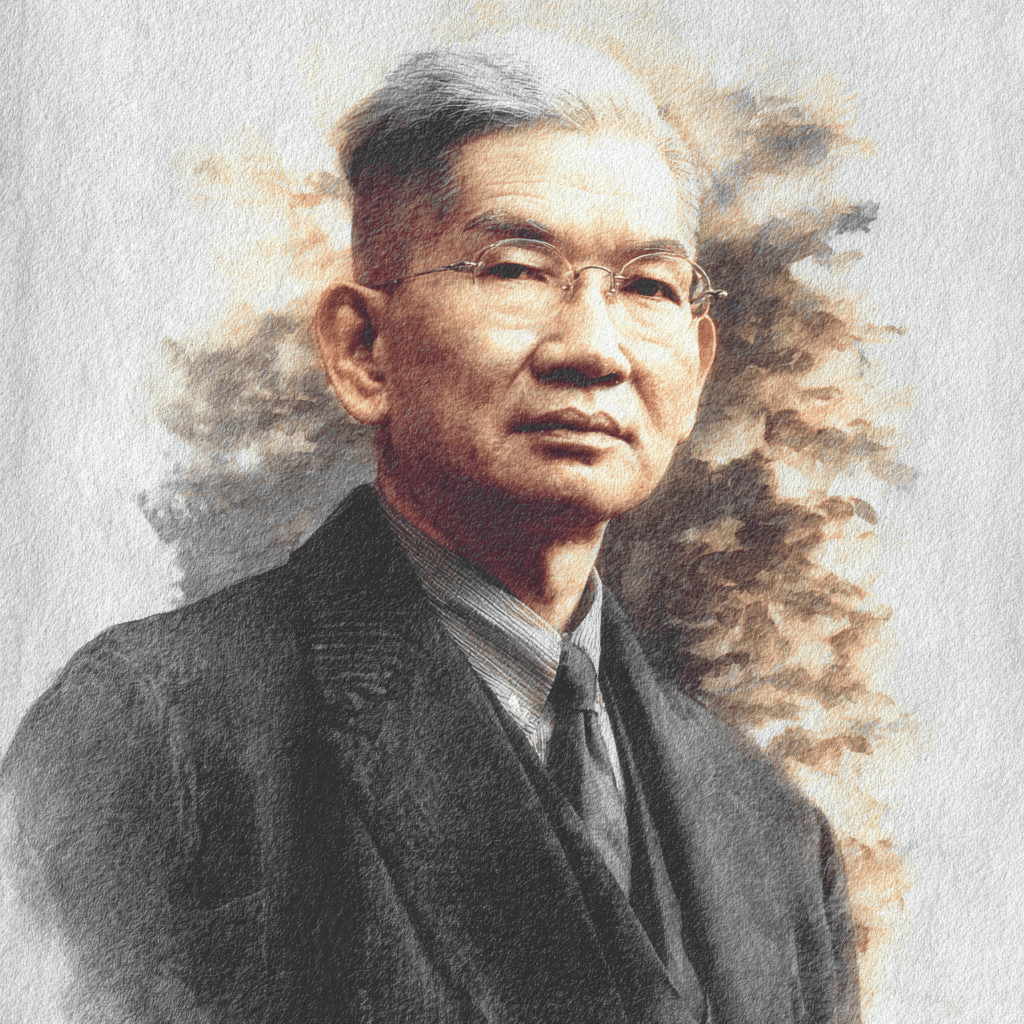
Yin Haiguang
Philosopher & Liberal Intellectual
Authoritarian Era
1919–1969
Yin Hai-guang, born in 1919 in Huanggang, Hubei province, was the most influential Chinese liberal philosopher to operate in 1950s and 1960s Taiwan, whose work on logic, analytic philosophy, and political thought provided much of the intellectual scaffolding for the constitutionalist opposition of the early authoritarian era. He came of age during the Sino-Japanese War, studying at Southwest Associated University (the wartime amalgamation of Peking, Tsinghua, and Nankai universities) in Yunnan, where he was deeply marked by exposure to Anglo-American analytic philosophy. He completed his graduate study at Tsinghua University and entered the Republican-era public intellectual world as a younger associate of the philosopher Chin Yueh-lin (金岳霖) and the liberal reformer Zhang Foquan. He moved to Taiwan with the Nationalist government in 1949 and joined the philosophy department of National Taiwan University, where for two decades he became one of the most influential teachers of his generation. He was the foremost essayist of the Free China Journal during its years of liberal criticism in the 1950s, writing extensively on logic, scientific method, civil liberties, and the limits of authoritarian governance. His thinking drew openly on Bertrand Russell, Karl Popper, F.A. Hayek, and contemporary analytic philosophy, importing into Chinese liberal discourse a set of categories distinct from older Confucian or Marxist frameworks. He published widely throughout the 1950s and 1960s, with major works including Logic and Method (思想與方法) and a sustained critique of authoritarian politics under the rubric of Chinese Cultural Prospects (中國文化的展望). The crackdown on Lei Chen in 1960 and the suspension of Free China deprived him of his principal publication venue and marked the beginning of his sustained marginalization by the security state. He was placed under constant police surveillance, his lectures monitored, his graduate students harassed, and his publications increasingly banned or rewritten. The Ministry of Education stripped him of his teaching duties at National Taiwan University in 1966, a humiliation that intensified the stress that medical historians have linked to his rapidly deteriorating health. He died of stomach cancer in Taipei in September 1969 at the age of 50, his death widely viewed by his students and colleagues as the result of slow political destruction. Yin is now widely revered as one of the foundational figures of post-war Chinese liberalism, his students and writings shaping a generation of post-1987 Taiwanese democratic intellectuals and his treatment by the KMT state standing as one of the most representative cases of late-authoritarian intellectual persecution.
Dismissed from NTU for criticizing the KMT regime
Philosopher & Liberal Intellectual
Yin Haiguang
Era
Authoritarian Era
Lifespan
1919–1969
Yin Hai-guang, born in 1919 in Huanggang, Hubei province, was the most influential Chinese liberal philosopher to operate in 1950s and 1960s Taiwan, whose work on logic, analytic philosophy, and political thought provided much of the intellectual scaffolding for the constitutionalist opposition of the early authoritarian era. He came of age during the Sino-Japanese War, studying at Southwest Associated University (the wartime amalgamation of Peking, Tsinghua, and Nankai universities) in Yunnan, where he was deeply marked by exposure to Anglo-American analytic philosophy. He completed his graduate study at Tsinghua University and entered the Republican-era public intellectual world as a younger associate of the philosopher Chin Yueh-lin (金岳霖) and the liberal reformer Zhang Foquan. He moved to Taiwan with the Nationalist government in 1949 and joined the philosophy department of National Taiwan University, where for two decades he became one of the most influential teachers of his generation. He was the foremost essayist of the Free China Journal during its years of liberal criticism in the 1950s, writing extensively on logic, scientific method, civil liberties, and the limits of authoritarian governance. His thinking drew openly on Bertrand Russell, Karl Popper, F.A. Hayek, and contemporary analytic philosophy, importing into Chinese liberal discourse a set of categories distinct from older Confucian or Marxist frameworks. He published widely throughout the 1950s and 1960s, with major works including Logic and Method (思想與方法) and a sustained critique of authoritarian politics under the rubric of Chinese Cultural Prospects (中國文化的展望). The crackdown on Lei Chen in 1960 and the suspension of Free China deprived him of his principal publication venue and marked the beginning of his sustained marginalization by the security state. He was placed under constant police surveillance, his lectures monitored, his graduate students harassed, and his publications increasingly banned or rewritten. The Ministry of Education stripped him of his teaching duties at National Taiwan University in 1966, a humiliation that intensified the stress that medical historians have linked to his rapidly deteriorating health. He died of stomach cancer in Taipei in September 1969 at the age of 50, his death widely viewed by his students and colleagues as the result of slow political destruction. Yin is now widely revered as one of the foundational figures of post-war Chinese liberalism, his students and writings shaping a generation of post-1987 Taiwanese democratic intellectuals and his treatment by the KMT state standing as one of the most representative cases of late-authoritarian intellectual persecution.
Dismissed from NTU for criticizing the KMT regime