

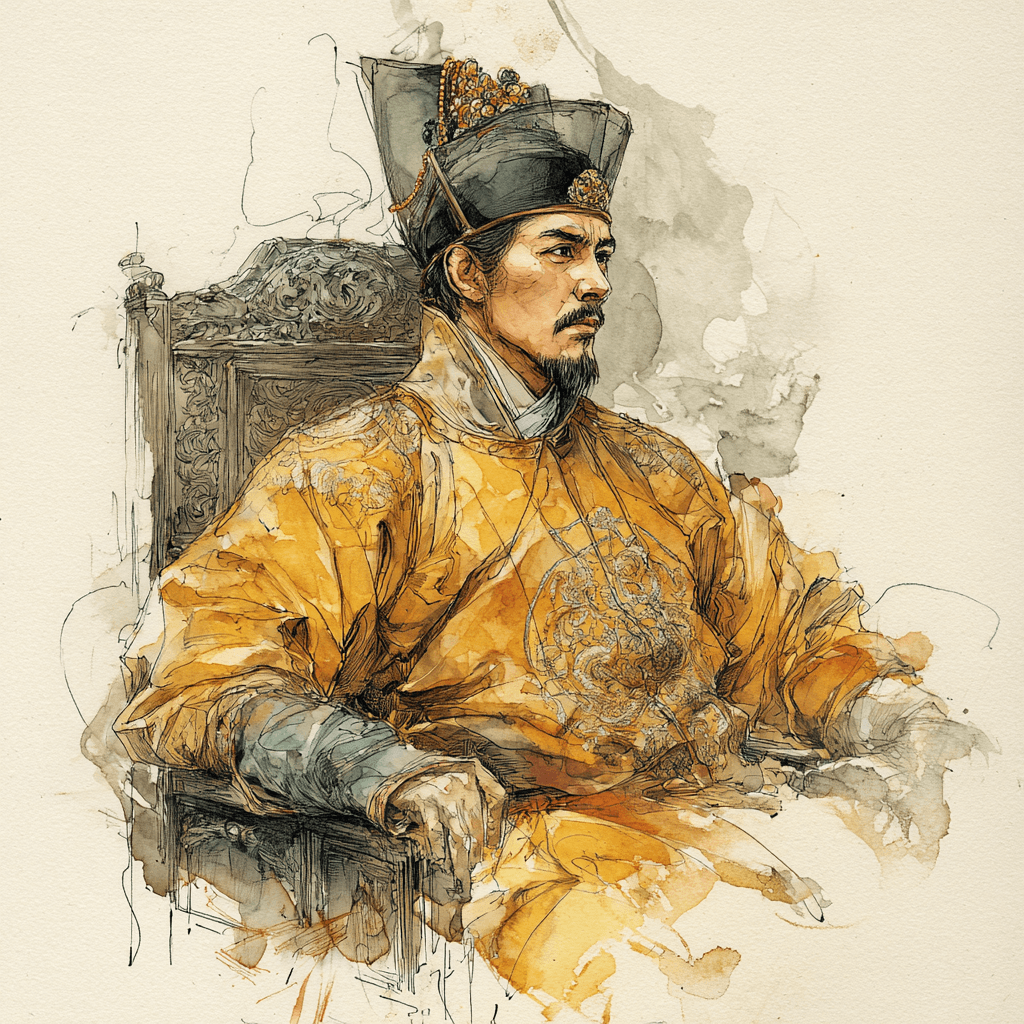
Zheng Jing
King of Tungning
Tungning Kingdom
1642–1681
Zheng Jing, born in 1642 in Quanzhou as the eldest son of Koxinga, ruled the Kingdom of Tungning for nearly two decades and is the central figure of independent Han Chinese rule over Taiwan in the seventeenth century. Educated in the classical tradition and trained in the military arts of his father's house, he served as the trusted garrison commander of Xiamen and Kinmen while Koxinga conducted the conquest of Taiwan. His affair with the wet nurse of his younger brother — which produced his eldest son Zheng Kezang — provoked his father's fury and an ultimately unenforced order for his execution. When Koxinga died suddenly in June 1662, a Tainan faction tried to install Koxinga's kinsman Zheng Xi in his place, but Zheng Jing crossed the strait, defeated the rival party in a short campaign, and consolidated the succession by 1663. Over the next several years the surviving Zheng coastal positions in Fujian collapsed under combined Qing-Dutch pressure, forcing him to withdraw fully to Taiwan and to make Tainan the seat of an island-based state. With the able administrator Chen Yong-hua as his chief minister, he expanded military colonies, built schools and a Confucian temple, and developed monopolies on salt and sugar that financed the regime. He cultivated commercial ties with Japan, the Spanish Philippines, and English East India Company traders, who briefly maintained a factory at Anping, embedding Taiwan deeply in the East Asian maritime economy. He maintained a defiant stance toward the Qing, repeatedly rejecting compromise proposals that would have granted him quasi-tributary status in exchange for cutting hair and adopting Qing dress. In 1673 he seized the opportunity of the Revolt of the Three Feudatories to launch a major mainland expedition, occupying portions of coastal Fujian and Guangdong for nearly seven years. Tungning's mainland gains were lost by 1680 after Qing counterattacks and the strategic isolation of his alliance, forcing him to retreat to Taiwan with a depleted military and a damaged treasury. Demoralized by the failure of the western campaign, he largely withdrew from administration in his final months and died in January 1681 at the age of 39. He is generally credited with transforming Taiwan from his father's military foothold into a functioning state with sustained agricultural, fiscal, and educational institutions, while his failed mainland gambit set the stage for the dynastic crisis that destroyed Tungning two years later.
Consolidated Tungning governance with Confucian institutions and maritime trade
King of Tungning
Zheng Jing
Era
Tungning Kingdom
Lifespan
1642–1681
Zheng Jing, born in 1642 in Quanzhou as the eldest son of Koxinga, ruled the Kingdom of Tungning for nearly two decades and is the central figure of independent Han Chinese rule over Taiwan in the seventeenth century. Educated in the classical tradition and trained in the military arts of his father's house, he served as the trusted garrison commander of Xiamen and Kinmen while Koxinga conducted the conquest of Taiwan. His affair with the wet nurse of his younger brother — which produced his eldest son Zheng Kezang — provoked his father's fury and an ultimately unenforced order for his execution. When Koxinga died suddenly in June 1662, a Tainan faction tried to install Koxinga's kinsman Zheng Xi in his place, but Zheng Jing crossed the strait, defeated the rival party in a short campaign, and consolidated the succession by 1663. Over the next several years the surviving Zheng coastal positions in Fujian collapsed under combined Qing-Dutch pressure, forcing him to withdraw fully to Taiwan and to make Tainan the seat of an island-based state. With the able administrator Chen Yong-hua as his chief minister, he expanded military colonies, built schools and a Confucian temple, and developed monopolies on salt and sugar that financed the regime. He cultivated commercial ties with Japan, the Spanish Philippines, and English East India Company traders, who briefly maintained a factory at Anping, embedding Taiwan deeply in the East Asian maritime economy. He maintained a defiant stance toward the Qing, repeatedly rejecting compromise proposals that would have granted him quasi-tributary status in exchange for cutting hair and adopting Qing dress. In 1673 he seized the opportunity of the Revolt of the Three Feudatories to launch a major mainland expedition, occupying portions of coastal Fujian and Guangdong for nearly seven years. Tungning's mainland gains were lost by 1680 after Qing counterattacks and the strategic isolation of his alliance, forcing him to retreat to Taiwan with a depleted military and a damaged treasury. Demoralized by the failure of the western campaign, he largely withdrew from administration in his final months and died in January 1681 at the age of 39. He is generally credited with transforming Taiwan from his father's military foothold into a functioning state with sustained agricultural, fiscal, and educational institutions, while his failed mainland gambit set the stage for the dynastic crisis that destroyed Tungning two years later.
Consolidated Tungning governance with Confucian institutions and maritime trade