

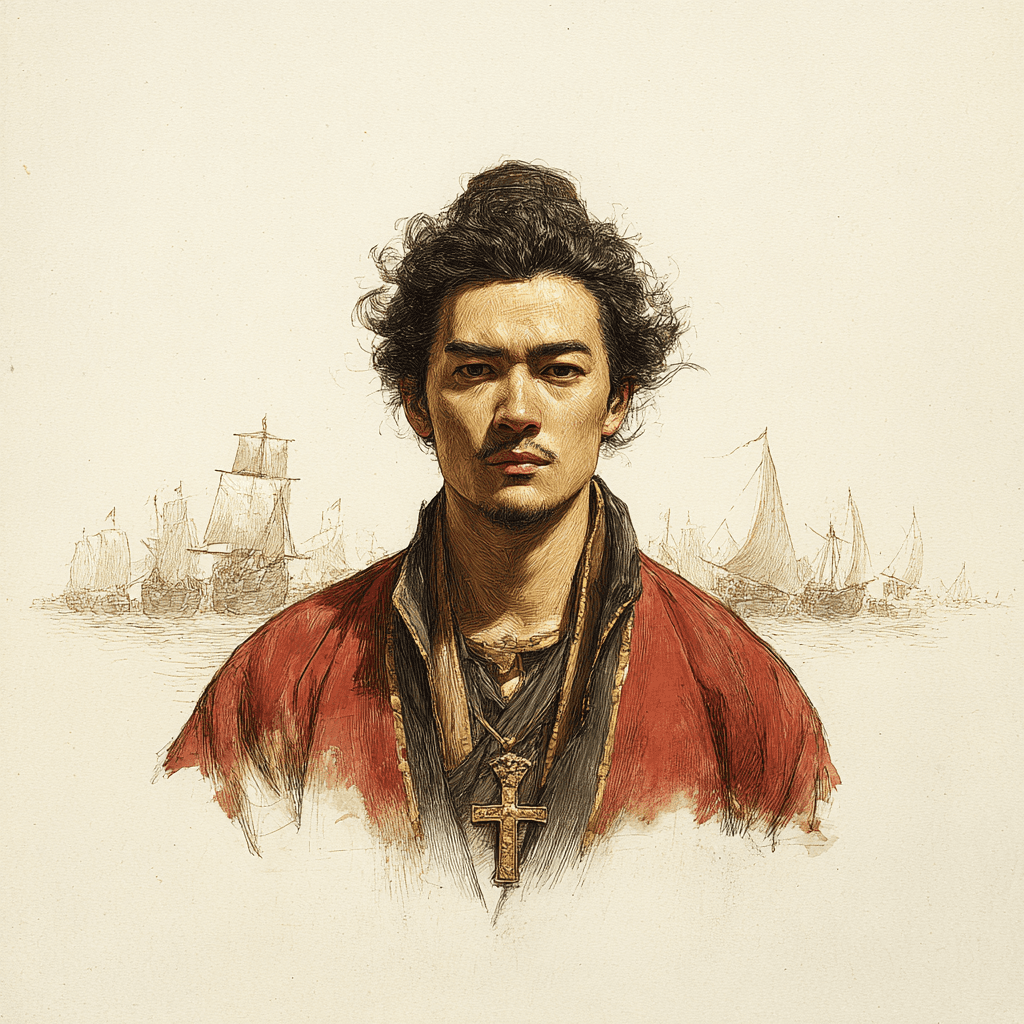
Zheng Zhilong
Sea Lord of the South China Sea
Age of Discovery
1604–1661
Zheng Zhilong, born in 1604 in Nan'an County, Fujian, baptized as Nicholas Iquan and known to the Dutch as such, was the dominant Fujianese sea lord of the early seventeenth century and the father of Koxinga. As a teenager he was sent to Macao to live with relatives, where he learned Portuguese, was baptized as a Roman Catholic, and acquired the linguistic and commercial skills that would shape his later career. In the early 1620s he moved to Hirado, Japan, the principal Chinese émigré port on Kyushu, and married a Japanese woman of the Tagawa family who in 1624 gave birth to their son Zheng Sen — later Koxinga. The Dutch East India Company hired him as a Hokkien-Portuguese interpreter for their factory at Penghu and then Tayouan, giving him direct experience of European commercial and naval methods. After the death of his patron Yan Siqi in 1625, he inherited the latter's fleet and trading network and over the next three years built it into the most powerful privately commanded armed force in the East China and South China Seas. He accepted a Ming amnesty in 1628 and was appointed a senior naval commander, giving the Ming court its only effective fleet along the Fujian coast in exchange for a license to monopolize maritime commerce. In October 1633 he commanded the Ming forces that destroyed a combined Dutch and Chinese pirate fleet at the Battle of Liaoluo Bay off Quemoy, breaking the VOC's challenge to his trade hegemony and establishing his fleet as the unrivaled power of regional waters. He used his quasi-state monopoly to amass an enormous fortune from silk, sugar, copper, and silver flows between China, Japan, Manila, and the Indonesian archipelago, becoming one of the wealthiest individuals in East Asia. After the Ming dynasty's collapse in 1644 he supported the Longwu Emperor of the Southern Ming in Fuzhou and was promoted to senior generalship, while his son Koxinga rose to prominence at the same court. In 1646 he abruptly accepted a Qing offer of surrender against the strong objections of his son and was taken to Beijing under nominal ennoblement but effective detention. He was held in the Qing capital for fifteen years and was executed by the Shunzhi court in 1661, partly in retaliation for his son's continuing armed resistance. Zheng Zhilong is generally remembered as the architect of the maritime power that his son would later use to conquer Dutch Taiwan, a figure whose biography uniquely fuses Hokkien trade, Japanese marriage, Catholic conversion, Dutch service, Ming office, and Qing detention.
Defeated the VOC fleet at the Battle of Liaoluo Bay (1633)
Sea Lord of the South China Sea
Zheng Zhilong
Era
Age of Discovery
Lifespan
1604–1661
Zheng Zhilong, born in 1604 in Nan'an County, Fujian, baptized as Nicholas Iquan and known to the Dutch as such, was the dominant Fujianese sea lord of the early seventeenth century and the father of Koxinga. As a teenager he was sent to Macao to live with relatives, where he learned Portuguese, was baptized as a Roman Catholic, and acquired the linguistic and commercial skills that would shape his later career. In the early 1620s he moved to Hirado, Japan, the principal Chinese émigré port on Kyushu, and married a Japanese woman of the Tagawa family who in 1624 gave birth to their son Zheng Sen — later Koxinga. The Dutch East India Company hired him as a Hokkien-Portuguese interpreter for their factory at Penghu and then Tayouan, giving him direct experience of European commercial and naval methods. After the death of his patron Yan Siqi in 1625, he inherited the latter's fleet and trading network and over the next three years built it into the most powerful privately commanded armed force in the East China and South China Seas. He accepted a Ming amnesty in 1628 and was appointed a senior naval commander, giving the Ming court its only effective fleet along the Fujian coast in exchange for a license to monopolize maritime commerce. In October 1633 he commanded the Ming forces that destroyed a combined Dutch and Chinese pirate fleet at the Battle of Liaoluo Bay off Quemoy, breaking the VOC's challenge to his trade hegemony and establishing his fleet as the unrivaled power of regional waters. He used his quasi-state monopoly to amass an enormous fortune from silk, sugar, copper, and silver flows between China, Japan, Manila, and the Indonesian archipelago, becoming one of the wealthiest individuals in East Asia. After the Ming dynasty's collapse in 1644 he supported the Longwu Emperor of the Southern Ming in Fuzhou and was promoted to senior generalship, while his son Koxinga rose to prominence at the same court. In 1646 he abruptly accepted a Qing offer of surrender against the strong objections of his son and was taken to Beijing under nominal ennoblement but effective detention. He was held in the Qing capital for fifteen years and was executed by the Shunzhi court in 1661, partly in retaliation for his son's continuing armed resistance. Zheng Zhilong is generally remembered as the architect of the maritime power that his son would later use to conquer Dutch Taiwan, a figure whose biography uniquely fuses Hokkien trade, Japanese marriage, Catholic conversion, Dutch service, Ming office, and Qing detention.
Defeated the VOC fleet at the Battle of Liaoluo Bay (1633)