

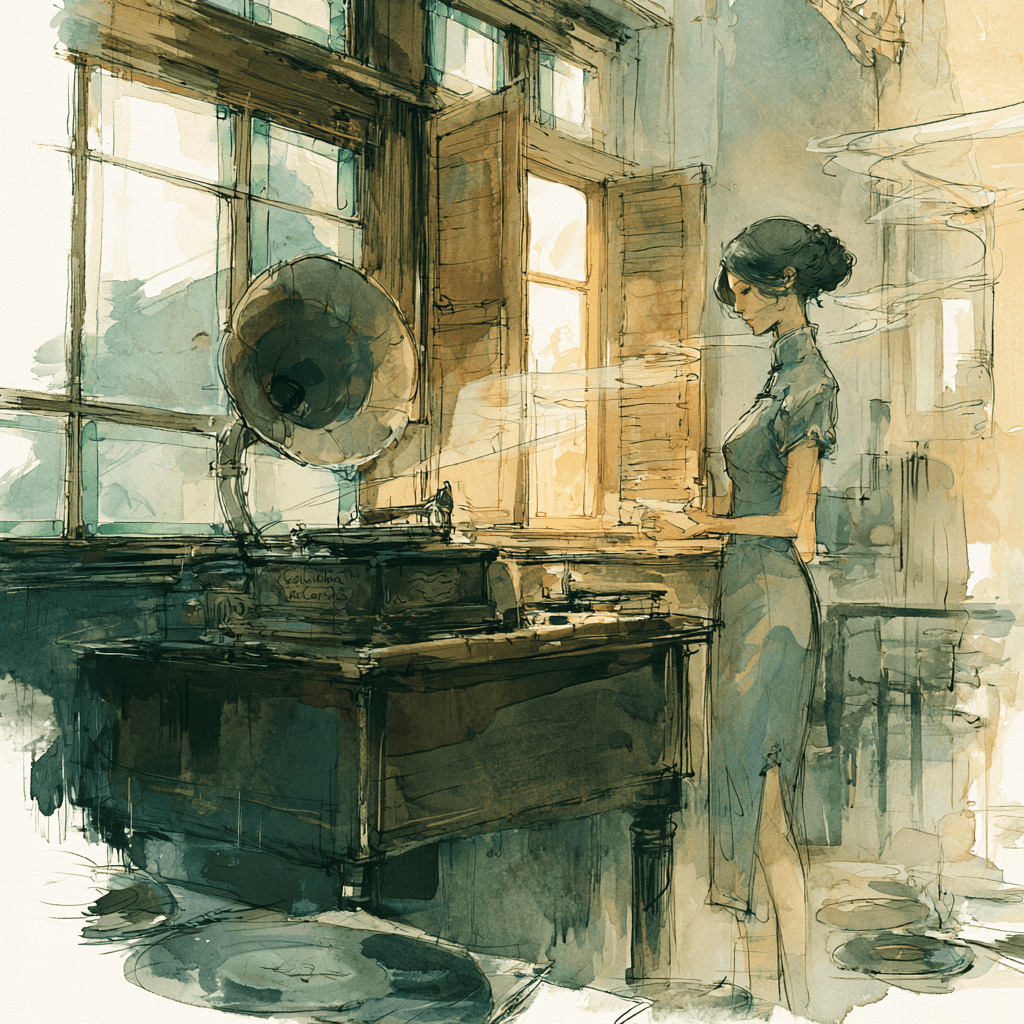
The Gramophone Era
In the mid-1920s, the gramophone and the shellac record arrived in Taiwan along the commercial arteries of the Japanese empire. In the shop windows of trading firms in Taipei's Sakaechō and Dadaocheng, and along the wharves of Keelung, the phonograph gradually became a fashionable fixture in middle-class homes. The earliest locally recorded products were mostly excerpts of gezaixi, beiguan, and nanguan, produced to serve the existing market for traditional opera; yet the gramophone also carried into Taiwan the shidaiqu of Shanghai, the ryūkōka of Japan, and the rhythms of Western jazz, preparing the soil for a wholly new genre of "popular song" aimed at urban listeners.
In 1932, Shanghai Lianhua Film Company's silent picture Peach Blossoms Weeping Blood premiered at Taipei's Eiraku-za. To promote the film, the distributor commissioned lyrics from Zhan Tianma and a melody from Wang Yunfeng, and had the singer Chunchun (Liu Ching-hsiang) record a title song to be played through the streets as advertisement. Intended merely as an advertising tool, the song unexpectedly swept across Taiwan, posting astonishing record sales and demonstrating for the first time that a popular song "sung in Taiwanese-Hokkien and released on disc" could stand as an independent commercial product. Columbia Records (コロムビア) swiftly established a dedicated recording division in Taipei and signed lyricists and composers such as Lee Lin-chiu, Teng Yu-hsien, Chen Chun-yu, and Chou Tien-wang, along with singers including Chunchun, Ai-ai, and Lin Shih-hao — building Taiwan's first systematically integrated pop-music industry.
The years 1933 to 1936 were Columbia's golden quartet. Bāng Chhun-hong (Longing for the Spring Breeze) — composed by Ten…
The years 1933 to 1936 were Columbia's golden quartet. Bāng Chhun-hong (Longing for the Spring Breeze) — composed by Teng Yu-hsien with lyrics by Lee Lin-chiu — wrapped colonial youth's longing for self-determined lives in the delicate feelings of a young woman's first love; Hō-iā-hoe (Rainy Night Flower) — with lyrics by Chou Tien-wang and music by Teng Yu-hsien — used a flower battered by wind and rain as a metaphor for the women at the bottom of society whom fate had crushed. Moon Night Sorrow, Four Seasons Red, and Riverside Spring Dream each captured, in turn, urban romance, festive life, and the nostalgia of displacement. These songs circulated through record shops, cafés, taverns, and radio stations, weaving together a shared aural memory for the urban middle class of mid-period Japanese-ruled Taiwan.
This volume chronicles the twelve critical years in which Taiwanese-Hokkien popular song was born from nothing: from the material conditions of the recording industry and the first hit song catalyzed by film advertising, to the complete lyricist-composer-singer-recording-distribution system built by Columbia. It shows how an entirely new form of mass art emerged in the interstices of colonial rule and, within only a few years, accumulated a songbook rich enough to be sung across generations. These songs would later face the successive fates of being banned, rewritten, banned again, and revived; but the musical vocabulary they established in the mid-1930s has permanently rewritten the way Taiwanese people hear their own voices.
Isle of Time