


One Island, One Day
On January 5, 2007, the Taiwan High Speed Rail officially entered service. From that day, streamlined orange-and-white trains raced along the western corridor, compressing what had been a journey of several hours between north and south into roughly ninety minutes, thoroughly rewriting the Taiwanese imagination of distance and time, and turning the 'one-day living circle' from a slogan into daily reality.
Before the high-speed rail opened, travel between Taiwan's north and south relied either on conventional railways that stopped all along the way or on frequently congested freeways, often consuming the better part of a day; and when this steel artery of a new era ran through from north to south, the space-time map of western Taiwan was refolded in an instant. Stretching about 345 kilometers, the line runs from Taipei in the north to Zuoying in Kaohsiung in the south, stringing together the most densely populated and industrially concentrated urban belt of western Taiwan.
The project was then one of Taiwan's largest public infrastructure undertakings and one of the rare high-speed railways in the world built through a build-operate-transfer (BOT) model, its construction passing through countless technical, financial, and institutional challenges. It introduced the core systems of Japan's Shinkansen, combined them with European signaling and engineering experience, and built across Taiwan's cramped, geologically complex, and earthquake-prone land a steel dragon that crossed rivers, bored through tunnels, and rode elevated above the plains, its viaduct piers stretching like a spine running hundreds of kilometers, holding up the whole island's dream of swift movement.
The Taichung station at Wuri sits precisely at the midpoint of the western corridor, becoming a vital hub linking central Taiwan and symbolizing how this railway stitched scattered cities into one. What the high-speed rail brought was far more than a gain in speed. It allowed people living in Kaohsiung to travel to Taipei and back in a single day for business, meetings, or visiting relatives, returning home with ease; it gave students in the south and the job market in the north, travelers from the north and the customs of the south, an unprecedented exchange in the span of a morning's departure and an evening's return.
Many families once estranged by distance could now reunite more often through a single rail ticket; the psychological di…
Many families once estranged by distance could now reunite more often through a single rail ticket; the psychological distance between cities shrank dramatically; the maps of commuting, study, tourism, and commerce were reshaped, and the western corridor gradually merged into a living community breathing as one. The high-speed rail also profoundly altered Taiwan's urban-rural relations and regional development.
The specially designated zones around new stations spurred surrounding development and transformation, and once relatively remote areas were seen anew through the convenience of a single stop; local tourism, industry, and population flows all sought new possibilities under the pull of this high-speed axis, and the fates of the cities along the line were thereby bound tightly together.
To be sure, the high-speed rail also faced financial challenges and operational controversies, reminding people of the complex trade-offs and long-term responsibilities behind large public works. Yet it is undeniable that the high-speed rail has become an indispensable artery of modern Taiwanese life, deeply embedded in the daily routines and life trajectories of countless people.
When people board in the south in the morning light, stroll the streets of the north by afternoon, and return to the family dinner table by evening, the two ends of this island have, through the binding of a single steel rail, become within each other's reach. In the moment the high-speed rail opened, Taiwan truly entered the age of the one-day living circle, and the pulse of the whole island drew closer together.
Before it opened, Taipei to Kaohsiung was an hour by air, four and a half hours on the fastest conventional train, and a matter of luck by road. After 5 January 2007 it was ninety-six minutes. The first thing that number changed was business travel: same-day return became normal and companies stopped paying for hotels. The second was where people lived — some began living in Hsinchu and working in Taipei, or living in Tainan and working in Kaohsiung. The costs were plain as well. Air tickets between Taipei and Kaohsiung all but disappeared within two years, leaving domestic aviation to the outlying islands and the east coast; long-distance coaches and the conventional railway's express services lost a share of their traffic, and the state railway shifted its weight to commuter and local trains. A high speed ticket costs more than twice the express fare, so the line divided the western corridor into two kinds of people: those whose time is expensive and those whose money is. They live beside the same track and do not ride the same train.
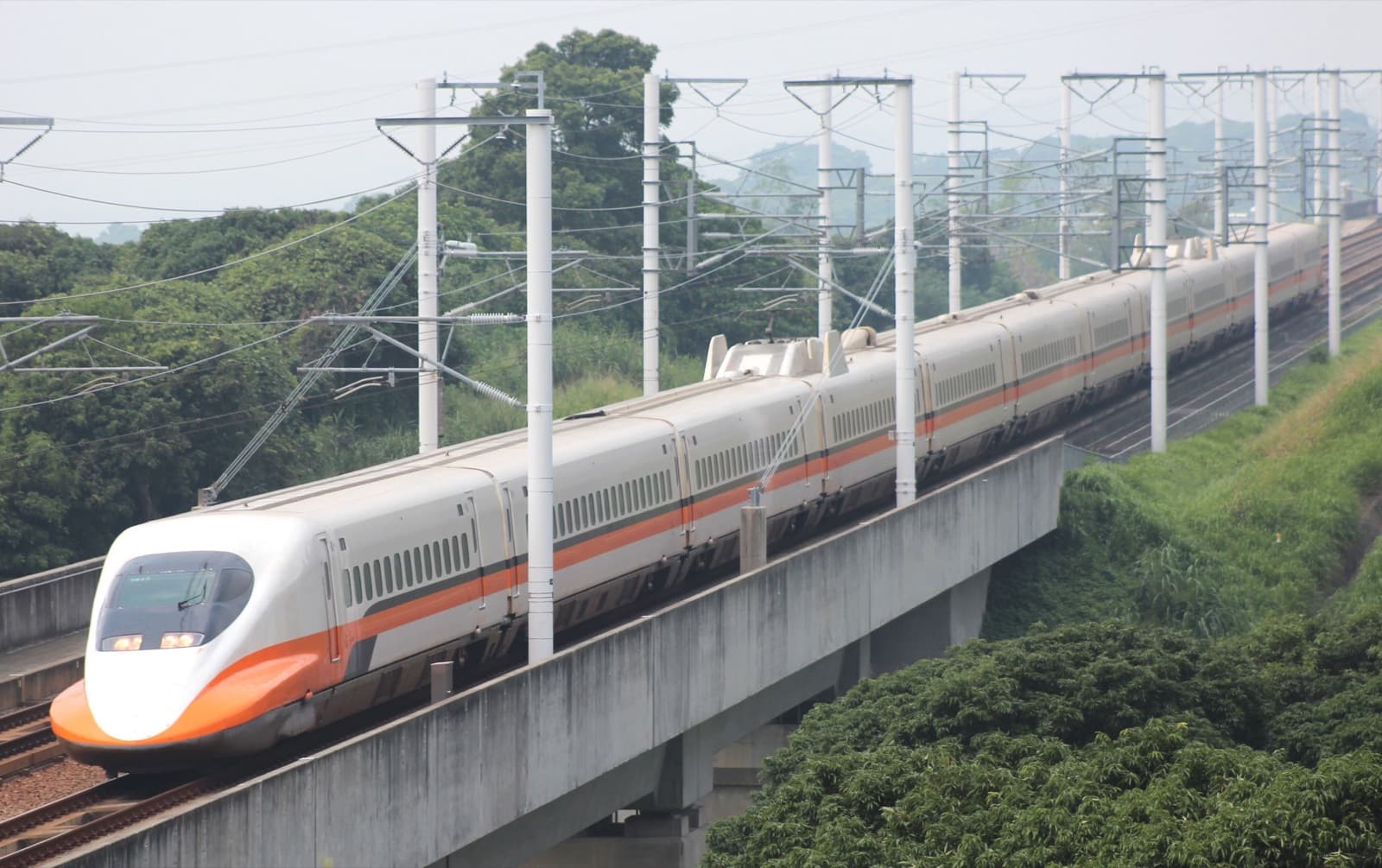
A 700T high-speed trainset. After the line opened in 2007 the run from Taipei to Kaohsiung fell from over four hours to ninety minutes, folding the western corridor into a single day's reach.
Rsa / CC BY-SA 3.0 via Wikimedia Commons
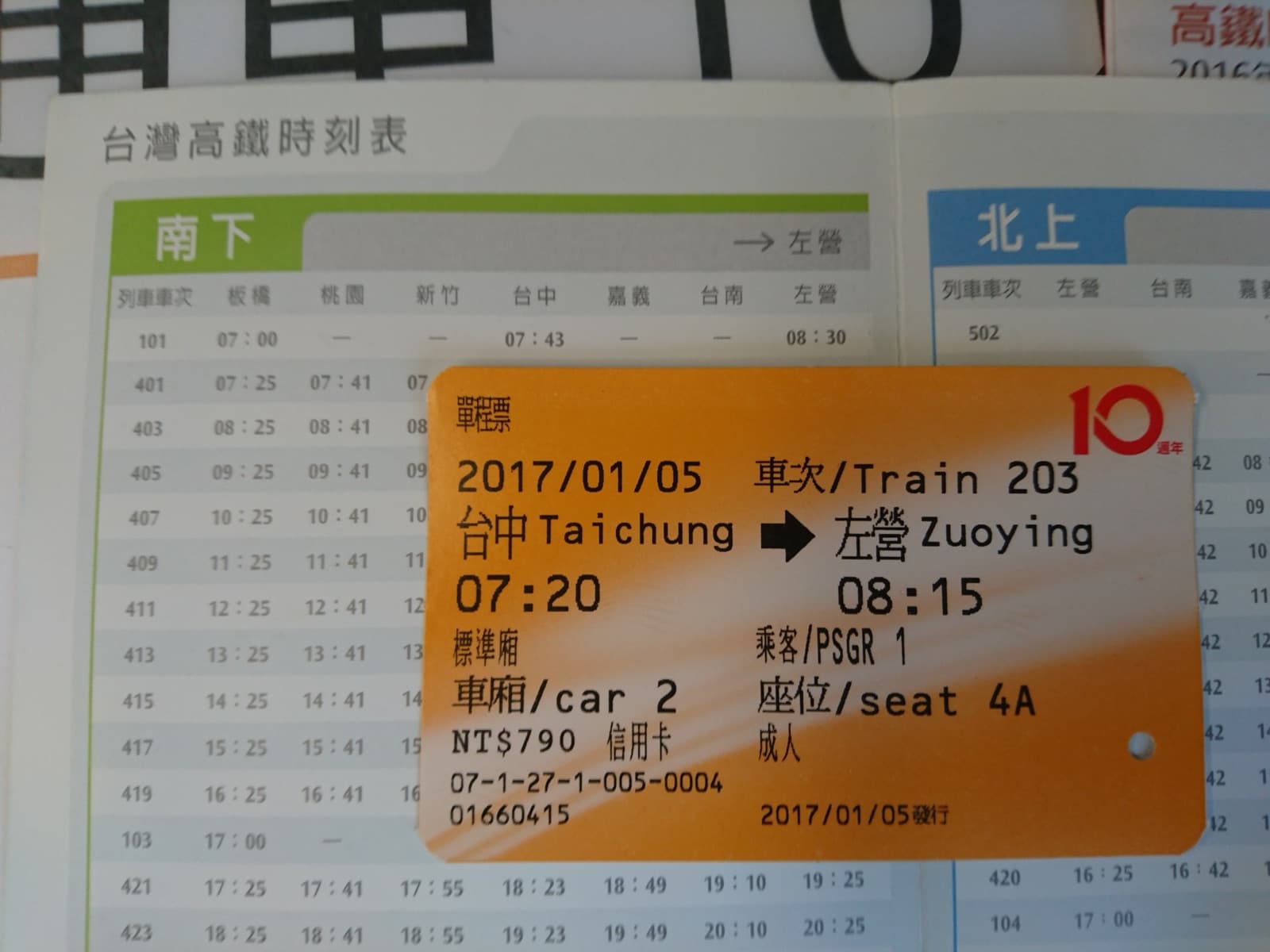
A one-way ticket from Taichung to Zuoying with the timetable. Before the line opened that leg took over three hours; after, fifty minutes. The timetable is the plainest record of the change.
Cheng-en Cheng / CC BY-SA 2.0 via Wikimedia Commons
Isle of Time