


The Voices of the Land
Entering the twenty-first century, Taiwanese society gradually awoke to a profound crisis: the mother tongues passed down for generations on this island — Taiwanese (Taiwanese Hokkien), Hakka, and the languages of the various Indigenous peoples — were rapidly being lost, and many of the younger generation could no longer fluently speak the language of their grandparents; some Indigenous languages even faced the endangered plight of having only a handful of elders left who could speak them.
This awakening and rescue concerning language is one of the most profound and moving pages in the construction of modern Taiwan's cultural subjectivity, and its historical depth can be traced all the way back to the scars left by past language policy. In the authoritarian era, the single-language policy promoting 'Mandarin' suppressed local languages in schools and public spaces; children could even be made to wear a placard reading 'I spoke a dialect' and be fined or punished for speaking their mother tongue at school, and so several generations drifted, unknowingly, ever further from their own native languages, which were for a time even stigmatized as symbols of the vulgar and backward — a linguistic rupture that became an unspeakable hidden grief between generations in many families.
After the lifting of martial law and democratization, as local consciousness rose, the call to rescue the mother tongues grew ever stronger, and people came to recognize anew that every mother tongue is an irreplaceable cultural asset. Beginning in the 2000s, local-language education gradually entered the classrooms of national education, and native-language classes became the starting point for many schoolchildren to reconnect with their mother tongue; public television successively launched dedicated channels and stations in Taiwanese, Hakka, and Indigenous languages, letting the mother tongues flow anew through drama, news, song, and children's programs in everyday life.
Academia and civil society poured in great effort, organizing writing systems, compiling dictionaries, promoting certifi…
Academia and civil society poured in great effort, organizing writing systems, compiling dictionaries, promoting certification exams, and cultivating teachers, and through literature, popular music, drama, film, and online creation, making local languages once again living languages bearing emotion and identity, and leading more and more young people to take pride in speaking their mother tongue and singing songs in it. This wave of revival met a milestone moment in 2019 — the National Languages Development Act formally took effect.
This law stipulated that the natural languages used by all of Taiwan's inherent ethnic groups, along with Taiwan Sign Language, are all national languages, equal in status without distinction by the size of their speaking populations; the state should safeguard the transmission, revival, and development of every national language, and ensure it gains its due space and respect in education, broadcasting, public services, and formal occasions. This meant that Taiwan finally, at the level of law, formally recognized the plurality of its own languages and solemnly took up the responsibility of guarding every mother tongue. The revival of local languages was never merely a question of linguistic survival.
A language carries a people's way of seeing the world, the wisdom accumulated over generations, and the emotion and memory embedded in its very sounds; once a language disappears, what passes away with it is an entire people's unique spiritual world. When a child once again learns to greet grandma and grandpa in the mother tongue, when long-absent folk songs are sung anew in schools and on stages, when the languages of different peoples can all be heard equally and confidently on this island, Taiwan, amid the polyphony of its languages, more profoundly affirms its own face as a pluralistic and inclusive society.
This intergenerational mother-tongue movement continues, quietly and resolutely, to this day, in every classroom, every household, and every conversation.
She is sixty-three, holds the Taiwanese language certificate, and works three primary schools a week, forty minutes a class, paid by the period with no insurance and no seniority. The post grew out of the introduction of local languages into the curriculum in 2001 — the system needed people to teach and teacher training could not supply them, so certified people from the community filled the gap, and the arrangement has held for twenty years. The textbook writes Taiwanese two ways, in the ministry's romanization and in Chinese characters, and both must be taught, so a child learns the spelling before he can spell the words he says every day. The real difficulty is not in the classroom. One period a week, forty minutes; and when the child goes home, whoever speaks to him there mostly speaks Mandarin, because his parents are no longer fluent in Taiwanese either. She says her work is closer to record-keeping than to teaching a language — leaving a word or a saying in the ears of forty children, and seeing which of them finds a use for it later.
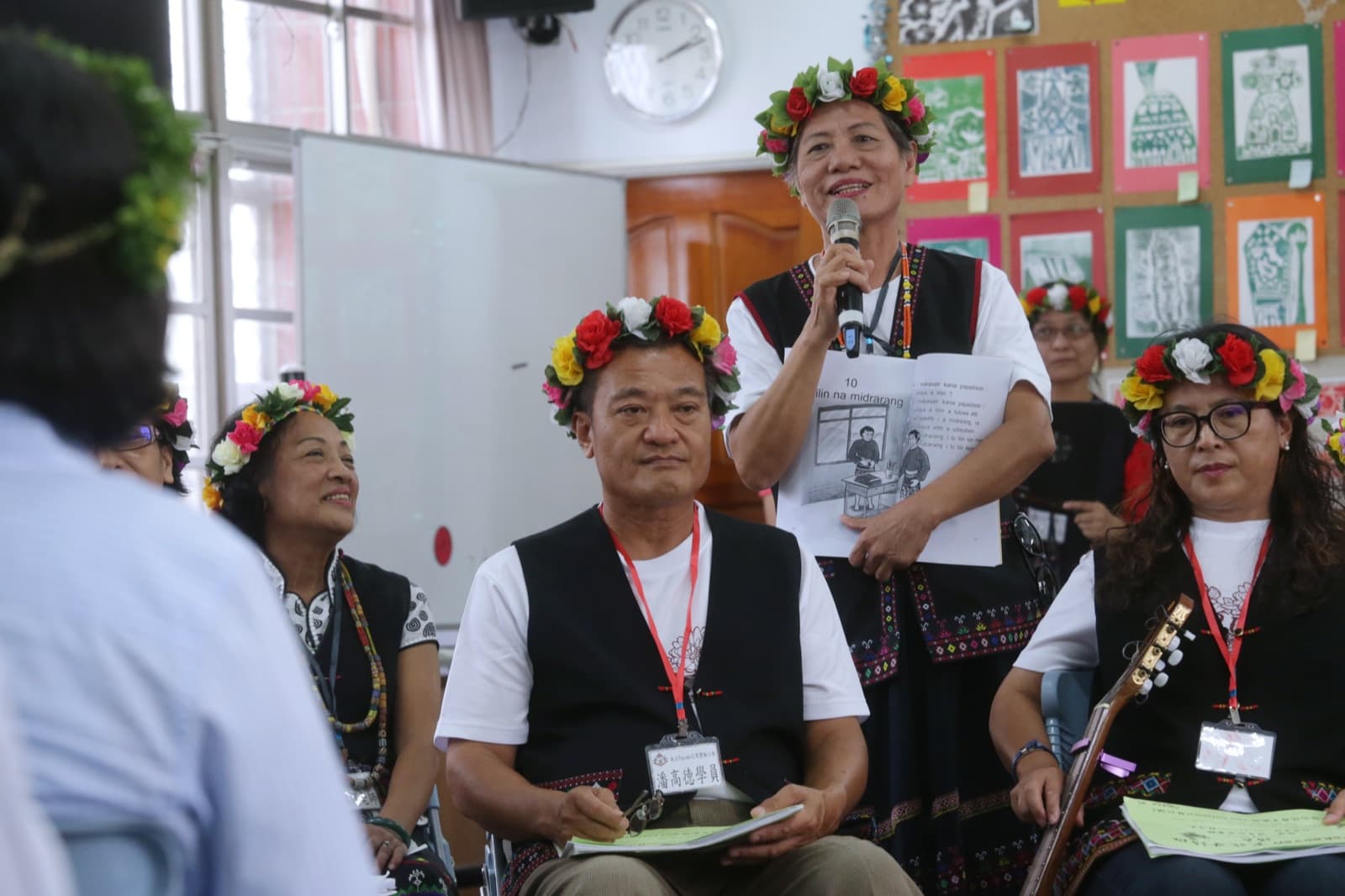
The president meeting indigenous language teachers at Puyuma Garland Experimental Primary School in Taitung, 2017. The Indigenous Languages Development Act passed that year, making sixteen peoples' languages national languages.
Office of the President, ROC (Taiwan) / CC BY 2.0 via Wikimedia Commons
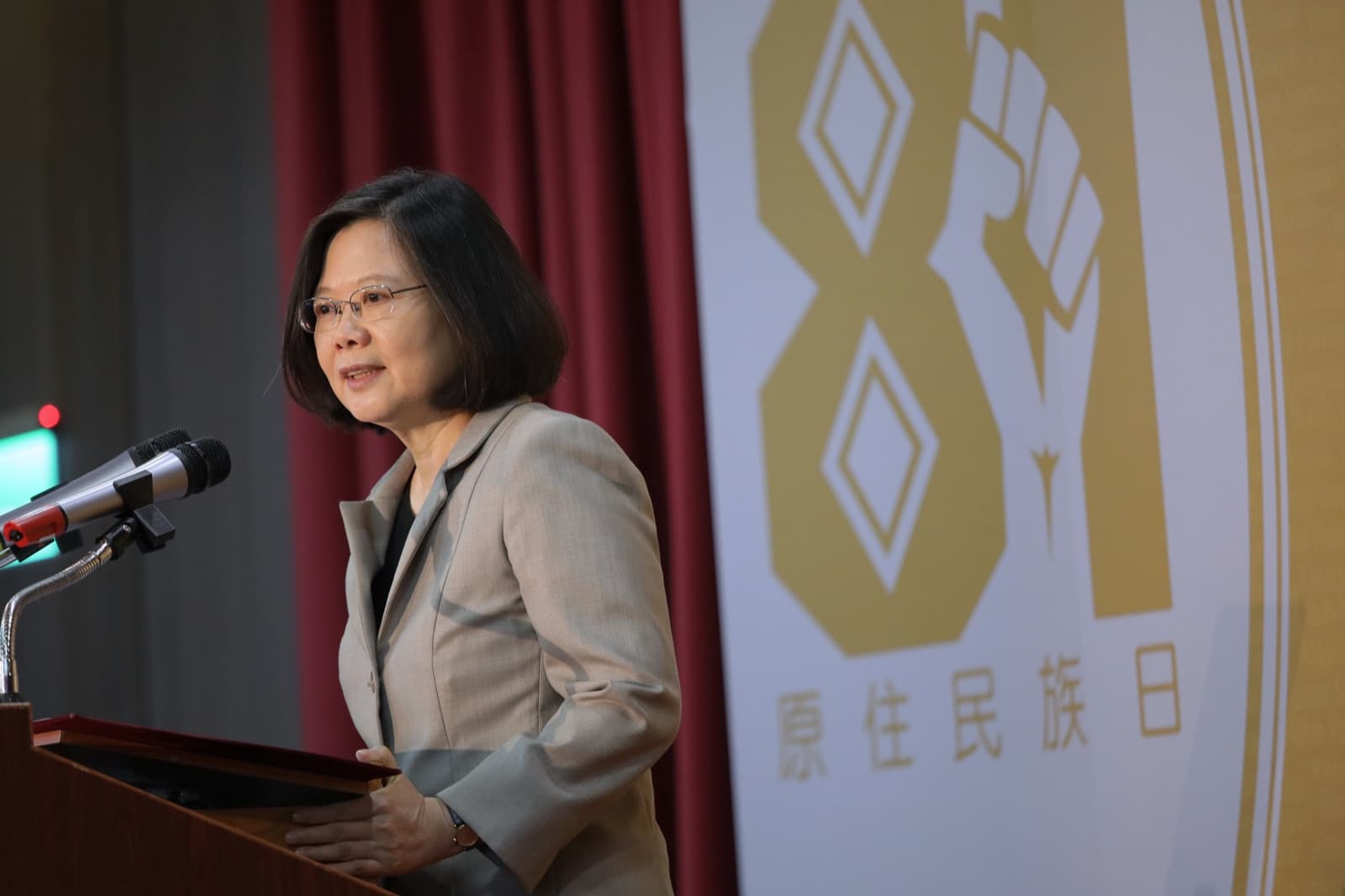
The national conference on indigenous affairs, 2017. The difficulty of reviving a language is not in the statute but in the speakers: for most of these languages the fluent are past sixty on average.
Office of the President, ROC (Taiwan) / CC BY 2.0 via Wikimedia Commons
Isle of Time