


The SARS Storm
In the spring of 2003, an unprecedented new coronavirus slipped quietly into Taiwan from abroad, and in April Severe Acute Respiratory Syndrome (SARS) erupted into a massive nosocomial outbreak inside Taipei Municipal Heping Hospital, becoming one of the gravest tests in Taiwan's postwar public-health history. That year, SARS spread across many parts of Asia, a disease transmitted by droplets at close range and carrying a fatality rate not to be taken lightly, plunging the whole of society into unprecedented panic.
Heping Hospital stood in the old Wanhua district, a long-established municipal institution serving grassroots medical needs; when unexplained high-fever cases began appearing, the virus had already spread silently through a tangled web of contact among laundry workers, cleaners, and patients, and the hospital's early reporting and isolation failed to halt the outbreak in time, letting the chain of infection burn unnoticed through the entire compound. On April 24, after repeated wrangling between central and local authorities, the Taipei City Government announced the immediate, total sealing of Heping Hospital, ordering all medical staff, employees, and inpatients to return and be collectively quarantined within its walls.
With a single command, more than a thousand people were locked inside with no preparation; panic, anger, and helplessness filled every corridor. Some climbed over walls trying to flee, some hung white banners from windows protesting that 'the hospital had become a prison,' while family members anxiously inquired through the iron gates, and the gaze of the entire city focused on that sealed hospital door.
The hasty lockdown decision also sparked fierce debate over how to weigh procedure, human rights, and epidemic prevention against one another — a case still repeatedly examined in public health and administrative ethics to this day. Yet amid the chaos and fear, more numerous were the figures who quietly held their posts — nurses, resident doctors, cleaning aunties, and volunteers — who, despite severe shortages of protective equipment and limited knowledge of the virus, remained on the front line of the wards, caring for stricken colleagues and patients alike.
There were also medical workers who had already gone off duty but, under the lockdown order, chose to return to the comp…
There were also medical workers who had already gone off duty but, under the lockdown order, chose to return to the compound to share the ordeal with their colleagues; their choices reflected the deepest professional conscience of healers. During the lockdown, dozens at Heping were infected and several medical workers and staff died, including a head nurse and a physician who fell ill caring for patients; their names were later carved on a memorial, becoming an indelible scar and a mark of honor for the city.
The SARS storm subsided that summer as the climate changed and prevention networks were gradually built. Taiwan paid a bitter price, but tempered profound lessons from it. In the aftermath, the government comprehensively overhauled its communicable-disease control system, establishing a dedicated Centers for Disease Control, building fever-screening and reporting networks, strengthening hospital infection control and negative-pressure isolation wards, advancing amendments to the Communicable Disease Control Act along with legal frameworks for large-scale quarantine, and at the same time building a command architecture for cross-agency coordination and real-time disclosure of information.
These institutional accumulations, won at bitter cost, became, seventeen years later when facing the global COVID-19 pandemic, a crucial foundation that allowed Taiwan to deploy ahead of the curve and respond with relative steadiness, as many of the lessons learned in the Heping Hospital incident were transformed into concrete shields safeguarding the health of the whole people.
The sealing of Heping Hospital is a collective memory woven from fear, sacrifice, and institutional reflection. It reminds us how precious the courage of medical workers is before an invisible virus, and how a society's institutional preparedness, transparency of information, prudence of decision, and mutual trust in the face of crisis often determine the line between life and death.
The walls of that old Wanhua hospital, which once divided inside from outside, life from death, in that spring, have now become one of the most profound lessons in Taiwan's public-health history, quietly recounting those days when an entire people held its breath and supported one another.
The announcement on the morning of 24 April told every member of staff to report back to the hospital within two hours, on pain of legal action. Some were on leave, some had just come off a night shift, and all of them had to come. The gates closed at noon with more than twelve hundred people inside — over nine hundred staff, more than two hundred inpatients, and the family members who had been caring for them. The trouble was that there was no separation inside. Staff, suspected cases and ordinary patients shared the corridors, the lifts and the canteen; there were not enough gowns and N95 masks were reused. People with fever and people without were shut inside the same building, which is to say the spread was completed within a sealed space. Head nurse Chen Ching-chiu had already fallen ill before the closure and died on 1 May, the first medical worker in Taiwan to die of SARS. Dr Lin Chung-wei, aged thirty-one, died on 15 May. Eleven health workers in Taiwan died in that epidemic, most of them from this hospital.
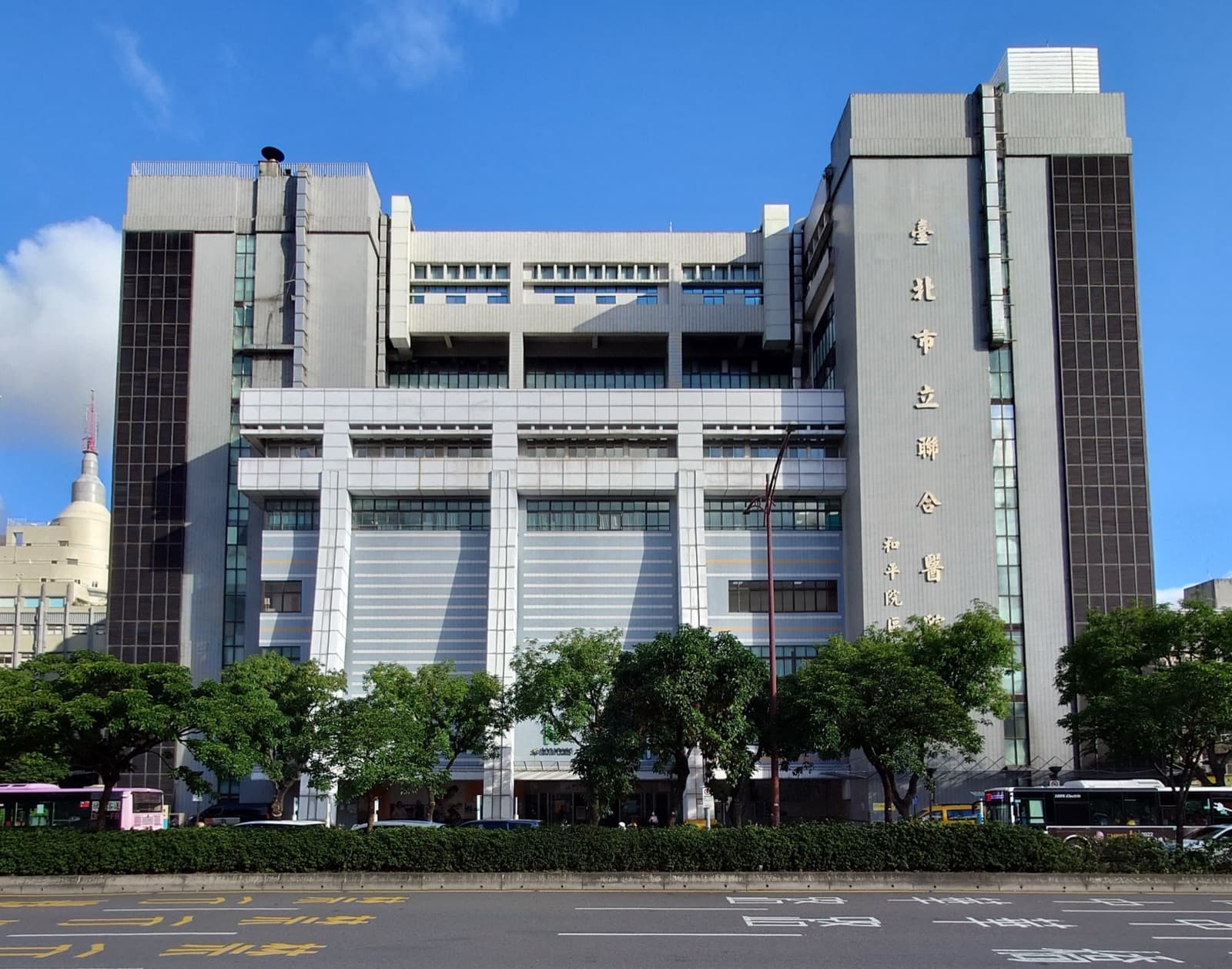
The Heping branch of Taipei City Hospital, photographed in 2022. On 24 April 2003 it was sealed within hours, shutting more than a thousand staff and patients inside — the most disputed decision in Taiwan's epidemic history.
Yu tptw / CC BY-SA 4.0 via Wikimedia Commons
Isle of Time