


Taipei 101
On December 31, 2004, as the New Year's bells rang out over Taipei's Xinyi district, a skyscraper reaching 508 meters officially opened — Taipei 101, in that moment the tallest building in the world, lifting Taiwan's skyline onto the international stage. Before its completion, the Xinyi Planning District was still a rising new urban area, and the tower's springing up from the ground was like planting in this city a flag facing the world, symbolizing how Taiwan, after its economic takeoff and democratic transition, yearned to converse with the world in a wholly new posture.
Designed under architect C. Y. Lee, this colossal tower was no mere contest of stacking steel and glass to reach for height, but a structure that deliberately wove Taiwanese cultural codes into modern engineering. Rising in segments of eight floors per unit, its form echoed the auspicious meaning of bamboo joints 'rising ever higher,' its silhouette like a stalk of upright, vigorous bamboo, symbolizing an endless, upward-striving spirit; its shaft was adorned with motifs of ruyi scepters, ancient coins, and auspicious clouds, with giant circular ancient-coin forms hung upon the tower, blending Eastern traditional imagery into a world-class supertall building and making this modern landmark at once a colossal sculpture laden with cultural meaning. In engineering terms, Taipei 101 was also a bold response to Taiwan's own geographic fate.
Sitting on the Pacific Ring of Fire and repeatedly battered by powerful typhoons, to erect a supertall tower on such land was to confront the shaking of earth and sky head-on. To this end, the engineering team drove enormous piles deep into the foundation to reach bedrock, and installed in the tower's upper levels a giant tuned mass damper weighing 660 tons — that golden sphere suspended high in the air, affectionately nicknamed the 'big steel ball,' which sways during strong winds and earthquakes to counteract movement, and was later opened for close-up viewing by visitors, becoming a rare engineering marvel that the public can witness firsthand and letting the world see with its own eyes how Taiwanese engineers tamed the forces of nature with their ingenuity.
Moreover, the high-speed elevators within once set the world record for the fastest, carrying visitors from the ground t…
Moreover, the high-speed elevators within once set the world record for the fastest, carrying visitors from the ground to the observation deck in mere tens of seconds to overlook the magnificent vista of the entire Taipei Basin. At its opening, Taipei 101 drew global attention with the title of 'world's tallest building,' and its annual New Year's fireworks swiftly became one of Taiwan's most iconic urban images, brilliant flames cascading down the tower's flank, ranked alongside New York and Sydney in New Year coverage worldwide and becoming a major focus as the globe welcomed the new year.
Though the record for the world's tallest was later surpassed by Dubai's Burj Khalifa, Taipei 101's place in the hearts of the Taiwanese has never wavered. It is not merely an office and shopping tower, but a symbol of an era's confidence: after bidding farewell to authoritarianism and walking toward democracy, Taiwan declared to the world, through a building fusing traditional imagery with cutting-edge technology, that it was capable of standing at the summit. Each year-end, as brilliant fireworks cascade down the tower's flank, the Xinyi night sky lights up, and countless Taiwanese in that moment gaze up at the same tower and make the same wish, sharing the same hope for the future amid the countdown to the new year.
Taipei 101 has long transcended the realm of architecture to become this island's spiritual landmark facing the new century and the world, standing quietly at the heart of the city, witnessing the turning of the years and the growth of Taiwan, year after year.
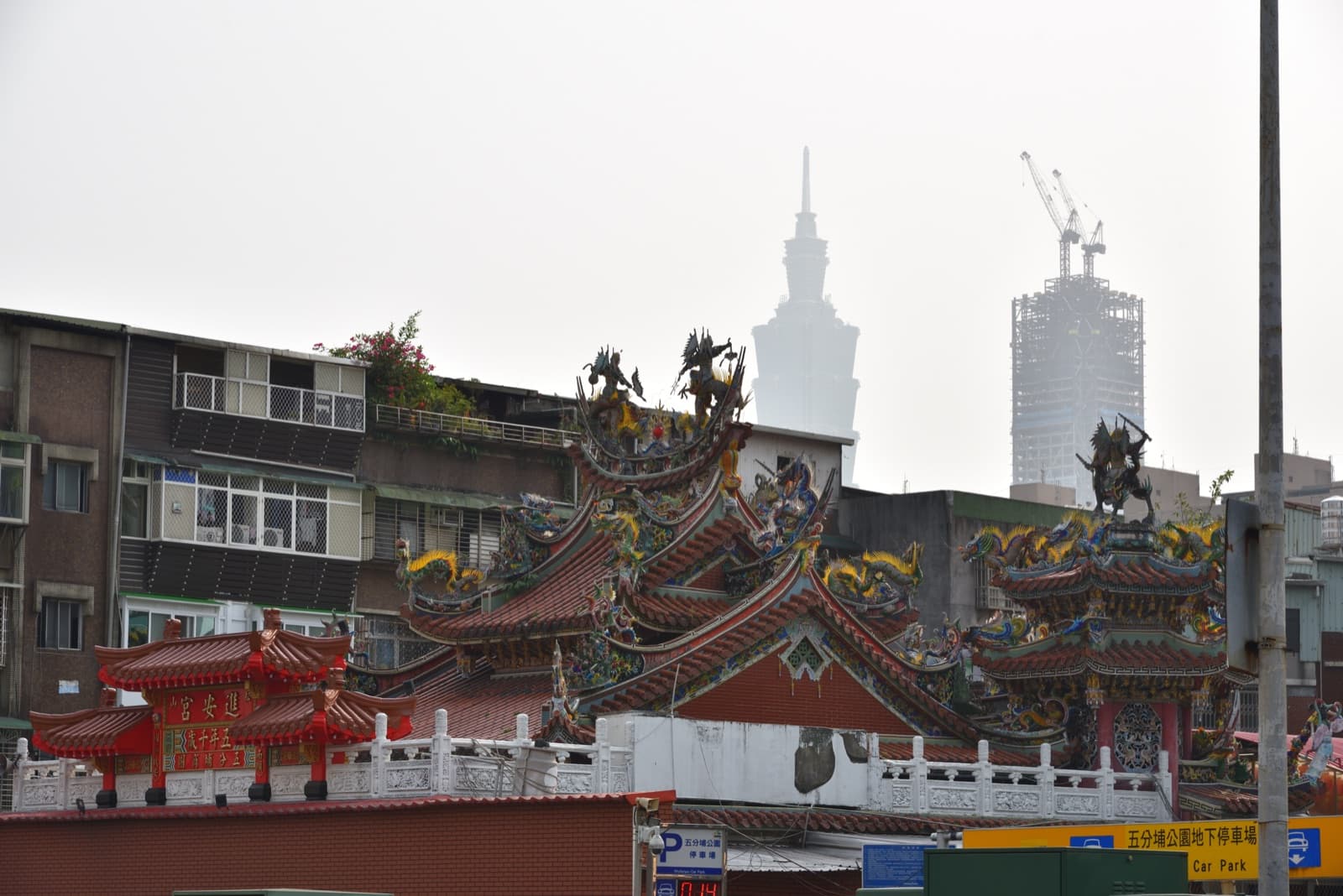
Taipei 101 going up, cranes still working the top, with the apartments and a temple of Wufenpu in front. Finished at the end of 2004, it was the tallest building in the world, and stayed so for six years.
Lokseng01 / CC BY-SA 4.0 via Wikimedia Commons
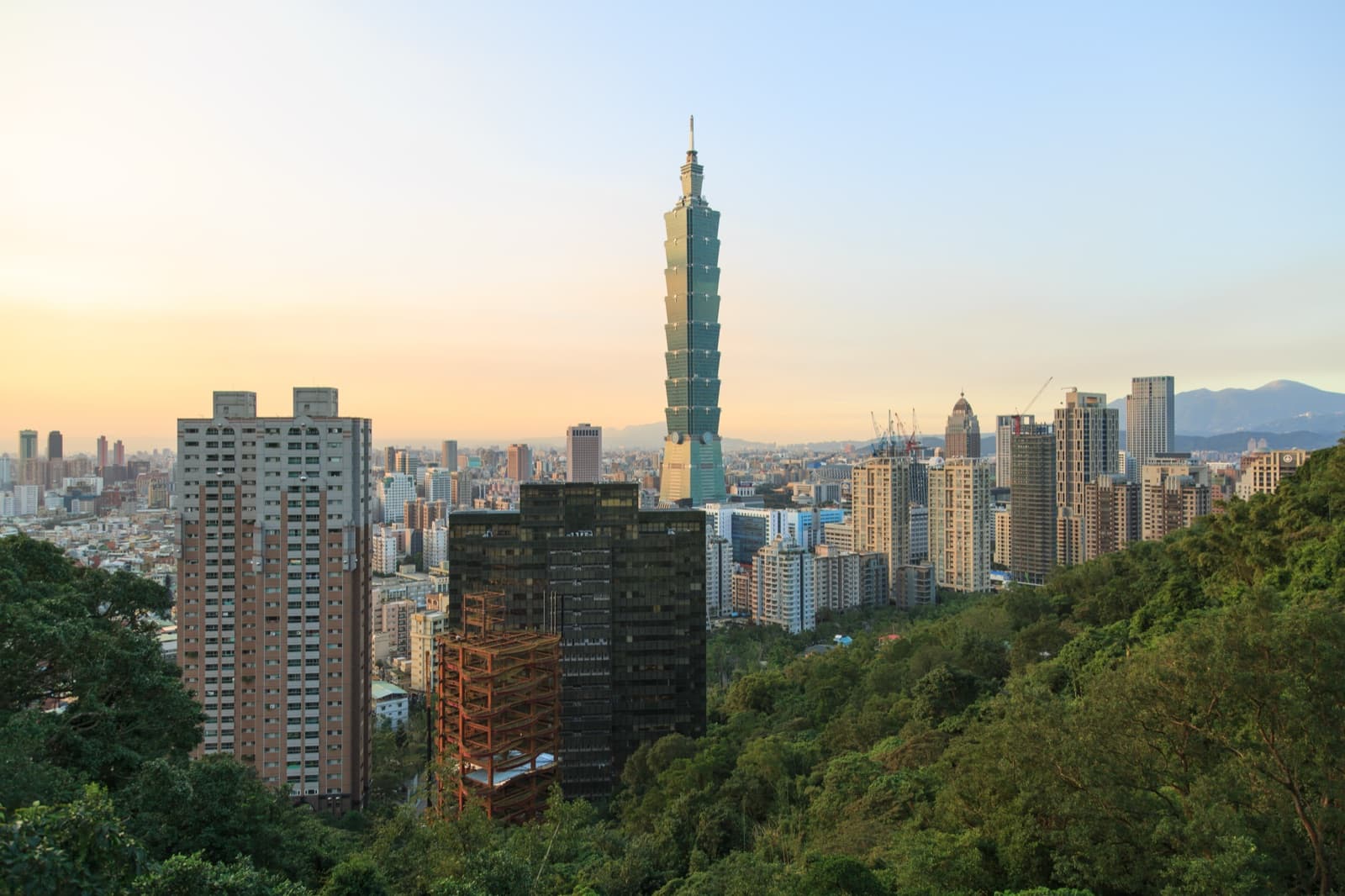
The tower itself: eight tapered sections stacked one on the next, drawn from bamboo joints and Chinese vessels. It was the first time Taiwan built its own image into a landmark the world would recognise.
CEphoto, Uwe Aranas / CC BY-SA 3.0 via Wikimedia Commons
Isle of Time