


On 18 January 1955 four to five thousand PLA troops landed on Yijiangshan, an island off the coast of Zhejiang, backed by more than two hundred vessels and over 180 aircraft. It was the first time their army, navy and air force had fought as one. The Nationalist garrison numbered about 1,030, and its commander, Colonel Wang Sheng-ming, was killed. The Nationalist account says 720 died. The PLA account says 519 died and 567 were captured. Yijiangshan was only twelve nautical miles from the Dachen Islands.
The Sino-American Mutual Defense Treaty signed in Washington on 2 December the previous year covered only Taiwan and Penghu. It did not cover Dachen. On 29 January the US Congress passed the Formosa Resolution, authorising the President to use force to protect Taiwan. The Nationalist government decided to give up Dachen and move all its soldiers and civilians to Taiwan, under the code name Operation King Kong. Besides the main Dachen islands, it covered nearby Yushan, Pishan and Nanji.
Planning began on 3 February. Islanders had to register first. Each person's baggage was limited to thirty kilograms, though some remember it as twenty, and mirrors and blades were forbidden. The harbour at Dachen was shallow and warships could not enter, so small fishing boats were lined up side by side with planks laid across their decks, making a temporary floating bridge that people crossed one by one to the larger ships.
On 8 February the Chinese and American fleets arrived off Dachen. The US Seventh Fleet committed 132 ships, fifty-seven of them warships, and more than four hundred carrier aircraft held the skies overhead. With the Nationalist vessels, close to two hundred ships of all sizes took part. At 11:20 on the morning of 13 February, the evacuation of the main Dachen islands was complete. On 23 February a second operation, code-named Flying Dragon, took the garrison and residents off Nanji Island. By 25 February the people of every island had been landed at Keelung, and Operation King Kong as a whole ended on 26 February.
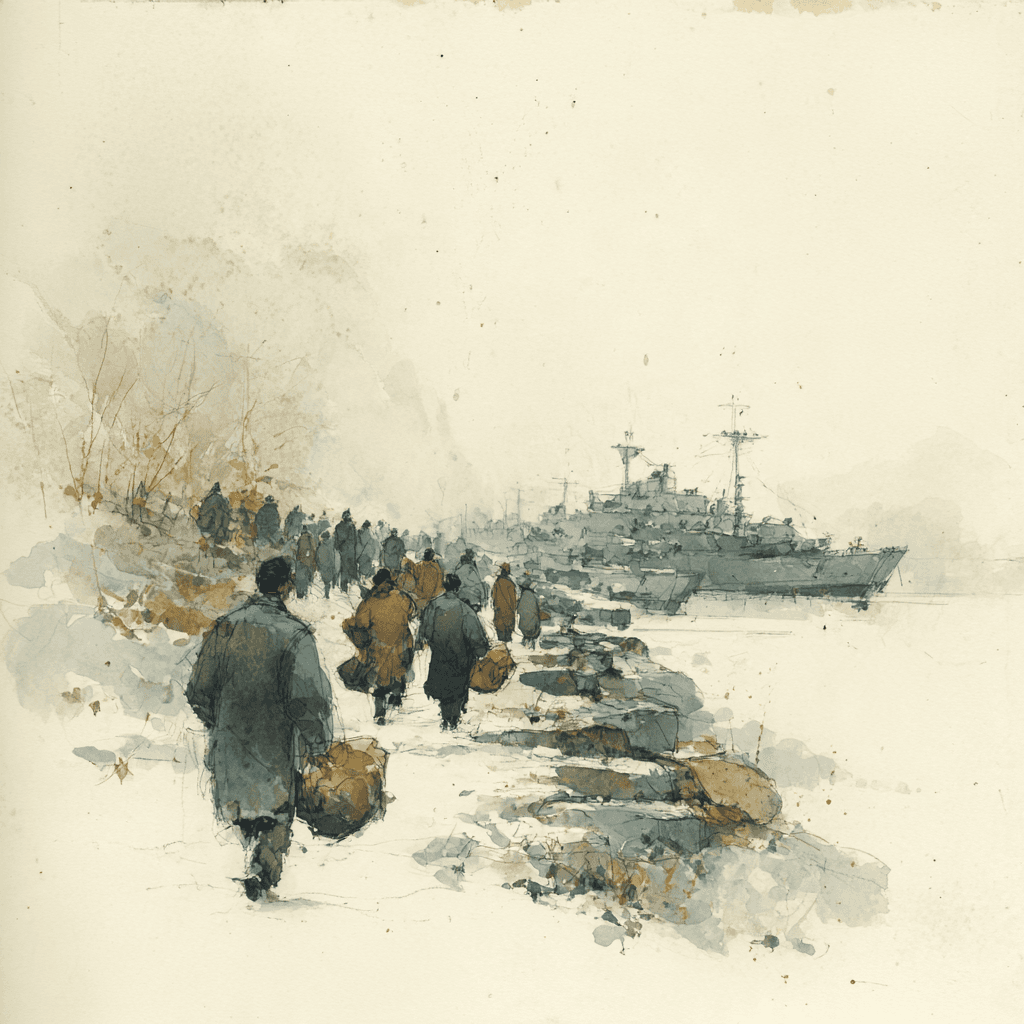
The original inhabitants of the Dachen Islands all left.
The residents who registered to leave numbered 17,132. Figures for the garrison troops range across different records from 16,053 to 25,000. The evacuation fell in the first lunar month, and the islanders spent that New Year season at sea.
After landing at Keelung they stayed a few days in temporary reception centres and were then sent out according to their occupations. Fishermen went to places by the sea, farmers to places with fields. Thirty-five Dachen New Villages were built across Taiwan, in Taipei, Taoyuan, Yilan, Hualien, Taitung, Tainan, Kaohsiung and Pingtung.
The government called them the Dachen righteous compatriots, meaning they had given up home and property without hesitation to follow the army to Taiwan. Those who came to welcome them included Huang Chao-chin, speaker of the provincial assembly, and Madame Chiang, Soong Mei-ling. On the islands, the evacuation had been carried out family by family by people such as Shen Chih-yueh, head of political affairs for the Dachen defence command, and Huang Baiqi, who chaired the Zhejiang branch of the women's league. On the islands she was known as Eighth Sister Huang of the Two Pistols.
The original inhabitants of the Dachen Islands all left. What each of them could carry onto the ships weighed no more than thirty kilograms.
The Ministry of Defence judged that after Yijiangshan, Dachen could not be held. It lay twelve nautical miles from Yijiangshan and more than three hundred kilometres from Taiwan, its supply line was long, and it fell outside the Mutual Defense Treaty. When Yijiangshan fell on 18 January, almost none of its 1,030 defenders came back. Holding on meant another Yijiangshan.
So the withdrawal was designed as an orderly operation. Planning began on 3 February. Residents registered first, baggage was limited, the harbour was bridged with fishing boats, and the American fleet provided cover. The main Dachen islands were cleared on 13 February, and Operation Flying Dragon took Nanji off on 23 February. The army's reports recorded times and numbers. The last ship left at 11:20 in the morning.
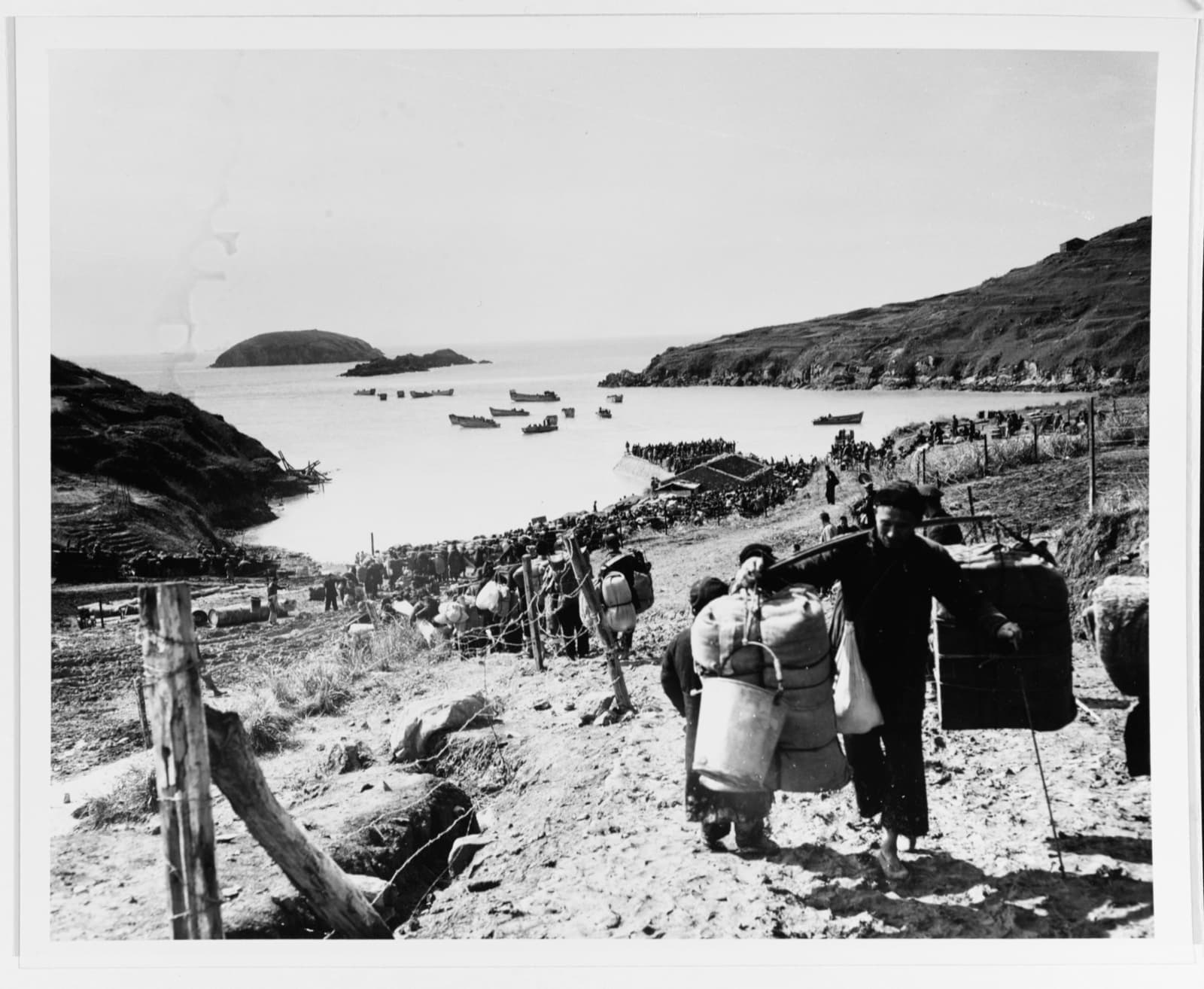
February 1955: people of the Dachen Islands carry their belongings down the hillside to queue on the beach for the boats. The fleet sent to take them waits offshore.
US Navy photo 80-G-654920; Naval History and Heritage Command
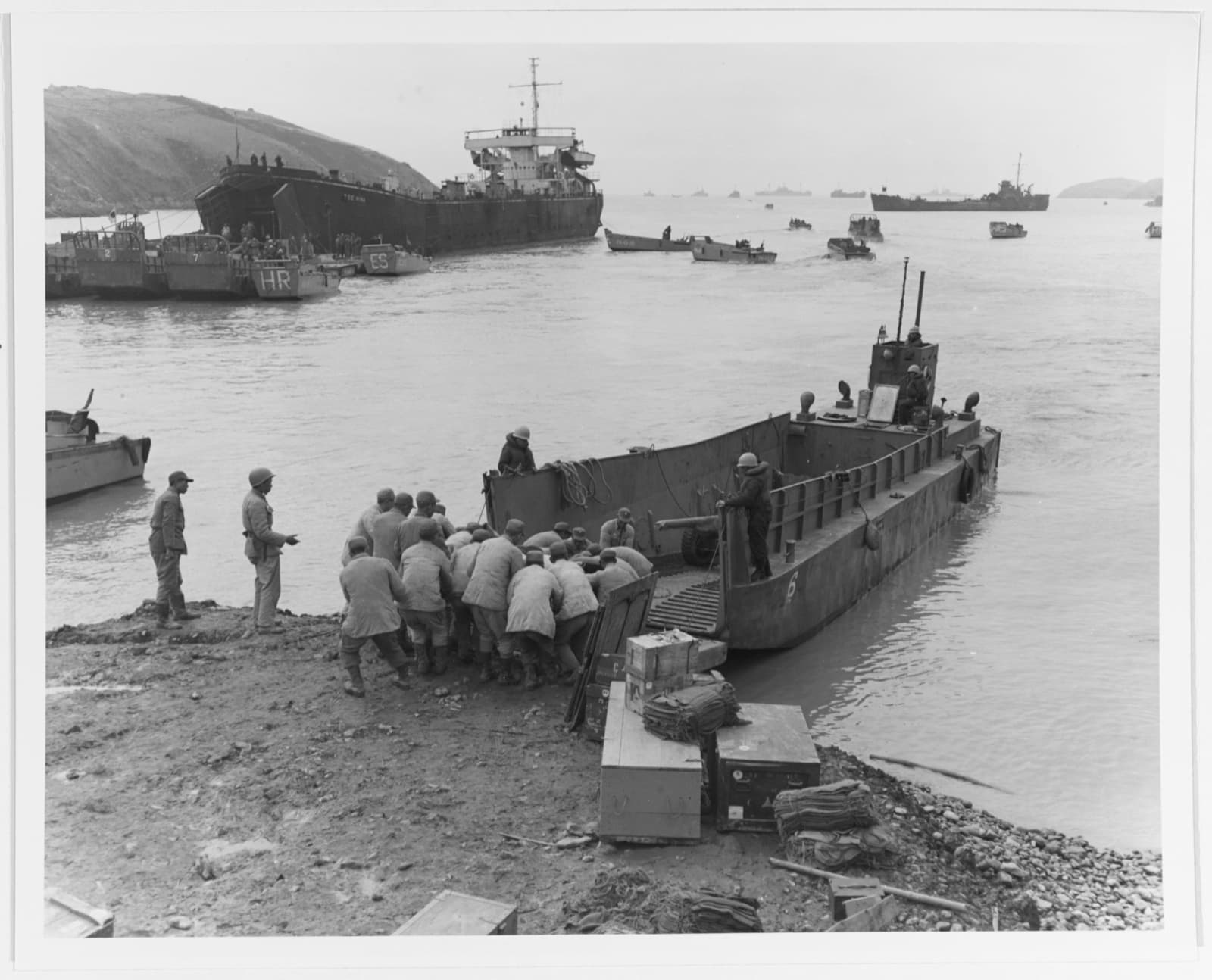
6 February 1955: Nationalist soldiers load artillery aboard a landing craft while ships wait at anchor offshore. The harbour at Dachen was too shallow for the large ships to enter.
US Navy photo 80-G-657548; Naval History and Heritage Command