


Sunflowers in the Chamber
On the night of March 18, 2014, a group of students and citizens climbed over the walls, broke through the police lines, and stormed into the legislative chamber on Jinan Road in Taipei, launching an occupation that would last twenty-four days. This movement, later known as the Sunflower Student Movement, was one of the largest and most far-reaching civic movements in Taiwan since the lifting of martial law, and the first time the younger generation intervened so directly and resolutely in the decision of a major national policy.
The fuse of the event was the Cross-Strait Service Trade Agreement then being pushed by those in power. Many feared that this agreement, which involved opening up a wide range of service industries, would, without adequate deliberation or transparency, profoundly impact Taiwan's economic autonomy, industrial ecology, job market, and even democratic procedures. When the agreement was declared 'review complete' in a legislative committee in a mere few dozen seconds, without article-by-article review, and prepared to be sent to the floor for record, long pent-up doubts and discontent erupted instantly; students and citizens resolved to express their protest by occupying the chamber in an unprecedented way, demanding the agreement be withdrawn and a monitoring mechanism for cross-strait agreements be established, defending through action the democratic procedures they cherished.
During the occupation, an unprecedented scene took shape inside and outside the chamber: within, students built barricades from the chamber's desks and chairs, taking shifts to keep watch through the night, organizing supplies, and speaking to the public, while live-streaming every move inside the chamber to the world over the internet, making this movement a highly transparent historical scene voiced by citizens themselves; outside, Jinan Road and Qingdao East Road were packed with supportive crowds, as volunteers in supplies, medicine, law, and media spontaneously built a dense support network, and street lectures, social movement groups, and arts workers all threw themselves in, transforming the protest site into an open civic classroom.
Countless strangers, in those days, sat shoulder to shoulder on the ground out of shared concern, listening to speeches,…
Countless strangers, in those days, sat shoulder to shoulder on the ground out of shared concern, listening to speeches, passing along lunchboxes, and looking after one another, guarding together a faith in the future through the chill spring nights. The movement, named for the sunflower — from the sunflowers supporters sent into the chamber — symbolized a yearning for sunlight, transparency, and hope. On March 30, hundreds of thousands clad in black surged onto Ketagalan Boulevard, voicing their demands through a peaceful and vast assembly that became an unforgettable page in the history of Taiwan's street movements and showed the world the mature, self-disciplined power of Taiwan's civil society.
Although there was a tense episode in which protesters rushed into the Executive Yuan and were forcibly cleared, the movement on the whole maintained a high spirit of nonviolence. After more than twenty days of standoff and negotiation, once the speaker of the legislature promised to establish a monitoring mechanism for cross-strait agreements and the service trade pact was effectively shelved, the occupiers announced their withdrawal on April 10, carefully cleaning the chamber before they left, leaving behind the image of those who 'occupied, and also protected.' The Sunflower Movement profoundly changed Taiwan's political landscape.
It made 'civic oversight,' 'procedural justice,' and 'information transparency' a broad social consensus, gave rise to a new generation attentive to public affairs, and prompted many young people to enter politics, social movements, media, and public participation, injecting new vitality into Taiwan's democracy. This youth-centered movement proved to the whole society that democracy is not merely voting once every few years, but the collective practice of every citizen who refuses to be silent at the critical moment and is willing to take to the streets in person and guard it with their own hands.
The wall of the legislature was climbed over that spring night, and the civic consciousness and passion for participation it opened up continue to grow and blossom on this island to this day.
The trigger lasted thirty seconds. On 17 March 2014 the convener of the interior committee, Chang Ching-chung, announced amid the disorder that review of the services trade agreement was complete and that it would be sent to the floor for the record. The whole thing took about half a minute and his microphone was not on. The following evening a group of students and citizens climbed the fence into the Legislative Yuan chamber and barricaded the doors with chairs. They expected to be carried out within hours. The occupation lasted twenty-four days. An order took shape inside: marshals, medics, translators, live streaming, supplies, decisions taken in internal meetings, and a running argument about who had the standing to speak for the floor. The demands narrowed from withdrawing the agreement to four points, at the centre of which was legislation on oversight of cross-strait agreements before any review of this one — moving the dispute from the content of the agreement to the procedure. On 6 April the speaker, Wang Jin-pyng, came to the chamber and undertook that the agreement would not be reviewed before the oversight law passed. They left on 10 April. The agreement has never returned to review.
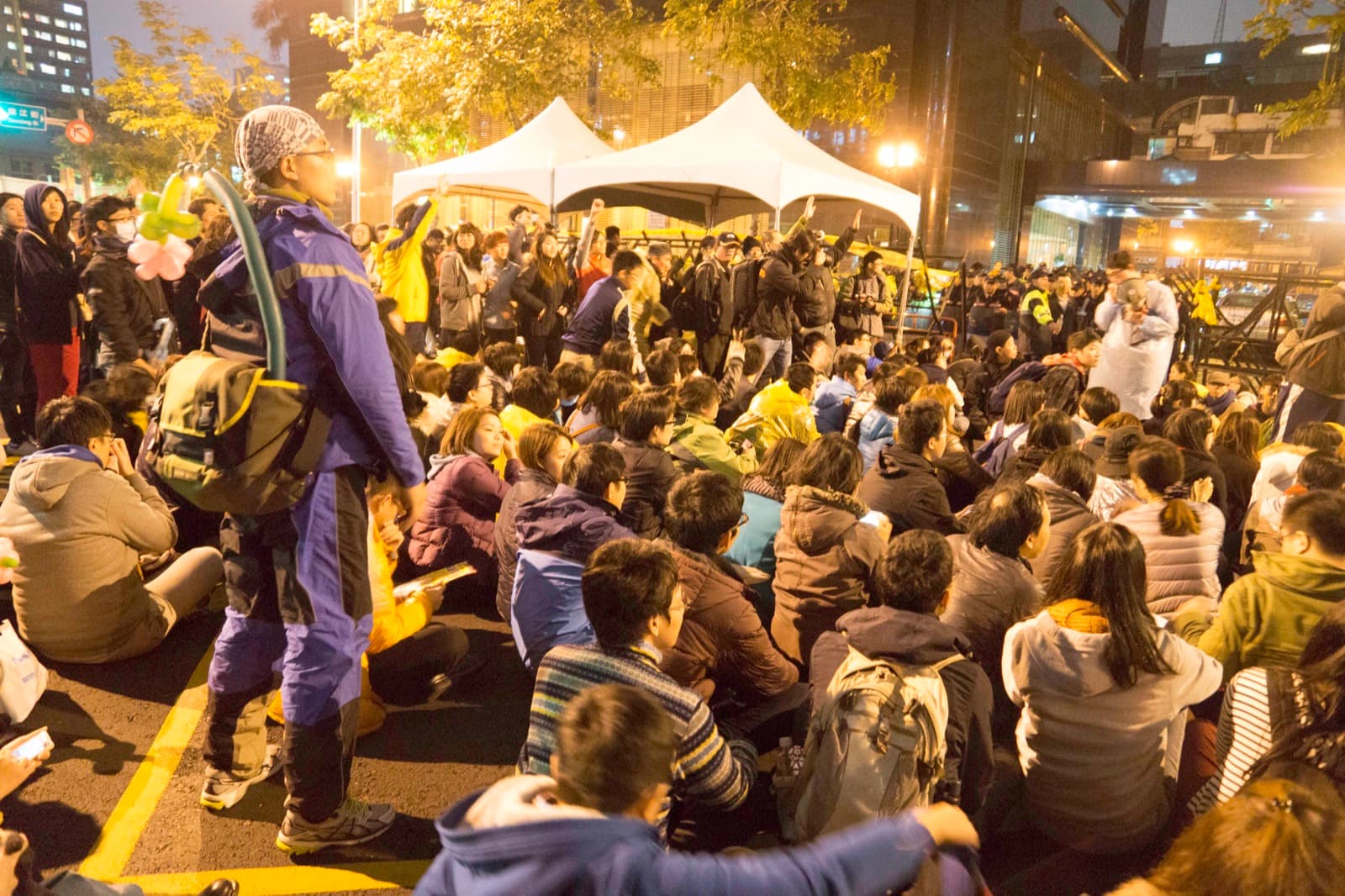
The sit-in outside the Legislative Yuan, March 2014. Students held the chamber for twenty-four days after the cross-strait services trade agreement was pushed through committee in thirty seconds. Outside, people kept watch in shifts.
WhoDYo / CC BY 2.0 via Wikimedia Commons
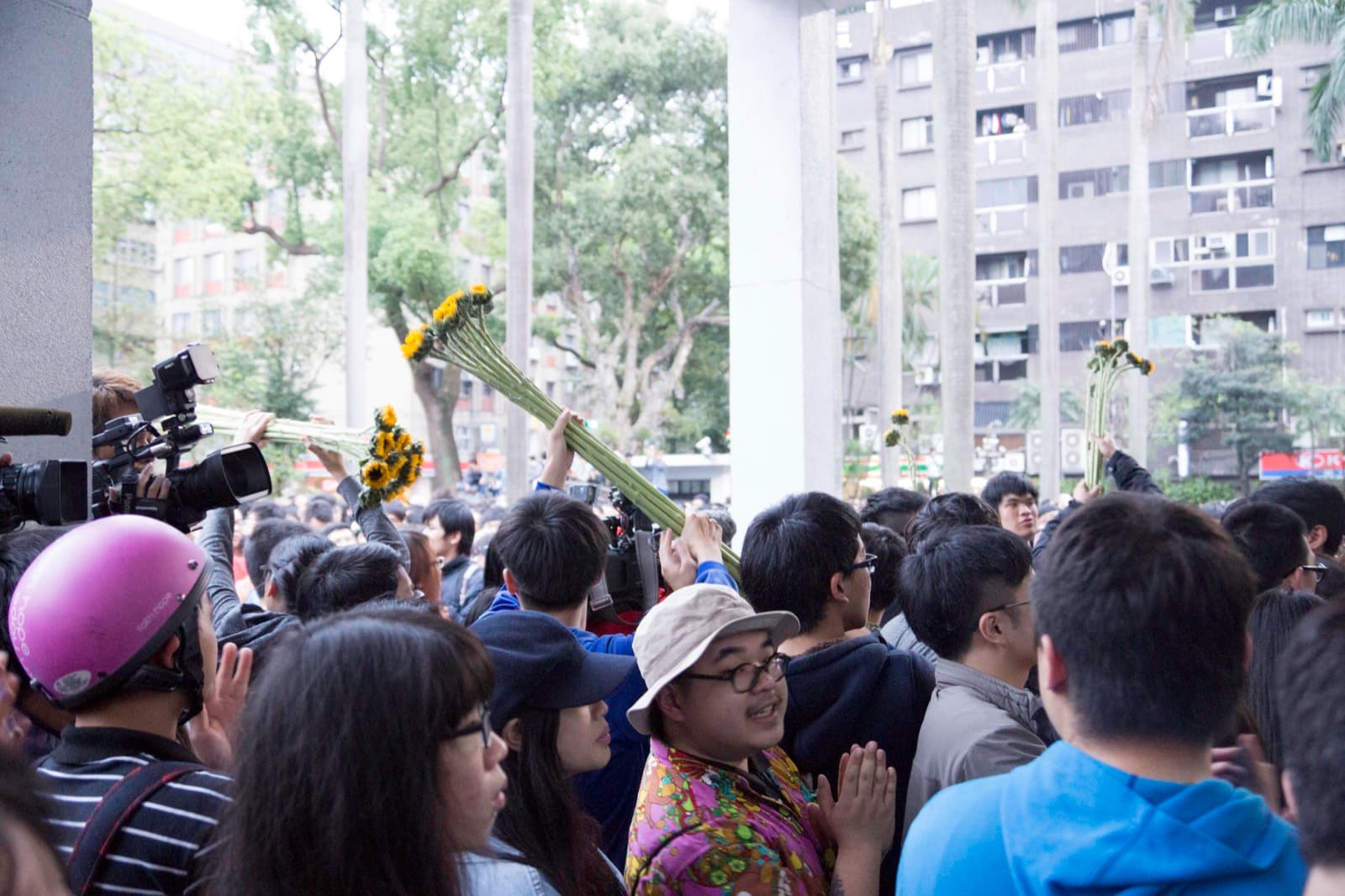
Sunflowers held up in the crowd. A florist had sent 1,300 of them into the occupied chamber as a gesture of support; the name of the whole movement came from that delivery.
WhoDYo / CC BY 2.0 via Wikimedia Commons
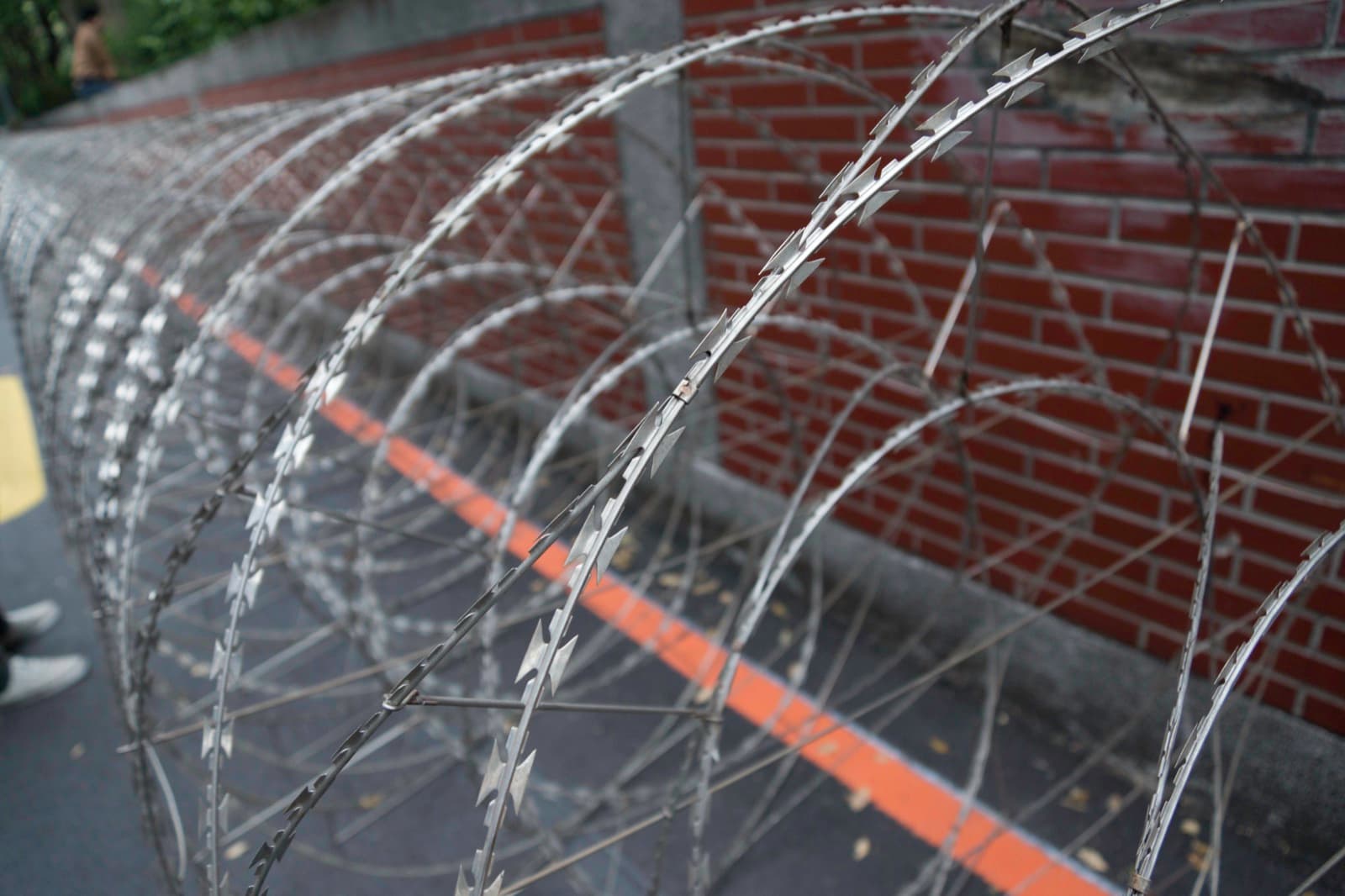
Razor wire on the wall outside the Legislative Yuan. On the night of 23 March the crowd got into the Executive Yuan and was cleared before dawn with water cannon and batons — those days seen from the state's side.
WhoDYo / CC BY 2.0 via Wikimedia Commons
Isle of Time