


The Hamada Yahee Incident
In the early seventeenth century, Taiwan was not yet the Chinese island that would later be ruled by Koxinga. Along its southern coast flew the flag of the Dutch East India Company. In 1624, the Dutch constructed Fort Zeelandia on the sandy peninsula of Anping, bringing Taiwan into their rapidly expanding trade network across East Asia.
From that moment onward, the island became a crucial crossroads linking China, Japan, Southeast Asia, and Europe. Merchant ships crowded its harbors. Silver, silk, deer hides, and sugar flowed through its ports in staggering quantities. To outside observers, Taiwan appeared to be a flourishing colonial outpost.
Yet beneath this prosperity, a conflict was quietly taking shape—one that would shake the balance of power across East Asia.
At the same time, Japan was entering the early years of the Edo period. Following the unification of the country under Tokugawa Ieyasu, the economy began to recover rapidly, and overseas trade became increasingly important. Many merchants received official "red-seal permits" from the shogunate, allowing them to conduct foreign commerce legally throughout Asia.
Among them was a wealthy merchant from Nagasaki named Hamada Yahee.
Hamada was no ordinary trader. For years, he had sailed the waters of East Asia with his own fleet and armed crew. He was part merchant, part maritime warlord. Traveling regularly between Japan, Taiwan, and Southeast Asia, he amassed a fortune through the silk trade. In Nagasaki, he was known for his audacity and determination. People often said that although he possessed the instincts of a merchant, he carried the temper of a samurai.
Unfortunately for the Dutch, they chose exactly the wrong man to provoke.
In 1627, seeking to increase revenue, Dutch authorities in Taiwan began tightening their control over Japanese merchants. Taxes were raised. Ships were detained. Cargoes were confiscated. To merchants accustomed to relatively free trade, these measures felt less like regulation and more like outright extortion.
Hamada repeatedly protested to the Dutch governor, but his complaints were ignored. Relations between the two sides deteriorated rapidly.
Then, one night in 1628, Hamada made a decision so reckless that it still sounds unbelievable today.
He decided to kidnap the Dutch governor.
Even by modern standards, the plan bordered on insanity. The Dutch East India Company was one of the most powerful commercial empires on earth, with influence stretching across Asia and Africa. Fort Zeelandia was the strongest military fortress in Taiwan. Yet Hamada believed that continuing to endure humiliation was worse than striking back.
Gathering dozens of armed followers, he approached the Dutch under the pretense of negotiation. As the meeting began, Japanese swordsmen suddenly drew their blades.
Chaos erupted.
Dutch soldiers were caught completely off guard. Steel flashed through the air. Amid the confusion, Hamada successfully seized Governor Pieter Nuyts and forced him aboard his ship.
When news of the incident spread, shock rippled through the colonial administration.
A group of Japanese merchants had penetrated the very heart of Dutch authority in Taiwan and abducted one of its highest-ranking officials. This was not merely a security breach—it was a direct humiliation of Dutch colonial power.
Alarm bells rang throughout Fort Zeelandia. Soldiers were mobilized. Company officials were furious. Retribution seemed …
Alarm bells rang throughout Fort Zeelandia. Soldiers were mobilized. Company officials were furious. Retribution seemed inevitable.
But events soon took an unexpected turn.
Rather than killing his captive, Hamada sailed directly back to Japan with Pieter Nuyts as a hostage.
Upon arriving in Nagasaki, he immediately presented his case before the Tokugawa shogunate, accusing the Dutch of abusing and exploiting Japanese merchants in Taiwan. Dutch officials assumed the shogunate would arrest Hamada as a criminal and swiftly release the hostage.
Instead, the opposite happened.
The Tokugawa government had already grown wary of the expanding influence of the Dutch in East Asian waters. When Hamada arrived with a living witness and extensive testimony, shogunate officials reacted with outrage. They concluded that Dutch authorities had indeed mistreated Japanese traders and refused to release Nuyts immediately.
Suddenly, the balance of power shifted.
The mighty Dutch East India Company found itself forced into the uncomfortable position of negotiating from weakness. Envoys were dispatched to Japan. Years of diplomatic discussions followed. Dutch representatives struggled to explain their actions and repair relations with the shogunate.
Meanwhile, Pieter Nuyts remained under effective house arrest, becoming perhaps the most unfortunate pawn in a geopolitical struggle stretching across the seas of East Asia.
Eventually, under sustained pressure from the shogunate, the Dutch East India Company agreed to significant concessions. Nuyts was finally released, but his political career never recovered. Once one of the most powerful men in colonial Taiwan, he returned home disgraced and was severely punished by his own company.
Hamada Yahee, meanwhile, entered Japanese legend.
At a time when European powers were beginning to dominate Asia with cannon fire and global trade networks, most local rulers and merchants had little choice but to accommodate Dutch demands. Yet Hamada accomplished something almost unimaginable. With a handful of ships and armed retainers, he marched into the center of a colonial government and carried off its highest official.
The incident dealt a serious blow to Dutch prestige in East Asia and reminded the Tokugawa shogunate of its own influence in regional trade.
More importantly, it revealed a pattern that would repeat itself again and again throughout history.
Taiwan may have appeared to be only a small island in the seas of East Asia. Yet whenever the interests of great powers converged upon its shores, it became one of the first places where storms began to form.
And just over three decades after the Hamada Yahee Incident, another maritime leader would arrive from the coast of China with tens of thousands of soldiers, forever changing Taiwan's destiny.
His name was Koxinga.
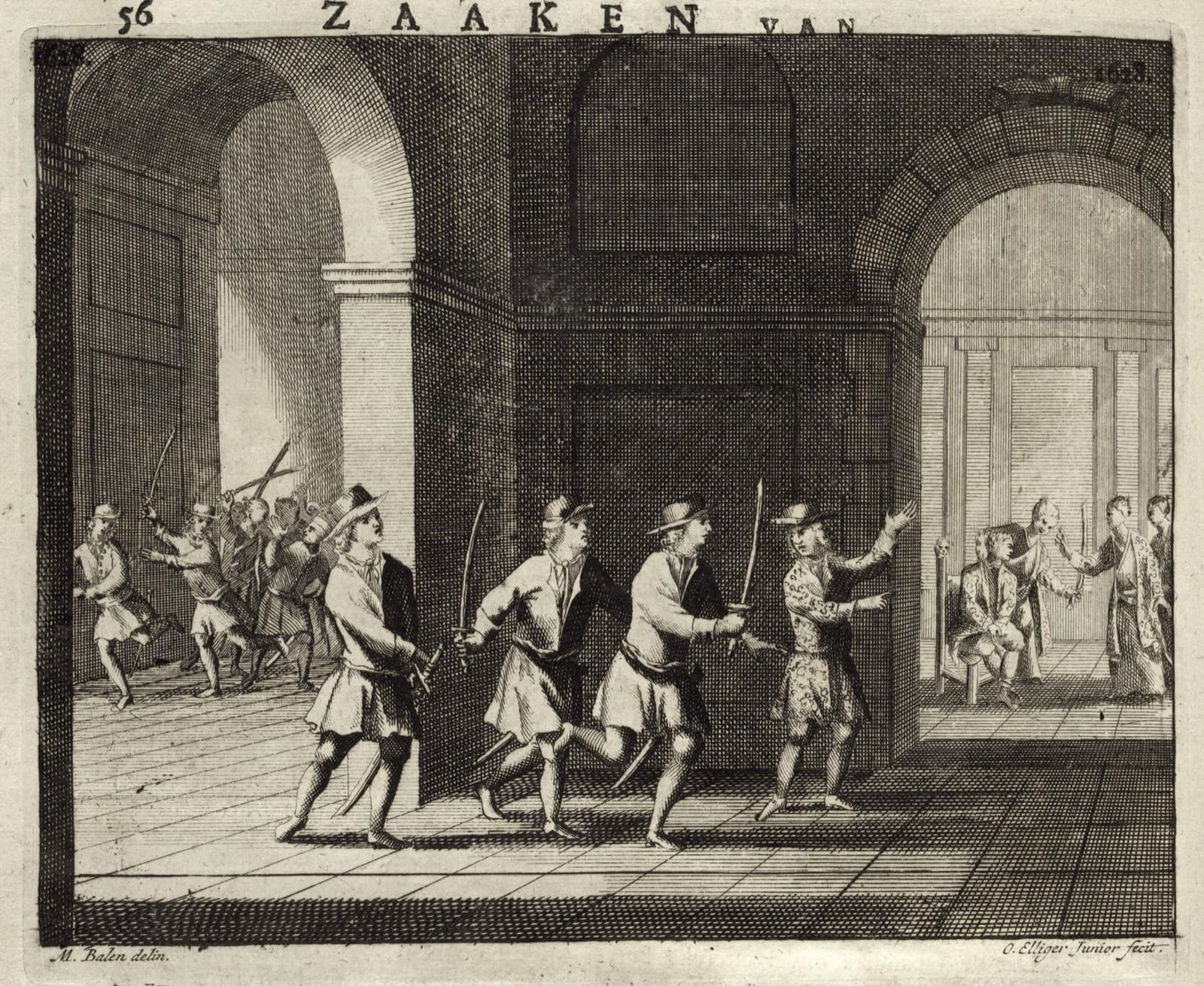
In 1628 Hamada Yahyoe and his men forced their way into Fort Zeelandia and seized the Dutch governor, Pieter Nuyts. Trade with Japan stopped for four years, and Nuyts was handed over by his own side to be imprisoned there.
Valentijn, *Oud en Nieuw Oost-Indiën*, 1726; Koninklijke Bibliotheek
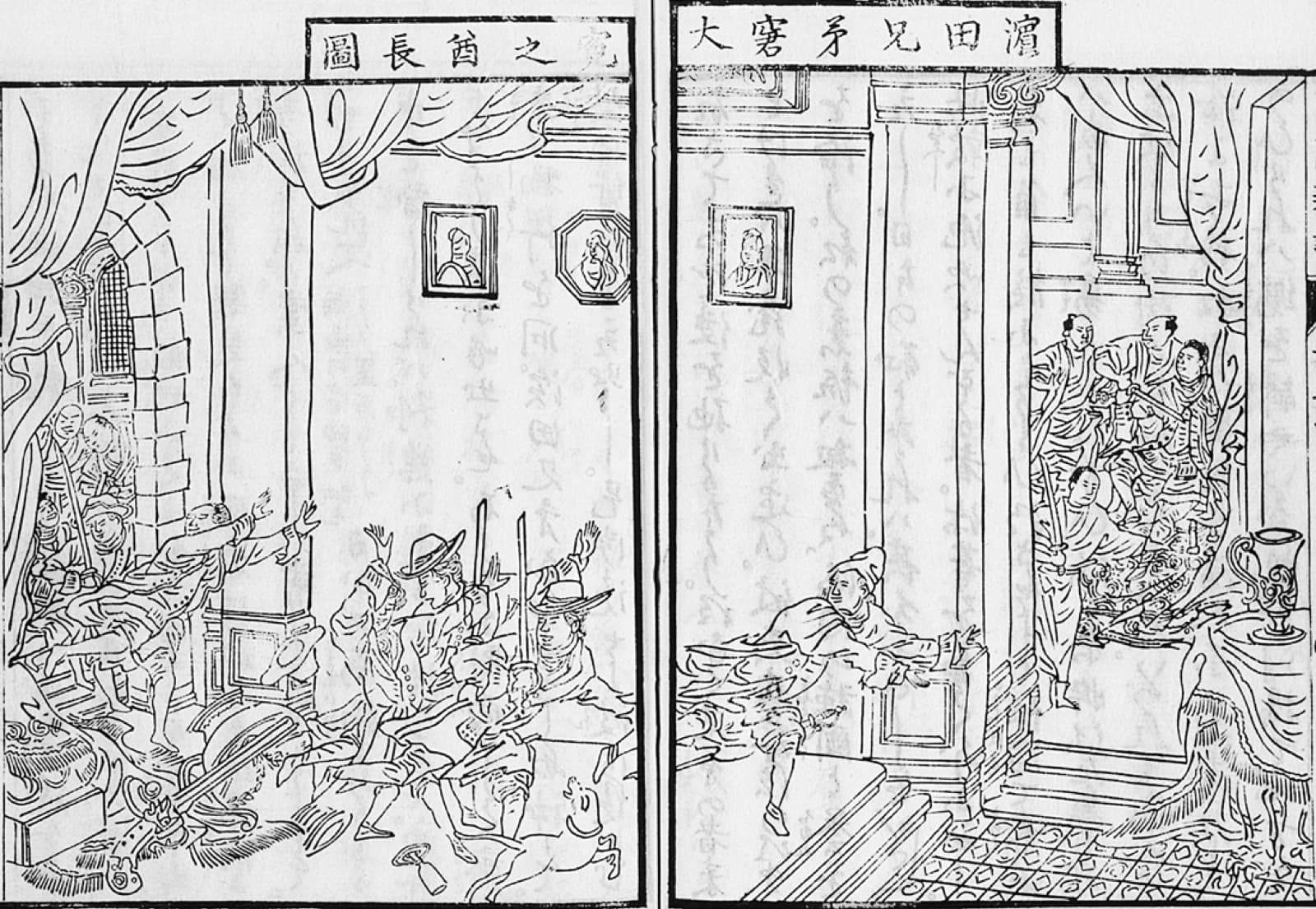
The same event as Japan told it: in Morishima Churyo's woodcut, Hamada Yahyoe has Nuyts pinned to the floor. The Dutch recorded a raid by thugs, the Japanese a righteous man taking back what was owed.
Drawn by Morishima Churyo; National Diet Library, Japan
Isle of Time