Archives

Sea and Fortress

Dutch and Spanish Colonial Taiwan: Maritime Trade, Missionaries, and Indigenous Encounters (1624–1662)

18 volumes

Vol. 1

An Account of the Eastern Barbarians

Before the Dutch arrived, the southwest coast of Taiwan was far from quiet. Every winter fishing boats from Zhangzhou and Quanzhou followed the mullet across, merchants came ashore to trade with the villages for deerskins, and pirates and wokou raiders used the coast to hide from government troops. In 1574 the pirate Lin Feng attacked Manila with sixty or seventy warships, three thousand men and four hundred Japanese soldiers. When he failed, he fell back to Wanggang. In September the following year he raided the fishing boats around Chihkan for the third time, for close to a month, before returning to Guangdong. In December the Ming commander Hu Shouren crushed him in the waters off Tamsui.

2 images

Vol. 2

Two Years in Penghu

On 11 July 1622 the fleet of Cornelis Reijersen, commander for the Dutch East India Company, sailed into Penghu. What the Company had wanted was Macau. Macau held, so they settled for a base from which the Ming could be pressed into opening trade. That Penghu lay inside the Ming domain was something they knew.

1 image

Vol. 3

The Dutch Arrival

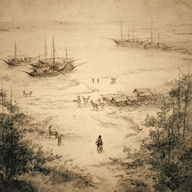
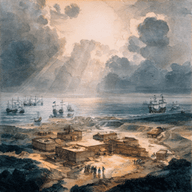
In the late summer of 1624, several colossal armed merchantmen flying the red, white, and blue tricolor of the Dutch East India Company glided gracefully into the shallow, windswept waters of Tayouan, off the southwestern coast of Taiwan. For two grueling years, these fair-haired, flintlock-bearing Western adventurers had been locked in a tense military standoff with the forces of the Ming Dynasty—the precursor to the Qing—from a fortress they had erected on the Penghu Islands. Ultimately, under the crushing tactical pressure and diplomatic orchestration of the massive Ming armies, a tacit trade-off was struck: the Dutch would demolish their citadel on Penghu and retreat to this uncharted, wild island marked on European charts as "Formosa." When the Dutch Governor, Martinus Sonck, first stepped onto this humid, sun-drenched sandbar, his sharp merchant instincts instantly recognized its monumental value. This island was not merely home to tens of thousands of roaming deer; it choked the very throats of the vital sea lanes connecting China, Japan, and the Philippines. The wild winds of the Age of Sail had just struck this beautiful, millennium-slumbering island with unrelenting force.


2 images

Vol. 4

Fort Zeelandia

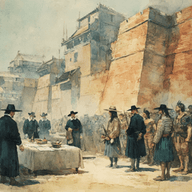
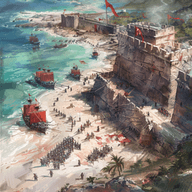
Following the landing of the Dutch on the Tayouan sandbar in the late summer of 1624, they were confronted with nothing but endless dunes and a pristine lagoon, entirely devoid of readymade fortifications. To establish a permanent foothold in this newly carved overseas outpost and to protect their rapidly expanding commercial wealth, the Dutch East India Company immediately embarked on a monumental construction project that would span several decades. Selecting the highest vantage point on the sandbar, they utilized bricks imported from Batavia and red sandstone quarried from Chikan, bonding them together with a heavy compound of tropical glutinous rice juice, sugar water, and crushed oyster-shell lime to erect an impregnable European-style fortress: Fort Zeelandia. Designed entirely in accordance with the most advanced Baroque military architecture of seventeenth-century Europe, the citadel featured projecting star-shaped bastions to eliminate blind spots for defensive artillery fire. It was not merely a military shield against foreign invasion, but the supreme center of executive power for Dutch colonial administration and global commerce on Formosa.

3 images

Vol. 5

Spanish Northern Taiwan

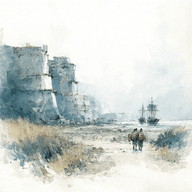
In the pale dawn of 1626, as the Pacific monsoons swept across the northeastern cape of Formosa, several towering Spanish galleons flying the red-and-yellow imperial banners glided into the magnificent natural harbor known today as Keelung. Under the direct decrees of the Governor-General in Manila, these Catholic adventurers crossed the treacherous Luzon Strait to launch a forceful military landing on the island of Jilong (modern-day Heping Island). In the eyes of the Spaniards, this was far more than a routine voyage of discovery; it was a desperate, high-stakes geopolitical gambit engineered by Manila to counter the rapidly expanding global trade monopoly of the Dutch East India Company in southern Taiwan. The Spanish pioneers immediately constructed a massive redoubt of stone and heavy timber—Fort San Salvador—before extending their governing tentacles westward to Tamsui to erect Fort San Domingo. The cold steel and religious fervor of the Age of Sail had violently shattered the millennium-long slumber of northern Taiwan.

3 images

Vol. 6

The Hamada Yahee Incident

In the early seventeenth century, Taiwan was not yet the Chinese island that would later be ruled by Koxinga. Along its southern coast flew the flag of the Dutch East India Company. In 1624, the Dutch constructed Fort Zeelandia on the sandy peninsula of Anping, bringing Taiwan into their rapidly expanding trade network across East Asia.

2 images

Vol. 7

Indigenous Encounters

Before the colossus of the Age of Sail crashed through Formosa's pristine coastlines, this emerald island had already thrived for millennia as a sprawling, vibrant, and entirely self-contained ancient cosmos. From the majestic heights of the Central Mountain Range to the expansive western plains and the jagged, sun-drenched reefs of the Pacific coast, countless Austronesian tribes called this island home. These original masters of the land, categorized by later historians as the Plain Tribes and Mountain Tribes, were by no means the isolated, primitive savages depicted in the early logs of Western colonizers. Instead, they had engineered highly complex, sophisticated social structures and spiritual worldviews perfectly calibrated to harmonious coexistence with the natural world. In their cosmic understanding, every mountain, river, and ancient forest was shielded by omnipresent animistic deities and ancestral spirits (Utux or Anito). Moving to the rhythmic cadences of seasonal monsoons and oceanic tides, they wove an extraordinary, unwritten tapestry of human civilization through song, tattoo, and sacred ritual.

2 images

Vol. 8

The Madou She War

In the early seventeenth century, the southwestern plains of Taiwan were not a unified land ruled by any single state.

Vol. 9

The Cave on Lamey

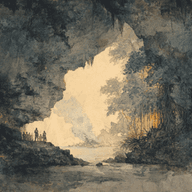
In October 1622 a Dutch East India Company ship, the Gouden Leeuw, put in at a coral island off the south-west coast of Taiwan for water. The men who went ashore did not come back. On Dutch charts the place became Golden Lion Island. The people living there called it Lamey.

1 image

Vol. 10

The Gold of Pimaba

Early in 1638 a company of the Dutch East India Company under Captain Johan van Linga rounded the Hengchun Peninsula, marched north along the coast from Taimali, and came out onto the Taitung plain. What the Company wanted was gold. The information had come from villages along the way, passed on piece by piece: somewhere over the mountains to the east there was a river, and there was gold in the river.

3 images

Vol. 11

The Staff With the Silver Head

On 20 February 1636 the Dutch called the first assembly of villages at Sinkan. Each headman who attended received three things: the tricolour of the Netherlands, a black velvet gown, and a rattan staff with a silver head. The staff was not ornament but warrant. From that day the man holding it was the village head the Company recognised, and the man the Company would come looking for when something went wrong.

1 image

Vol. 12

The Sinckan Script

In the early seventeenth century, the plains of Taiwan had no written language.

2 images

Vol. 13

The Banishment of the Inibs

Siraya religion was in the hands of women. The inibs conducted the rites, treated the sick and read what was auspicious, and they also enforced a strict order around childbearing: a woman under thirty-five who conceived had to abort, husbands and wives lived apart after marriage, and only when the man was around forty did they share a house. These were not personal choices. They were a system, and the inibs administered it.

1 image

Vol. 14

The Deer That Built an Empire

If a modern person could travel back to seventeenth-century Taiwan, the most astonishing sight would not be Fort Zeelandia, nor the Dutch merchants, nor even the Indigenous villages scattered across the plains.

Vol. 15

The Last Bastion of San Salvador

In 1626 the Spanish came north from Manila and raised the fortress of San Salvador on Sheliao Island off Keelung. What they wanted was a sea route that went around the Dutch, and a stepping stone for missions into Japan and China. Northern Taiwan now held two foreign powers, one in the south and one in the north, with the whole island between them.

1 image

Vol. 16

The Guo Huaiyi Rebellion

In the 1650s, Taiwan entered a period of unprecedented population growth.

Vol. 17

A Map That Changed a Dynasty

In history, some people build dynasties with their own hands.

Vol. 18

The Siege of Fort Zeelandia

On the pale morning of April 30, 1661, as the heavy mists over the Tayouan sea slowly dissolved in the dawn light, the Dutch garrison standing watch upon the battlements of Fort Zeelandia witnessed the most breathtaking and terrifying spectacle of their lives. Across the distant horizon, the turbulent waves of the Taiwan Strait churned beneath hundreds of massive Chinese warships. Their bows were carved into ferocious dragon heads, and their rigging fluttered with the crimson banners of the "Prince of Yanping." It was an elite vanguard of twenty-five thousand ironclad warriors, commanded by the legendary warlord Zheng Koxinga. Facing near-total defeat on the mainland by the advancing armies of the Qing Dynasty, Koxinga had turned his calculated gaze across the strait to this beautiful island, which had been governed by the Dutch East India Company for thirty-eight years. This was far more than a routine campaign for territory; it was a titanic, nine-month clash between two entirely different maritime civilizations, military structures, and geopolitical ambitions, known to history as the Siege of Fort Zeelandia.

3 images