


The 823 Artillery Battle
At 6:30 in the evening on August 23, 1958, the artillery emplacements along the Fujian coast opened fire simultaneously. Within two hours, more than fifty-seven thousand shells fell on the Kinmen archipelago — an area of less than 150 square kilometers — a density that led contemporary observers to describe it as the heaviest concentration of shellfire per unit of ground since the Second World War. The opening salvo struck Cuigu, the valley housing the Kinmen Defense Command, killing three deputy commanders — Chi Hsing-wen, Chao Chia-hsiang, and Chang Chieh — where they stood, and wounding Defense Minister Yu Ta-wei, who happened to be inspecting the front. Over the forty-four days that followed, what became known as the 823 Artillery Battle, or the Second Taiwan Strait Crisis, poured close to 470,000 shells onto the island.
Beijing's objective was never Kinmen alone. Blockading Liaoluo Bay, severing the supply line, and forcing a Nationalist withdrawal from the offshore islands were tactical aims. The deeper purpose was to probe the boundaries of the 1954 Sino-American Mutual Defense Treaty, which explicitly covered Taiwan and the Penghu Islands but remained deliberately vague about the islands hugging the mainland coast. What Beijing wanted to learn was precisely how far Washington would go for a few outcrops of granite.
The answer proved harder than expected. The U.S. Seventh Fleet escorted resupply convoys to the three-mile limit, allowing Nationalist landing craft to run the final stretch and unload directly onto the beaches of Liaoluo Bay under fire. On September 18, eight-inch self-propelled howitzers arrived on Kinmen, giving the defenders counter-battery reach and weight for the first time. Sidewinder air-to-air missiles arrived in the same period, and in late September Nationalist fighters used them to inflict lopsided losses in the air battles over the strait. By October 6, Peng Dehuai issued his "Message to Compatriots in Taiwan," announcing a seven-day suspension of the bombardment. What followed settled into something close to ritual: shelling on odd-numbered days, silence on even ones, with most of the shells packed not with explosive but with propaganda leaflets. This strange metronome ran for two full decades, stopping only on January 1, 1979 — the day the United States established diplomatic relations with the People's Republic of China.
For Taiwan, however, the true price of the battle was written into the Dulles–Chiang joint communiqué of October 23 that…
For Taiwan, however, the true price of the battle was written into the Dulles–Chiang joint communiqué of October 23 that same year. Secretary of State John Foster Dulles flew to Taipei and secured a public declaration from the Republic of China government that the recovery of the mainland would be pursued "principally through the implementation of Dr. Sun Yat-sen's Three Principles of the People, and not by the use of force." With that sentence, the possibility of an armed return to the mainland was formally surrendered in an international document. The slogan of recovery continued to be shouted daily, but it had been quietly demoted from a military plan to a domestic political necessity.
For the people of Kinmen, the years after the shelling were a different kind of long. The entire island was militarized under the Wartime Administration system: curfews, blackout regulations, compulsory civil defense units, permits required to enter or leave. Tunnels were cut inch by inch into the granite, and air-raid shelters spread beneath every village. On Taiwan proper, meanwhile, the reality of shellfire at the front became the most powerful argument martial law ever had. When shells were genuinely falling, the "Period of Mobilization for the Suppression of Communist Rebellion" ceased to be a legal abstraction, and any questioning of the party-state could be recast as destabilizing the rear.
Today Kinmen's tunnels are tourist attractions, and its shell casings are forged into kitchen knives that visitors carry back to the main island as souvenirs. But the valley at Cuigu, where three generals died in the first minute, and the twenty-year rhythm of odd days and even days, still testify to something particular about this island: here the Cold War was not an abstraction of geopolitics but the daily texture of an entire generation's life.
When the shells came down, we had no rear to fall back to. People on the main island read about heroism at the front; we learned about this war from the sound of our own roofs coming off. Over forty-four days, more than a dozen shells fell for every person on these islands. For twenty years afterward, life ran on odd and even days — take cover on the odd, work the fields on the even. Children could recite which days they were allowed to walk to school. The Wartime Administration turned the whole island into a garrison. Curfew, blackout, permits to leave or return, every household enrolled in a civil defense unit. The men cut tunnels into the granite, and so did the women. We had no elections and no freedom of movement. What was called martial law on Taiwan proper was, on Kinmen, something a layer deeper than that. Later the shell casings were forged into kitchen knives and sold as souvenirs, and the tunnels became ticketed attractions. This is not a complaint; we live off it now. But whenever someone praises this island for having witnessed the price of freedom, we understand one thing very clearly: the people who paid the price were never the people who decided it would be paid. We did not live here in order to become a symbol. We simply lived here.
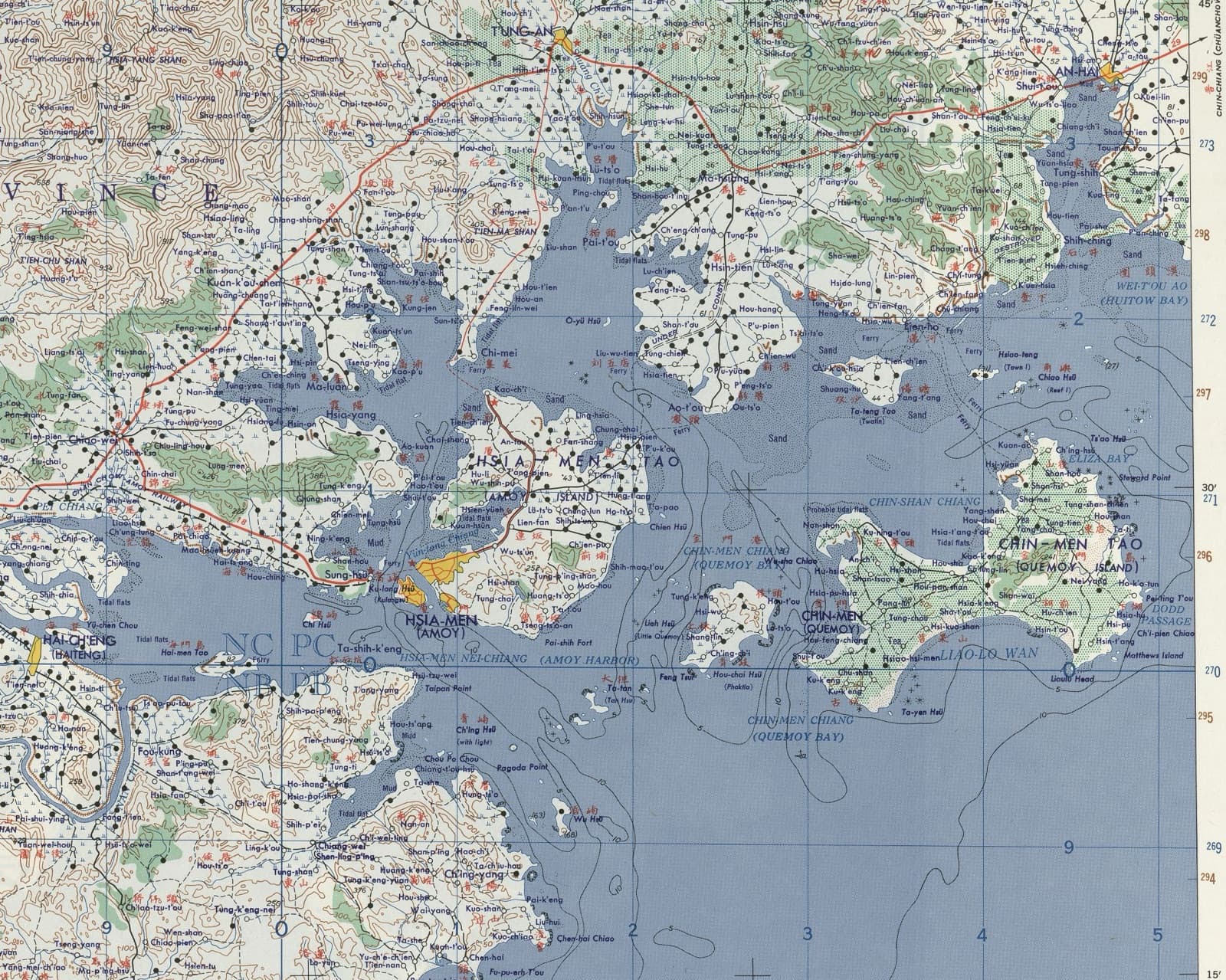
A U.S. Army Map Service sheet of Amoy and its surroundings, November 1958. Xiamen and Kinmen sit on the same sheet; Liao-lo Wan is marked in the lower right, the bay where the supply ships ran the guns for forty-four days.
U.S. Army Map Service; University of Texas Libraries, University of Texas at Austin
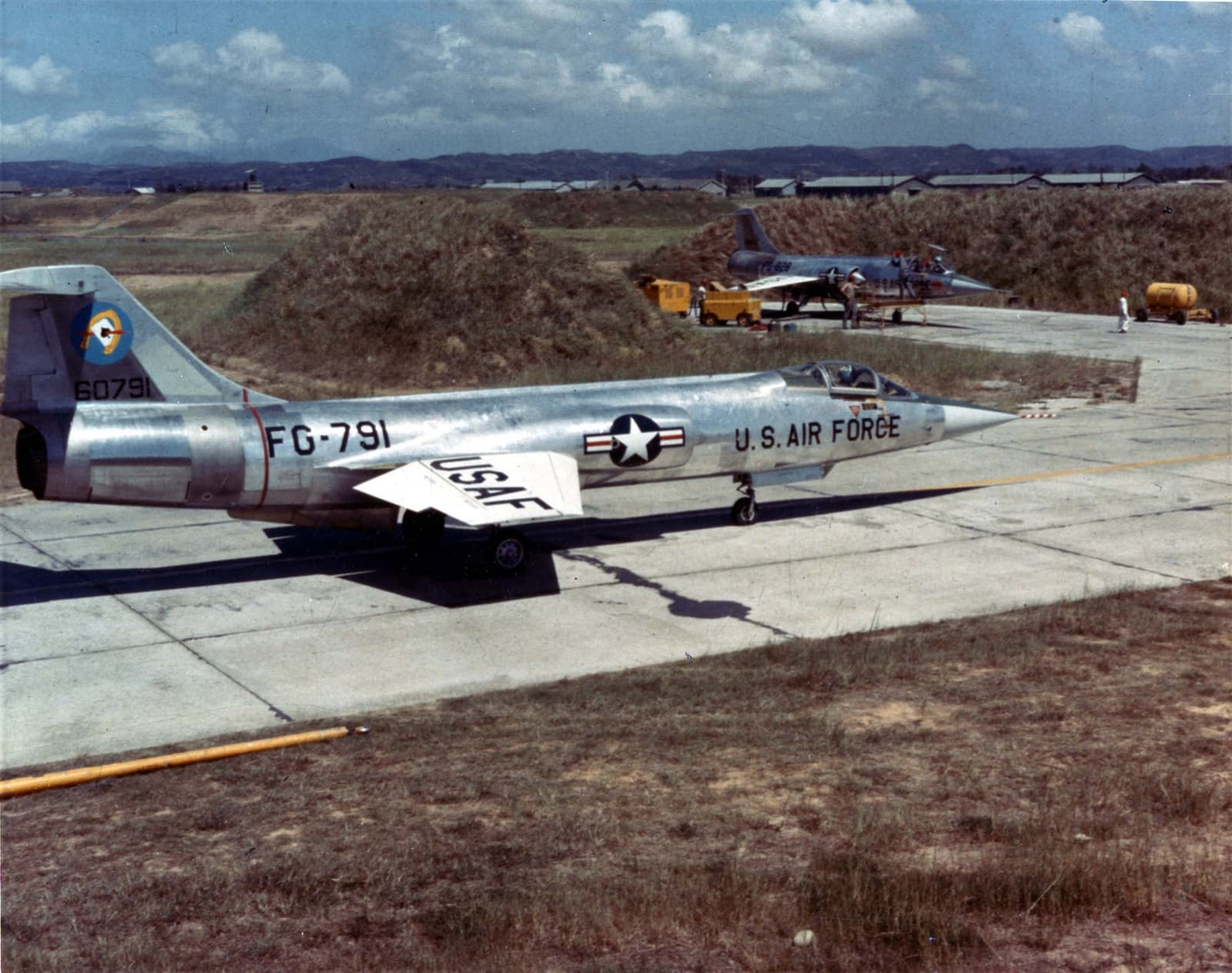
Taoyuan Air Base, 15 September 1958. F-104A Starfighters of the U.S. Air Force's 83rd Fighter Interceptor Squadron on the apron; the deployment, code-named Jonah Able, put America's newest interceptor on Taiwan. Three weeks into the shelling.
U.S. Air Force; National Museum of the U.S. Air Force
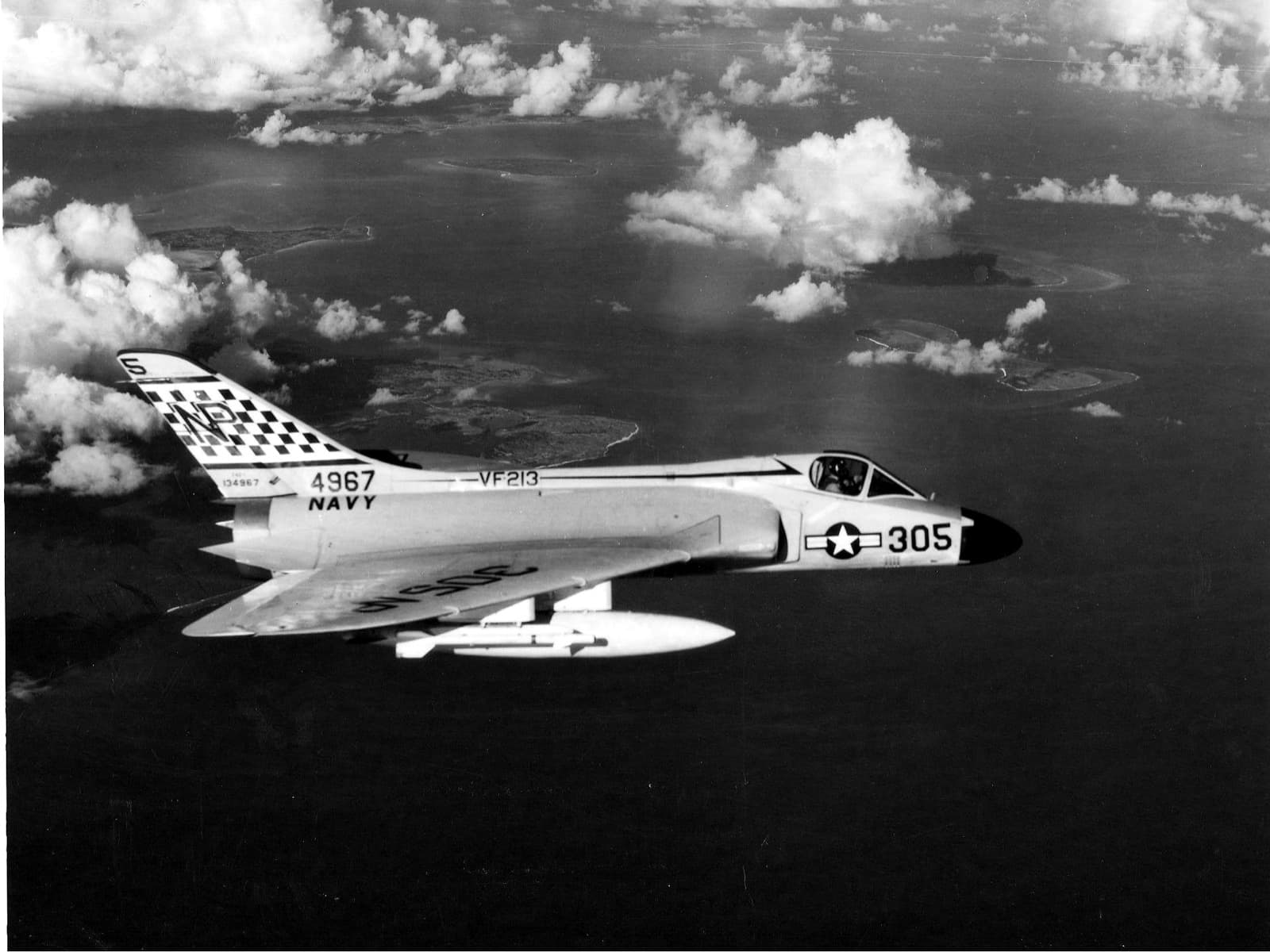
Off Taiwan, September 1958. An F4D-1 Skyray from the carrier USS Lexington, a Sidewinder under its wing. The same missile reached ROC squadrons that month, and the air battles of late September came out differently.
U.S. Navy; USS Lexington 1958 cruise book
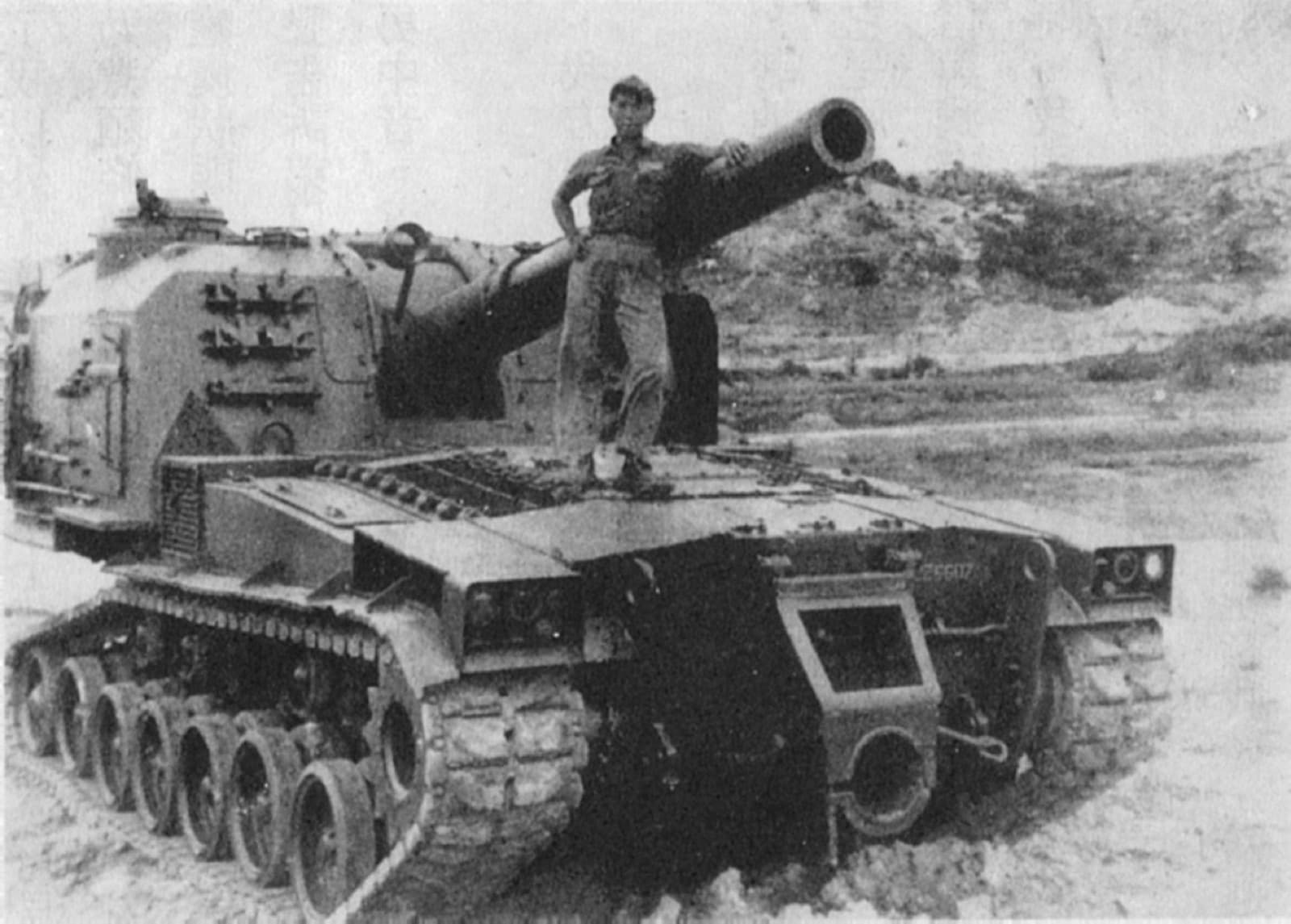
An M55 eight-inch self-propelled howitzer, transferred to ROC forces from the U.S. 3rd Marine Division. The guns reached Kinmen on 18 September and could reach the batteries on the far shore. Photographed a year later, a gunner standing at the barrel.
Public domain; photographer unknown
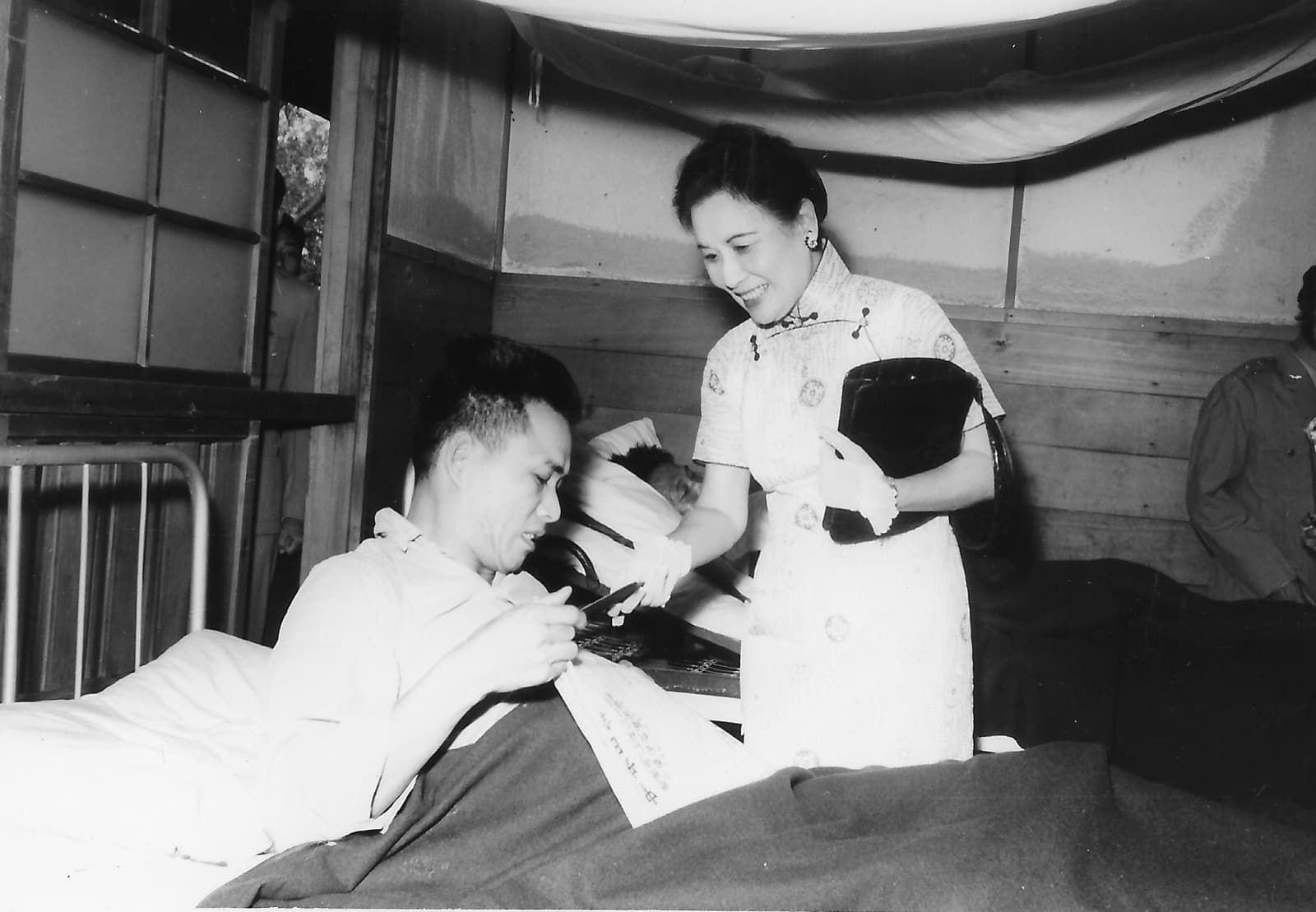
The military hospital at Beitou, 1958. Wounded men shipped back from Kinmen filled the corridors; the main Tri-Service hospital on Tingzhou Road had run out of beds long before. Soong Mei-ling came with the Women's League; the patient takes what is handed to him without getting up.
National Cultural Memory Bank, Taiwan; photographer unknown
Isle of Time