


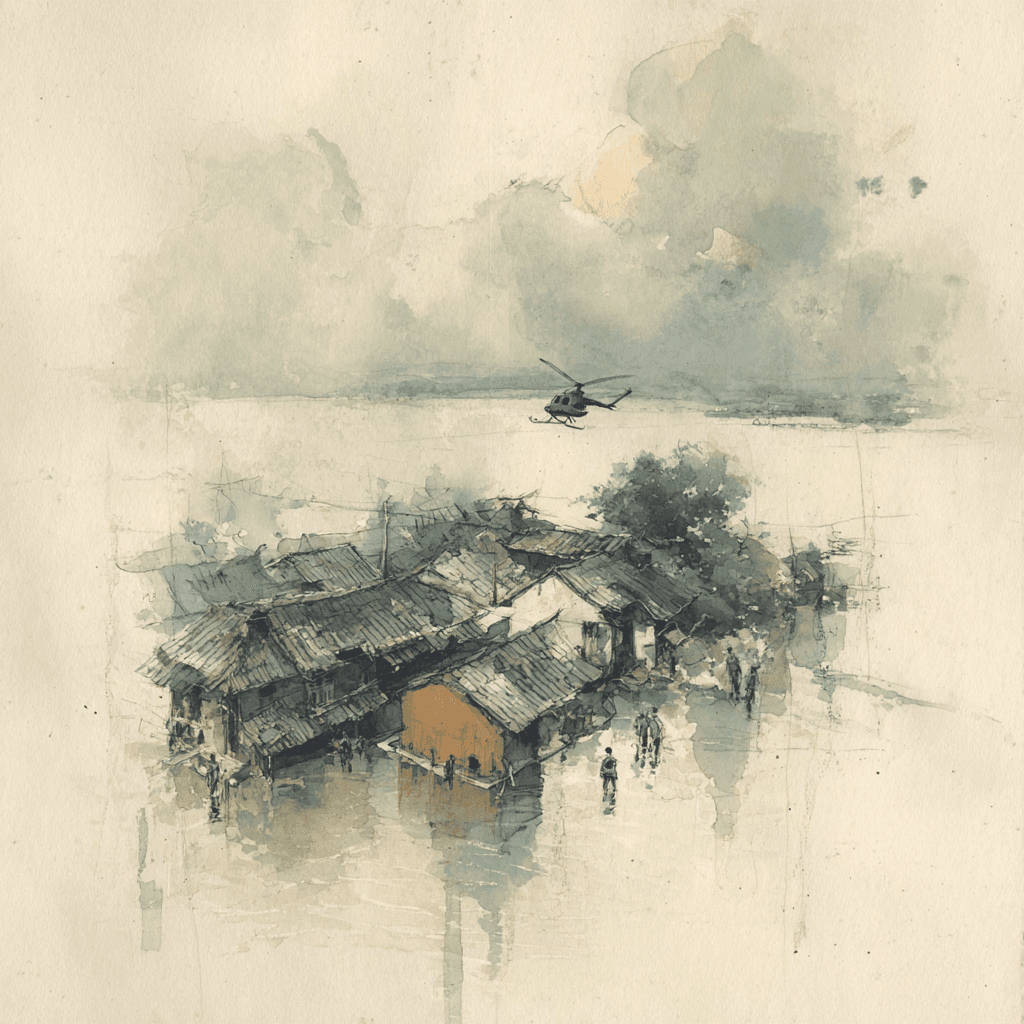
On 7 August 1959 a tropical depression came ashore at Budai in Chiayi. Drawn by Typhoon Ellen out at sea, it pulled in a powerful southwesterly airflow, and the rain fell from the seventh to the ninth. On the seventh alone, central and southern Taiwan received five hundred to a thousand millimetres, and fifteen stations recorded more than five hundred millimetres in a single day. The heaviest rain fell on Miaoli, Fengyuan, Fenyuan, the upper Wu River, Douliu and Alishan. Around Douliu, about 1,100 millimetres fell in half a day.
Overnight the rivers topped their banks. The railway bridge over the Dadu River was swept away, and between Hsinchu and Tainan there was damage along almost every kilometre of track. The railways were hit at 297 points and the roads at 476, and transport and telecommunications went down together.
Thirteen counties and cities were affected, home to thirty-eight percent of Taiwan's population. The worst hit were Miaoli, Taichung, Nantou, Changhua, Yunlin, Chiayi and Taichung City. Six hundred and sixty-seven people died, 408 went missing and 942 were injured. 27,466 houses were destroyed and 18,303 half destroyed. More than 136,000 hectares of farmland were damaged. Floodwater covered 1,365 square kilometres, and over three hundred thousand residents were affected.
The government mobilised large numbers of troops and, under the National Compulsory Labour Act, brought in about a million civilians to clear mud and help with relief. The homeless were put up in schools and in places such as the Taichung tobacco factory, more than three hundred thousand at the peak. The US military sent helicopters and an aircraft carrier to fly food and supplies into villages cut off by water, under the code name Operation Hunger.
Overseas Chinese also raised money, for relief and for schools.
Relief came with set rates: 1,000 dollars for each person killed, 700 for each person missing, 400 for each household whose house was destroyed. American aid sent flour and rice worth close to ten million New Taiwan dollars. The Bank of Taiwan issued twelve rounds of savings bonds with a top prize of 400,000 dollars.
Losses were estimated at 3.5 to 3.7 billion New Taiwan dollars, around eleven to twelve percent of the previous year's national income. The money had to come from taxes. The government introduced a flood reconstruction levy, a fifteen percent surcharge on business income tax and thirty percent on personal income tax. Entertainment and banquet taxes were raised, and land value tax and the land tax on farms carried a further forty percent surcharge. For several years, part of what people paid to see a film, host a banquet or slaughter a pig went to this flood.
After the flood the government issued an emergency decree and an outline for reconstruction, and in 1960 the Taiwan Provincial Water Conservancy Bureau set up a machinery engineering corps. A dedicated Disaster Prevention and Protection Act would not be promulgated until 2000. The flood was the deadliest natural disaster in postwar Taiwan until the 921 earthquake, and the first disaster of the postwar era that the whole island remembered together.
Overseas Chinese also raised money, for relief and for schools. Twenty-four elementary schools whose names began with the character qiao, for overseas Chinese, were founded in the disaster areas, and some village schools in central Taiwan still carry that character in their names today.
The government met this disaster with mobilisation and taxation. The army went in first, and then, under the National Compulsory Labour Act, about a million civilians were organised to clear mud, carry supplies and repair embankments. Schools, warehouses and the Taichung tobacco factory were cleared to serve as shelters for more than three hundred thousand people.
The money for reconstruction had to come from the whole island. The flood reconstruction levy was added to business and personal income tax, and entertainment, banquets, land value and farmland each carried a surcharge. Relief payments were graded by death, disappearance and destroyed home. In 1960 the Water Conservancy Bureau set up a machinery engineering corps. To the government, these measures showed one thing: a regional flood could be carried by the strength of the whole island.
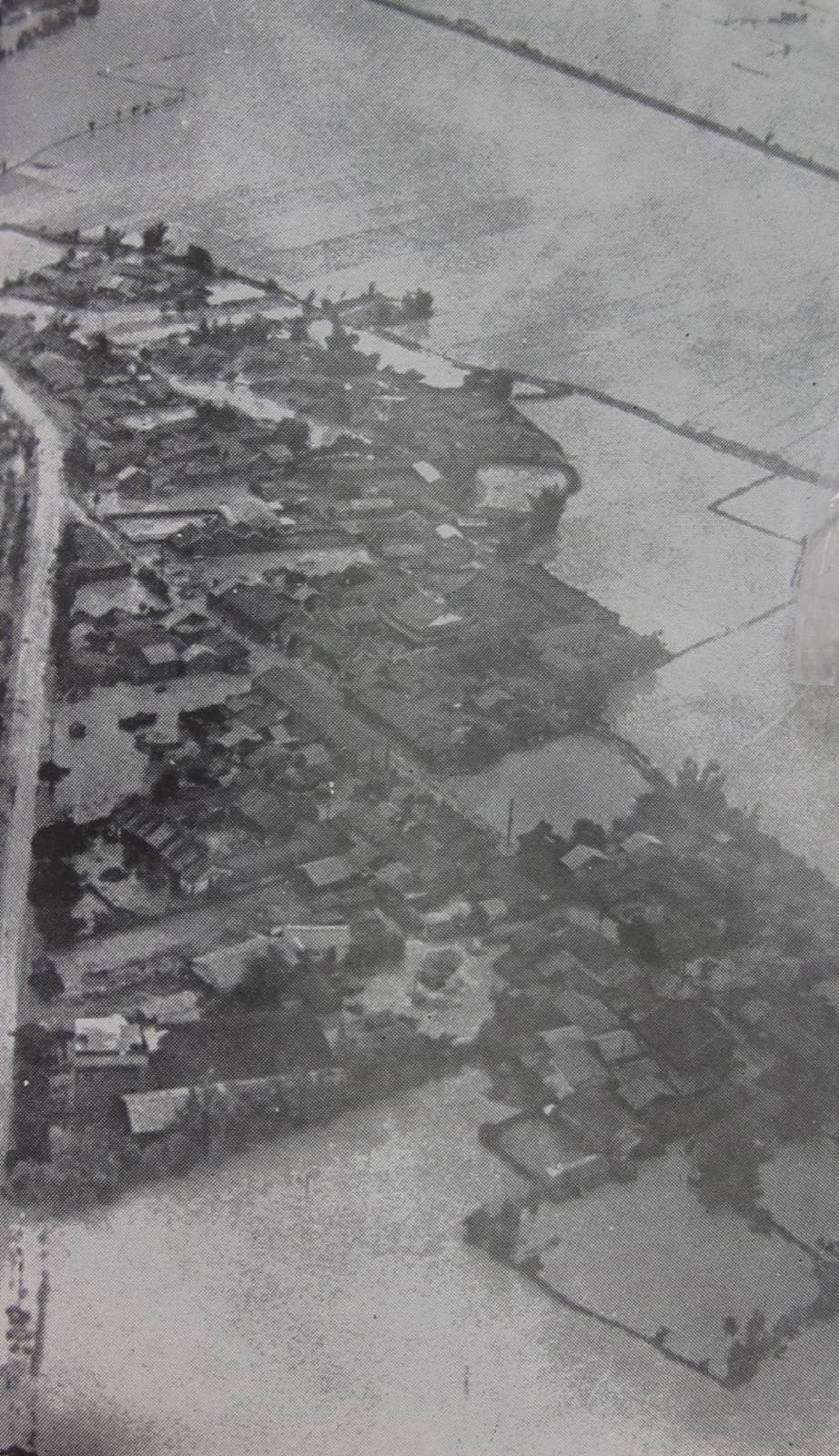
Villages around the Nanyao Temple in Changhua under floodwater during the August 7 Flood. Reproduced from the Ministry of National Defense's account of the army's flood relief.
General Political Department, Ministry of National Defense, record of the army's August 7 flood relief
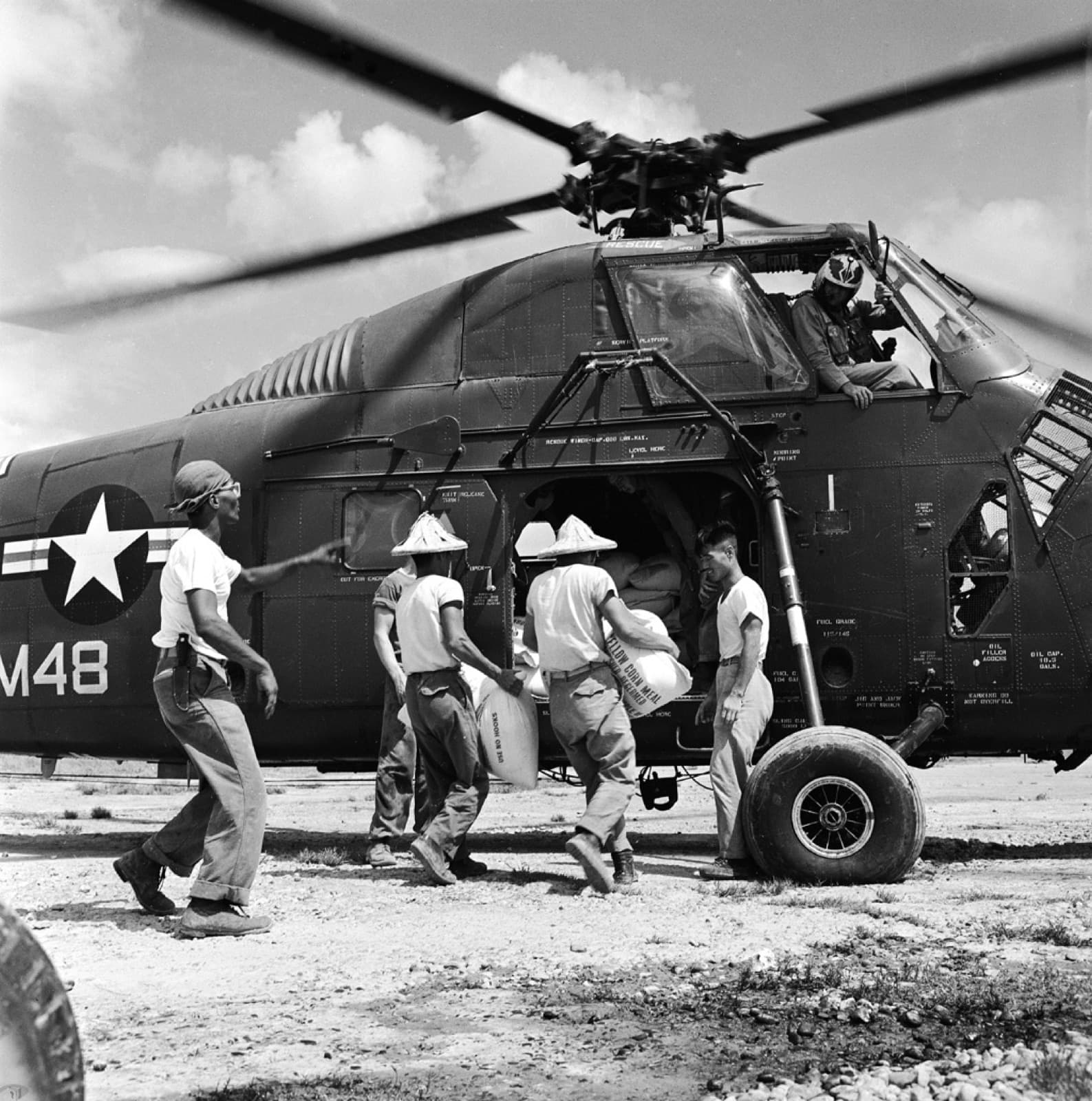
A US Navy helicopter delivers relief supplies as workers unload sacks from the cabin. The American relief effort was code-named Operation Hunger.
National Archives Administration, National Development Council
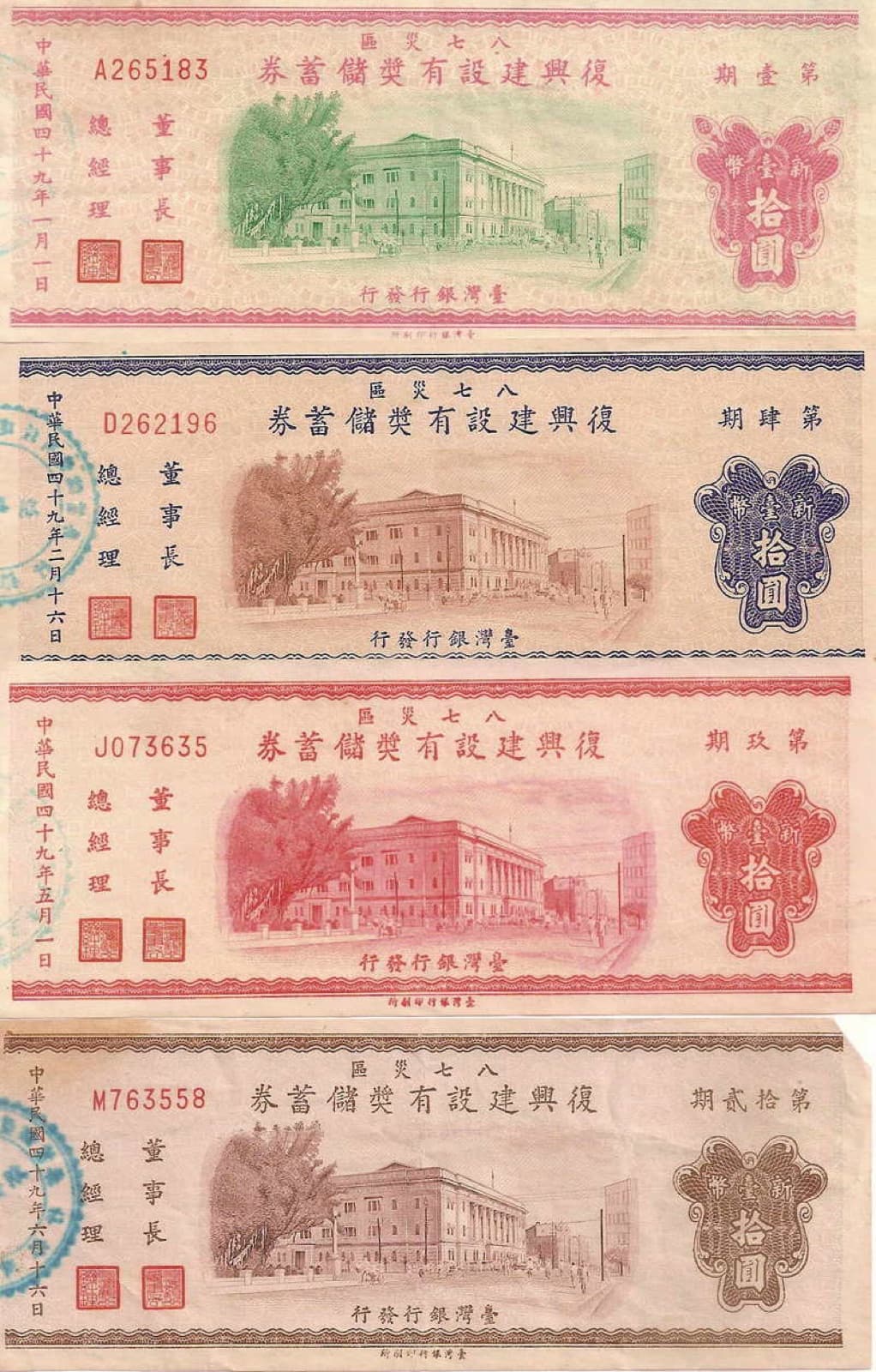
Prize savings bonds for reconstruction issued by the Bank of Taiwan after the flood, four of the issues shown here, each worth ten dollars. Twelve issues were sold in all, with a top prize of 400,000 dollars.
Bank of Taiwan, 1960