

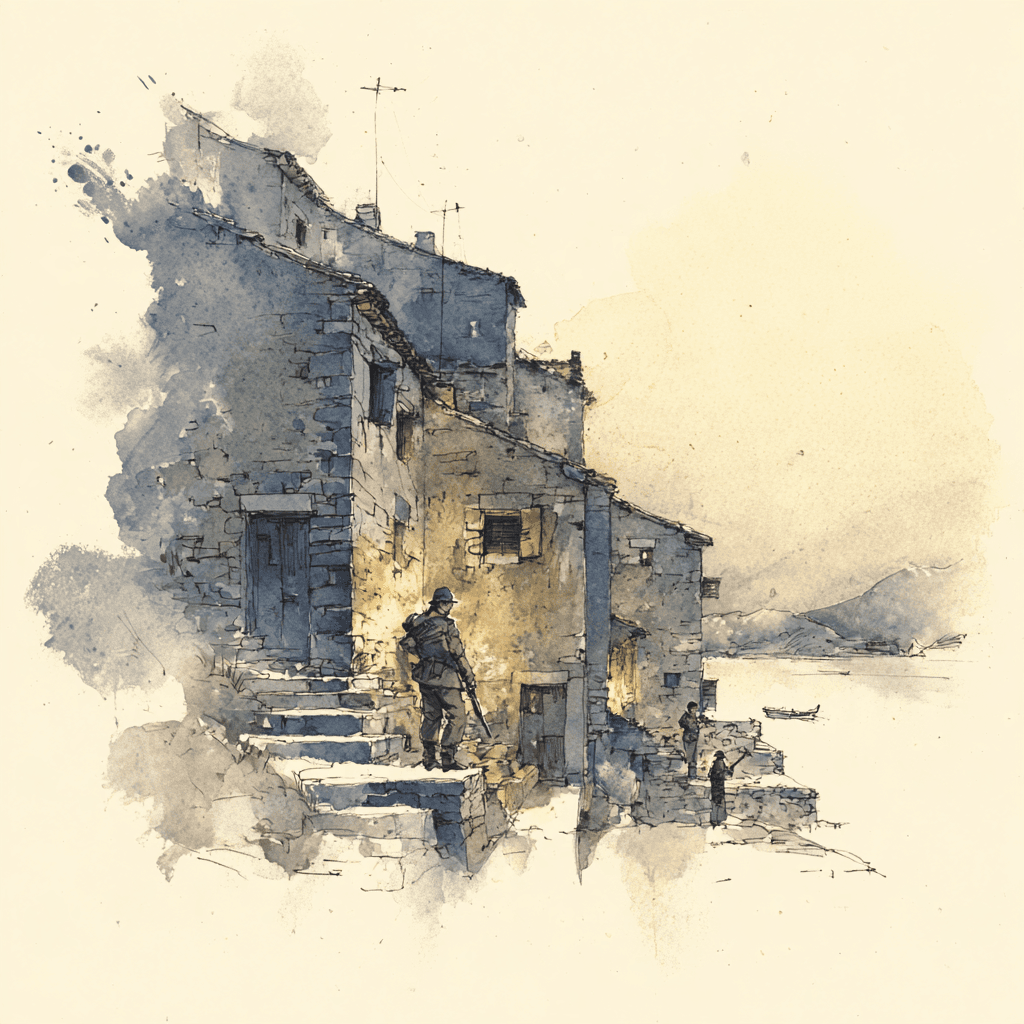
On 16 July 1956 the Matsu War Zone Administration Committee was established. Its chairman was the commander of the defence zone, and the county magistrate was appointed by the Ministry of National Defense from among serving officers. From that day until 1992, a resident of the islands who broke the law was tried by the military law office, and there was no defence lawyer in the room. The islands' newspaper was first called the Tengpu Daily, after the battle of Tengpu Island. On 3 September 1957 it was renamed the Matsu Daily News under the army's Matsu garrison command, and from 1964 it was published by the War Zone Administration Committee.
After dark Matsu ran on a different set of rules. There was a curfew. Anyone who needed to go out at night had to apply for a pass first, and a sentry who stopped you on the road expected you to recite that night's password. Every household closed its windows and fitted its lamps with shades, and no light was allowed to leak out over the sea.
The day had its list too. Radios were forbidden, a television needed a permit, and cameras could not be used freely. Refrigerators, washing machines, electric rice cookers and air conditioners, anything that drew heavy power, were banned. Keeping pigeons and flying kites were forbidden. Basketballs, volleyballs and life buoys could not be brought in, and betel nut and firecracker rockets were on the prohibited list as well. The money in circulation was issued for Matsu alone and could not be spent in Taiwan. To go to Taiwan you applied to the Ministry of the Interior's Entry and Exit Bureau for a permit, and in the early years the passage was on a military supply ship, with many people sick the whole way to Taiwan.
The petitions began the next month.
People were written into the defences as well. Men from eighteen to fifty-five and women from sixteen to thirty-five without children were enrolled in the civil defence corps and assigned by age to mobile, garrison, military-service and women's units. They trained in combat skills, maintained weapons, stood sentry, treated casualties and did construction work, and they also entertained the troops and carried out psychological warfare. In 1973 the civil defence corps was renamed the self-defence corps. Matsu men did not do separate military service. Once they had accumulated enough hours of civil defence training they could exchange them for a Class B national militia certificate.
Doctors were few on the islands, and for a long time the person who delivered babies was a Belgian nun, Sister Shi Ren'ai, who brought more than a thousand children into the world. Not until the mid-1970s did Matsu have trained midwives of its own. The military pushed Mandarin hard on the islands so that soldiers and civilians could communicate. More people learned to read, and each generation spoke less of the Matsu dialect at home.
In 1971 the population of Lienchiang County reached 17,088, the highest on record. That same year the residents of the islands of Daqiu and Gaodeng were moved off. From then on the population kept falling, and by 1991 only 5,547 were left. In 1987 martial law was lifted on the island of Taiwan. It was not lifted in Kinmen or Matsu.
The petitions began the next month. On 18 September 1987, fifty-nine people in Dongyin signed one. On 12 January 1988, eighty-four people in Matsu signed another. That July a motion was raised at the Kuomintang's Thirteenth National Congress. On 23 August 1989 the Kinmen-Matsu Hometown Alliance held an "823 march" in Taipei, and on 7 May 1991 the alliance's representatives slept at the Legislative Yuan for eleven nights. On 7 November 1992 the government announced the end of war zone administration. Two months later, on 1 January 1993, the men of Matsu became liable for military service just like the men of Taiwan.
For the people who lived in Matsu, war zone administration was not a statute but a duty roster. Men from eighteen to fifty-five and women from sixteen to thirty-five who had not yet had children were all enrolled in the civil defence corps, with a company in each village, a battalion in each township and the county magistrate as commander of the whole. The training ran to a long list: combat skills, weapons maintenance, sentry duty, casualty care, construction, entertaining troops and psychological warfare. A photograph dated 5 December 1972 shows a row of women members lying on the ground at firing practice, and for the National Day parade of 1978 Matsu sent a contingent of a hundred and ninety-nine.
The roster came with its own bargain. Once a man had built up enough civil defence hours he could exchange them for a Class B national militia certificate and did not have to go to Taiwan to serve. A woman who had a child fell outside the rules for enrolment. When war zone administration ended in November 1992 the corps was disbanded, and from 1 January 1993 the men of Matsu had to enlist and serve like everyone on the main island. For the thirty-six years before that they had been serving all along, only it was not called that.
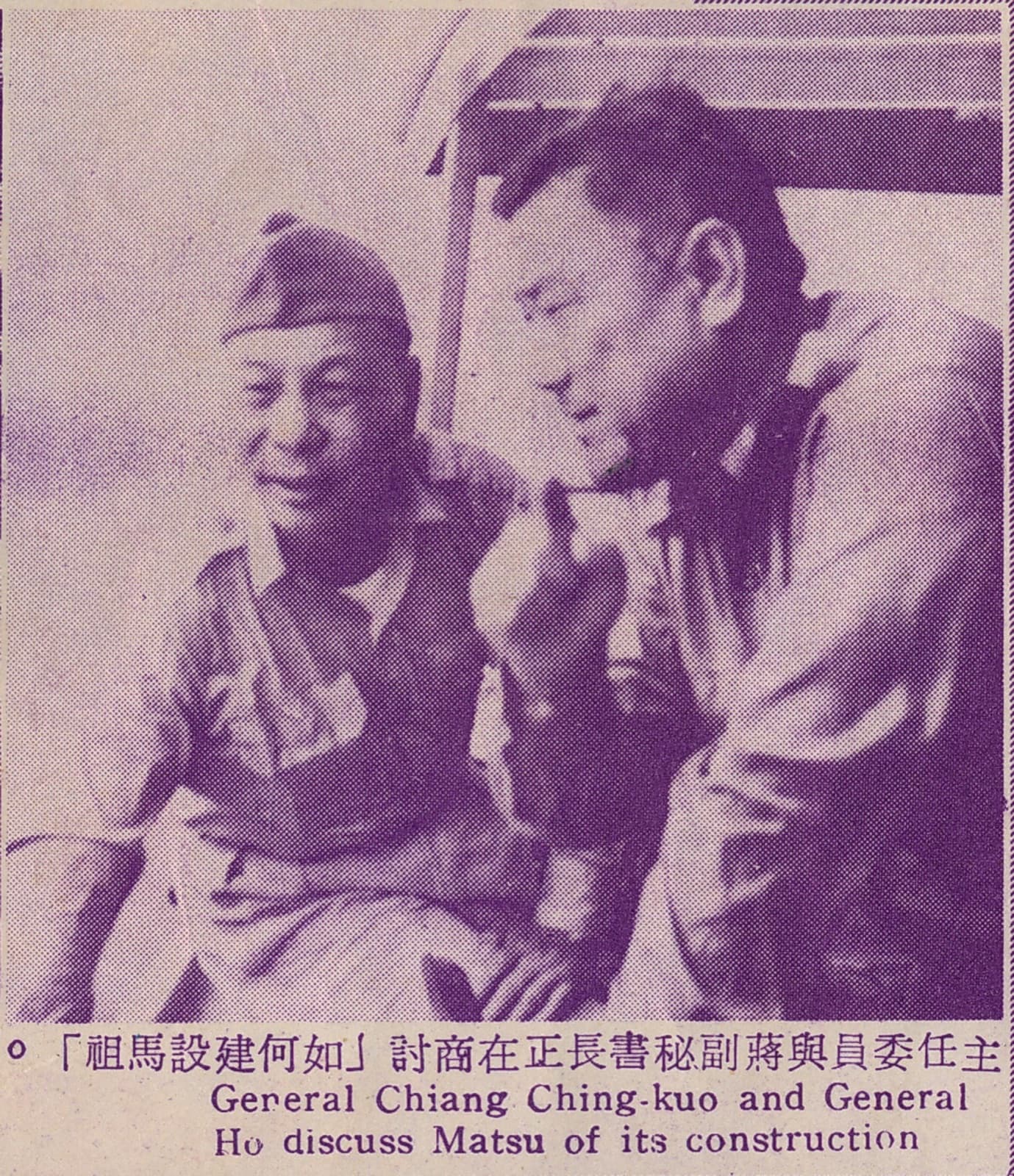
A page from the Matsu Pictorial's special issue on war zone administration, 1 March 1958, captioned "The chairman and Deputy Secretary-General Chiang discuss how to build up Matsu." The chairman of the War Zone Administration Committee was the commander of the defence zone.
Matsu Pictorial, 1958; courtesy of the Lienchiang County Cultural Affairs Bureau
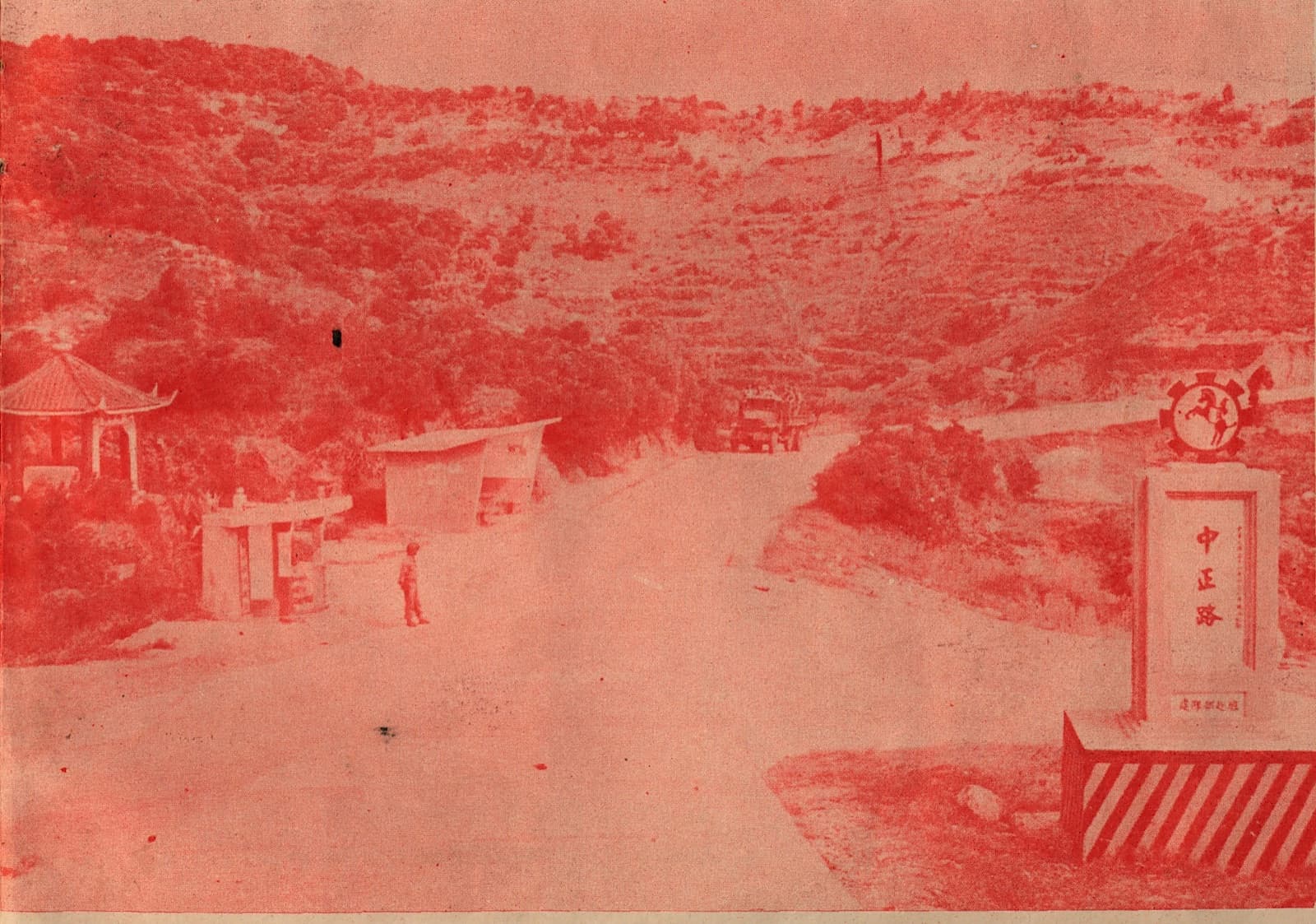
Zhongzheng Road on Nangan, around 1962. A road-name marker stands at the junction on a base painted in red and white diagonal stripes, and a military truck is coming down the slope in the distance. The photograph appears in Matsu Scenery, compiled by the Matsu Garrison Command.
Matsu Garrison Command, Matsu Scenery; courtesy of the Lienchiang County Cultural Affairs Bureau
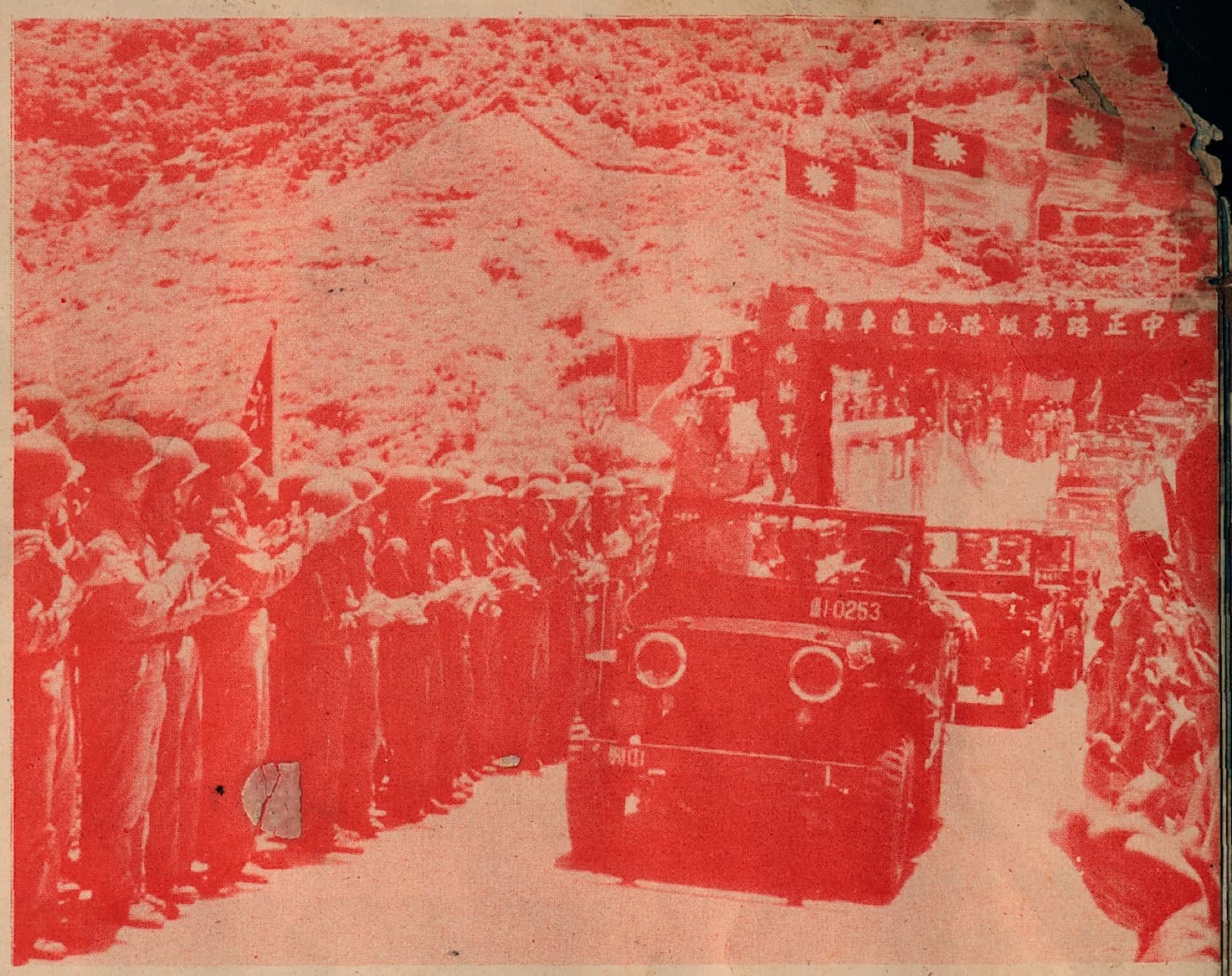
The opening ceremony for the paved surface of Zhongzheng Road on Nangan, 11 May 1962. The ranks lining the road are soldiers in steel helmets, and the motorcade passes beneath an arch hung with national flags.
Matsu Garrison Command, Matsu Scenery; courtesy of the Lienchiang County Cultural Affairs Bureau