


Qing Incorporation
In 1683, Qing admiral Shi Lang defeated the remnants of the Zheng dynasty at the Battle of Penghu, bringing Taiwan under Qing sovereignty for the first time. The annexation was far from inevitable — a fierce debate erupted at the imperial court over whether to retain or abandon this distant island. Minister Shi Lang argued that Taiwan's strategic position made it essential for coastal defense, while others viewed it as a lawless frontier not worth the administrative burden. Emperor Kangxi ultimately sided with retention, incorporating Taiwan as a prefecture of Fujian Province.
The early Qing administration treated Taiwan with cautious neglect. A garrison of rotating soldiers was stationed on the…
The early Qing administration treated Taiwan with cautious neglect. A garrison of rotating soldiers was stationed on the island, and a civil bureaucracy of magistrates and prefects was installed, but the court imposed strict limits on migration. A permit system required prospective settlers to obtain official approval before crossing the Taiwan Strait, and families were initially forbidden from accompanying male migrants — a policy designed to prevent permanent settlement but widely circumvented in practice. Illegal migration from Fujian and Guangdong surged throughout the eighteenth century, transforming the island's western plains into a patchwork of Hokkien and Hakka farming communities.
This volume examines how a reluctant empire absorbed a peripheral island, tracing the policies that shaped Taiwan's early Qing identity: the quarantine line (番界) separating Han settlements from indigenous mountain territories, the rotating garrison system that prevented military entrenchment, and the informal networks of kinship and commerce that bound Taiwan to the mainland despite official restrictions. These administrative choices — born of imperial ambivalence — would define Taiwan's ethnic geography and frontier character for the next two centuries.
He had served under Zheng Zhilong, broke with Zheng Chenggong in 1651 at the cost of his father and brother, and spent the thirty years that followed in Qing service waiting for the battle he fought in 1683. The engagement at Penghu lasted seven days and destroyed the Zheng fleet. The first thing he did on reaching Taiwan was not to settle scores but to offer sacrifice at the shrine of Zheng Chenggong — an act discussed for years in Fujian officialdom, taken by some as magnanimity and by others as posture. The real difficulty came afterwards. The court debated whether to keep the island, and most officials favoured withdrawing the garrison and moving the population back to the mainland. His memorial on retaining or abandoning Taiwan argued from geography rather than sentiment: lose Taiwan and the maritime gate to four provinces stands open; the Dutch might return at any time, and taking it back then would cost more than holding it now. He added an account as well — the garrison could be paid out of Taiwan's own land tax without drawing on mainland funds. The Kangxi emperor accepted this in 1684 and established Taiwan prefecture under Fujian. In the same year he drafted the ban on crossing to Taiwan.
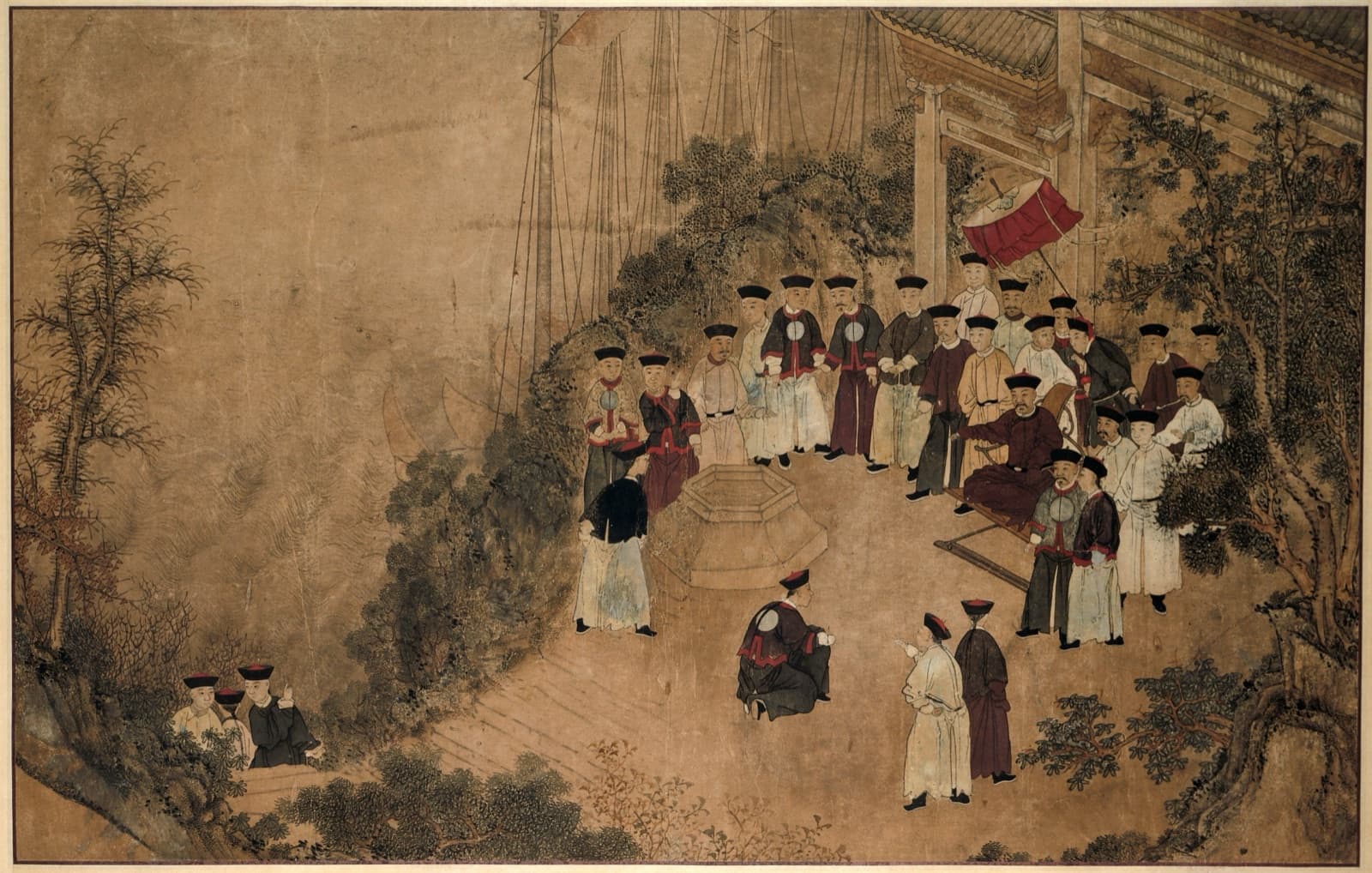
Shi Lang and a company of officials at a well by the sea, as a Dutch engraver imagined them. His fleet broke Liu Guoxuan's at Penghu in 1683; Zheng Keshuang surrendered, and the next year Taiwan became one prefecture and three counties under Fujian.
Public domain; artist unknown
Isle of Time