Taiwan Under the Qing Empire: Migration, Rebellion, and Modernization (1683–1895)
34 volumes
Vol. 1
In 1683, Qing admiral Shi Lang defeated the remnants of the Zheng dynasty at the Battle of Penghu, bringing Taiwan under Qing sovereignty for the first time. The annexation was far from inevitable — a fierce debate erupted at the imperial court over whether to retain or abandon this distant island. Minister Shi Lang argued that Taiwan's strategic position made it essential for coastal defense, while others viewed it as a lawless frontier not worth the administrative burden. Emperor Kangxi ultimately sided with retention, incorporating Taiwan as a prefecture of Fujian Province.
Vol. 2
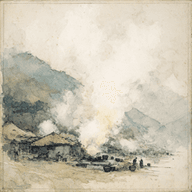
In the winter of the thirty-fifth year of Kangxi, 1696, the gunpowder magazine in Fuzhou caught fire and more than five hundred thousand catties of sulphur and saltpetre burned. Saltpetre could still be found on the mainland. Sulphur was harder. The Qing court had taken Taiwan into the empire only thirteen years earlier and set up one prefecture and three counties. The northernmost, Zhuluo, nominally reached as far as Jilong, but its yamen still sat in the south at Jialixing and would not move to Zhuluoshan until 1704. At the island's northern end, beyond the government's reach, in the hills around Jilong and Tamsui, there was sulphur.
Vol. 3
In the late seventeenth century along the Fujian and Guangdong coast, deciding whether to cross to Taiwan was a deadly gamble with one’s life as the stake.
Vol. 4
By the final years of the Kangxi Emperor's reign, the Qing court was confronting an awkward truth: more than three decades after annexing Taiwan, it still knew almost nothing about the island. Officials rotated in and out on brief appointments, completing their terms and departing for more comfortable postings on the mainland, leaving behind few records of what they had seen. The vast interior remained unmapped. Taiwan, for the purposes of imperial governance, was administered rather than known.
Vol. 5
The Han Chinese settlement of Taiwan's western plains proceeded roughly from south to north, and the town of Zhudian — known in the Qing records as Zhudian, today as Hsinchu, meaning 'New Bamboo' — was the crucial hinge point where the frontier of northern Taiwan tilted from wilderness into settled agricultural society. The name traces back to the dense bamboo groves that the Taokas indigenous people had long used as natural boundaries around their villages.
Vol. 6
The broad Changhua plain had deep, rich soil that should by rights have yielded abundant harvests, yet it suffered from one great want: water. Flat and low-lying, the plain saw its rivers flood in the rainy season and run dry in the drought, leaving farmers at the mercy of an unreliable sky. A single dry year could ruin a crop. Until the land could be steadily irrigated it remained a country of parched fields and uncertain harvests, where settlers came and went and villages struggled to take root. In the early eighteenth century, seeing such fertile ground lying idle for lack of water, the wealthy landowner Shi Shi-bang resolved to change all of this, undertaking one of the most ambitious engineering feats of Qing Taiwan: a great canal to draw the waters of the Zhuoshui, the island's mightiest river, out across the plain.
Vol. 7
The Taipei Basin had rich soil, but for most of the Qing era it could not realize its agricultural potential. The basin's geography was frustrating: the central lowlands accumulated standing water and flooded regularly, while the terraced hillsides were chronically dry, too far above the nearest river to be irrigated by gravity. Farmers who settled here found themselves fighting on two fronts — against inundation in the wet season, against drought in the dry.
Vol. 8
In the early eighteenth century, southern Taiwan was a land filled with violence, resentment, and despair. Countless “Luohanjiao” — lone migrant men who had survived the deadly crossing of the Black Ditch — discovered that the island was not the golden frontier promised in rumors back home. Instead, they found themselves trapped beneath the ruthless exploitation of the Qing imperial bureaucracy.
Vol. 9
On the twelfth day of the sixth lunar month of 1721, more than twenty thousand of Zhu Yigui's followers appeared on the west bank of the Lower Tamsui River. On the other bank lay a belt of Hakka villages, their settlers mostly from Tingzhou, Zhenping, Pingyuan and Chengxiang, with a few Plains Indigenous villages scattered among them. Two months earlier, both banks had been on the same side.
Vol. 10
Before the tide of Han migration swept across central Taiwan, this fertile plain was already the homeland of the plains peoples — the Taokas, the Papora, the Pazeh and their neighbours — who for generations had fished, hunted, farmed and multiplied here. But as the Qing brought Taiwan into its realm, these "acculturated aborigines" were enrolled into the system of rule, becoming subjects burdened with corvée labour and tribute.
Vol. 11
The expansion of Han Chinese settlement across Taiwan's plains during the Qing era operated through a distinctive set of legal instruments — known collectively as indigenous land contracts, or fan qi — that served as the formal mechanism through which frontier agricultural land moved from indigenous to Han Chinese ownership and control. These contracts existed at the intersection of Qing legal norms, indigenous customary practices, and the raw economics of land hunger, and they produced outcomes that were systematically disadvantageous to the indigenous communities who entered into them.
Vol. 12
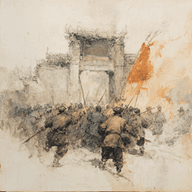
Qing-era Taiwan earned a reputation as one of the empire's most turbulent frontiers. The folk saying 'every three years a minor revolt, every five years a major rebellion' (三年一小反、五年一大亂) was no exaggeration — over two hundred recorded uprisings occurred during two centuries of Qing rule. The roots of this instability lay in the island's unique social fabric: a rapidly growing settler population, weak imperial oversight, ethnic rivalries between Hokkien and Hakka communities, exploitative local officials, and the absence of a deeply rooted gentry class to mediate disputes.
Vol. 13
In mid-eighteenth-century central Taiwan, the migrants who had braved the deadly Black Ditch crossing and survived the Qing's restrictive isolation policies found themselves in a society far more chaotic than the one they had left behind. The Qing Empire still treated the island with wary suspicion rather than genuine governance. Local officials grew rich through corruption, and rank-and-file Green Standard soldiers were little better than roaming thugs. Worse still, as arable land grew scarce, migrants from Zhangzhou, Quanzhou, and the Hakka regions of Guangdong fought endless ethnic feuds over water rights and farmland. In a land where law offered no justice and officials offered only extortion, the lower classes turned to extralegal networks for survival. This twisted pressure cooker eventually birthed a vast underground mutual-aid society in Dali, Taichung — the Tiandihui, or "Heaven and Earth Society."
Vol. 14
Beyond the mountains of Taiwan's northeast lay a fertile expanse cradled between the Snow Mountains and the Pacific — the Kavalan plain, today's Yilan. For most of the Qing era this plain lay outside the empire's borders, and Han settlers were expressly forbidden to cross into it. It was the ancestral home of the Kavalan people, who lived by rice farming, fishing, hunting, and trade among the villages scattered across the lowland. Yet on the western coast, only a mountain range away, Han settlement had already saturated the available land, and this rich but unclaimed valley became, in the eyes of adventurers, the most tempting prize of the age.
Vol. 15
The Kavalan plain — known in the Qing records as Jiazinanlai, today as Yilan — lay on the other side of the Snow Mountains from the rest of Qing Taiwan's administrative world. The Kavalan people had farmed, fished, and traded there for centuries. The Qing court had long classified the plain as 'savage territory' and issued formal prohibitions against Han Chinese settlement, a policy designed more to avoid the administrative complications of a new frontier zone than to protect the Kavalan from encroachment.
Vol. 16
While the Luohanjiao on land battled the Qing with broadswords and blood, the Black Ditch — the strait separating Taiwan from the mainland — entered its most chaotic and dramatic golden age. In the early nineteenth century, the Taiwan Strait was at once a golden corridor of merchant ships and rolling wealth, and a lawless blue wasteland beyond the reach of any government. Out of these storm-tossed seas rose a pirate king whose very name made the Qing Empire, Western powers, and merchant houses tremble: Cai Qian.
Vol. 17
The Fengshan plain south of present-day Kaohsiung had been under continuous Han Chinese cultivation since the early eighteenth century, yet its agricultural productivity remained hostage to the region's unpredictable hydrology. The summer typhoon season brought brief floods that sometimes drowned standing crops; the long dry season left the soil cracked and unworkable. Farmers had developed local workarounds — small weirs, seasonal channels, water-sharing arrangements — but no systematic infrastructure capable of irrigating the plain at scale.
Vol. 18
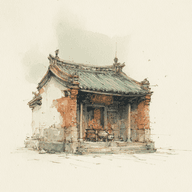
In mid-Qing Taiwan, whether walking the winding alleys of Tainan prefecture or the dusty plains of Zhanghua and Chiayi, one often comes across small, unassuming shrines tucked beneath banyan trees or beside abandoned burial grounds far from any village. They lack the grand swallowtail roof ridges or ornate carved beams of major temples; their red-brick walls bear only a stone tablet inscribed with "Dazhongye" (Lord of the Multitude) or "Wanshan Tonggui" (Ten Thousand Souls Returning Together).
Vol. 19
In mid-eighteenth-century Taiwan, as the gunpowder smoke of rebellions and ancestral feuds slowly settled on land, a golden artery — woven from wealth, sails, and the currents of the Black Ditch — began to pulse violently along the western coast. It was an age called "Taiwan's money up to the ankles." As the Kangxi Emperor's once-strict crossing prohibition collapsed before the sheer pressure of survival, waves of Han migrants who had gambled their lives to reach Taiwan cut irrigation channels across the western plains, turning wilderness into endless seas of rice paddies and sugarcane fields.
Vol. 20
Among the cultural achievements of Qing-era Taiwan, the literary tradition that flourished in Zhudian — today's Hsinchu — occupies a distinctive position. While most of the island's western plains were still in the early phases of agricultural colonization, Zhudian developed alongside its commercial growth a scholarly gentry culture organized around classical Chinese poetry and the cultivation of Confucian literary values. This was not a transplanted mainland culture maintained by officials on temporary posting; it was a locally rooted intellectual tradition created by people who had been born on the island and thought of Taiwan as their home.
Vol. 21
For much of the Qing era, Taiwan was a young society of migrants from every quarter packed in together. They had crossed the treacherous Black Ditch to get there, and on unfamiliar ground they contended fiercely over fields, water and livelihood. Such a society was restless and unsettled, and it earned a grim reputation: "a small revolt every three years, a great upheaval every five."
Vol. 22
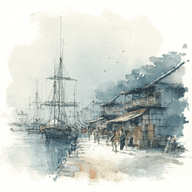
Following the Second Opium War, the Treaty of Tianjin (1858) and the Convention of Peking (1860) compelled the Qing to open Taiwan's ports to international trade — a turning point that would transform the island from an imperial backwater into a node of global commerce. Tamsui, Keelung, Anping, and Takao (present-day Kaohsiung) were designated as treaty ports, and by the 1860s foreign merchants, missionaries, and consular officials had established a permanent presence on Taiwan's shores.
Vol. 23
The opening of Taiwan to foreign residence following the Treaty of Tientsin in 1858 coincided with the high period of the Victorian collecting expedition, when natural history museums across Europe and North America were actively soliciting specimens and observations from the frontiers of empire. Taiwan's combination of geographic accessibility, biological diversity, and indigenous communities largely untouched by Western contact made it unusually attractive to the naturalists, adventurers, and cultural observers who began arriving in the port towns of Danshui and Dagou in the 1860s and 1870s.
Vol. 24
Dai Chaochun came from Sizhangli village in Changhua County. His forebears came from Longxi in Zhangzhou, and for generations the family had served as clerks to the Northern Route garrison. In 1861 an officer named Xia Ruxian demanded a bribe from him, he refused, and he lost the post. Years earlier his elder brother Dai Wangui had formed an Earth God society, and later, with Zhang Shui, gathered the district's wealthy households into the Eight Trigrams Society, pledged to come to one another's aid when trouble came.
Vol. 25
On a summer day in 1865, James Laidlaw Maxwell — known in Taiwan as Ma Yage — stepped ashore at the port of Dagou with a medicine chest and the New Testament in Chinese. He was the first Western physician to establish a permanent medical presence in Taiwan, and his arrival initiated a mission that would, over the following three decades, transform the social landscape of southern Taiwan in ways that went far beyond the conversion of souls.
Vol. 26
In the early spring of 1867, the monsoon winds and ocean currents of the Pacific converged upon the southernmost tip of Taiwan. This was a stretch of water that sailors spoke of with dread, thick with hidden reefs and vaguely charted, its coast ringed by ranges of forested mountains upon which the Qing empire had never truly set foot. It was here, in the wild seas off the southern cape near present-day Kenting, that the American merchant bark Rover struck the reefs and was wrecked. As the vessel broke apart in the surf, the surviving crew rowed desperately for shore and struggled onto unfamiliar ground, believing they had escaped death, unaware that they had entered a far more perilous realm.
Vol. 27
Throughout the Qing period, the relationship between Han settlers and Taiwan's indigenous peoples was defined by an official boundary — the 'savage boundary' (番界) — a line of earthen mounds, ditches, and guard posts stretching across the island's western foothills. East of this line lay the territories of indigenous communities whom the Qing classified as 'raw savages' (生番), largely beyond imperial control; to the west spread the Han-settled plains, where 'cooked savages' (熟番) — indigenous groups that had adopted Han customs and paid taxes — occupied an increasingly precarious middle ground.
Vol. 28
The encounter between Taiwan's indigenous peoples and Qing Chinese expansion did not have a single form or a single outcome. It was not simply a story of conquest followed by resistance followed by defeat, though all three were certainly present. It was a more complicated set of negotiations, adaptations, and confrontations spread across more than two centuries, involving dozens of distinct peoples facing a colonial pressure that arrived with different intensities in different places and at different times.
Vol. 29
The Mudan Incident of 1874 — in which Japanese forces landed in southern Taiwan on the pretext of punishing an indigenous village for the killing of Ryukyuan sailors — delivered a shock to the Qing court that transcended its immediate military dimension. The real blow was conceptual: when Qing officials attempted to protest the Japanese landing, they found their position undermined by their own previous statements classifying eastern Taiwan as territory beyond effective imperial administration. They had, in effect, conceded their own sovereignty over the areas they now sought to defend. The resulting settlement required the Qing to pay an indemnity to Japan, making clear that the island's internal geography had become an external vulnerability.
Vol. 30
The Kavalan once lived on the Lanyang Plain. After Wu Sha led settlers in to farm it in 1796, Han fields pushed steadily deeper into the plain, and in the 1830s and 1840s a group of Kavalan, led by the people of Kaliawan village, moved south along the coast and rebuilt their villages around the Meilun River on the Qilai Plain. Their neighbours were the Sakizaya, whose main village was Takubuwan, written in Qing documents as Jinlaoye. Sakizaya territory ran roughly from south of the Liwu River to north of the Mugua River.
Vol. 31
In 1884 a war fought far away over suzerainty and control of Vietnam suddenly washed up on Taiwan's shores. As relations between the Qing and France broke down over the Vietnamese question, the fighting spread along China's southeastern coast, and Taiwan — an isolated island guarding the maritime approaches to Fujian — became overnight a frontline in a contest between great powers. For the island's inhabitants it was a disaster that fell from the sky without warning, and they called the whole ordeal the 'Western barbarians' revolt.'
Vol. 32
In 1885, in the wake of the Sino-French War — during which French forces blockaded and bombarded Keelung and briefly occupied northern Taiwan — the Qing court recognized the island's strategic importance and elevated it from a prefecture of Fujian to a full province. Liu Mingchuan, the military commander who had successfully defended Taiwan against the French, was appointed as its first governor.
Vol. 33
At the close of the nineteenth century, the Qing Empire stood in the bleak autumn of its decline. Yet on this side of the strait, in Taipei, an unfolding modernization experiment would prove the most radical and forward-looking the empire had ever attempted. Shaken by the Sino-French War, the Qing court in 1885 resolved to elevate Taiwan to provincial status, appointing the open-minded Huai Army general Liu Mingchuan — celebrated for his battlefield exploits — as its first governor.
Vol. 34
The final two decades of Qing rule in Taiwan — the period between the inauguration of Liu Mingchuan's modernization program in the mid-1880s and the island's transfer to Japan in 1895 — were in some respects the most active period in the history of the Taiwanese gentry class. The construction projects of the late Qing era — the first railway, the telegraph system, the new stone walls of Taipei, the government schools — required capital and social organization that the state could not supply entirely from its own resources. What filled the gap was the wealth, the local networks, and the organizational capacity of the island's established merchant-gentry families.