


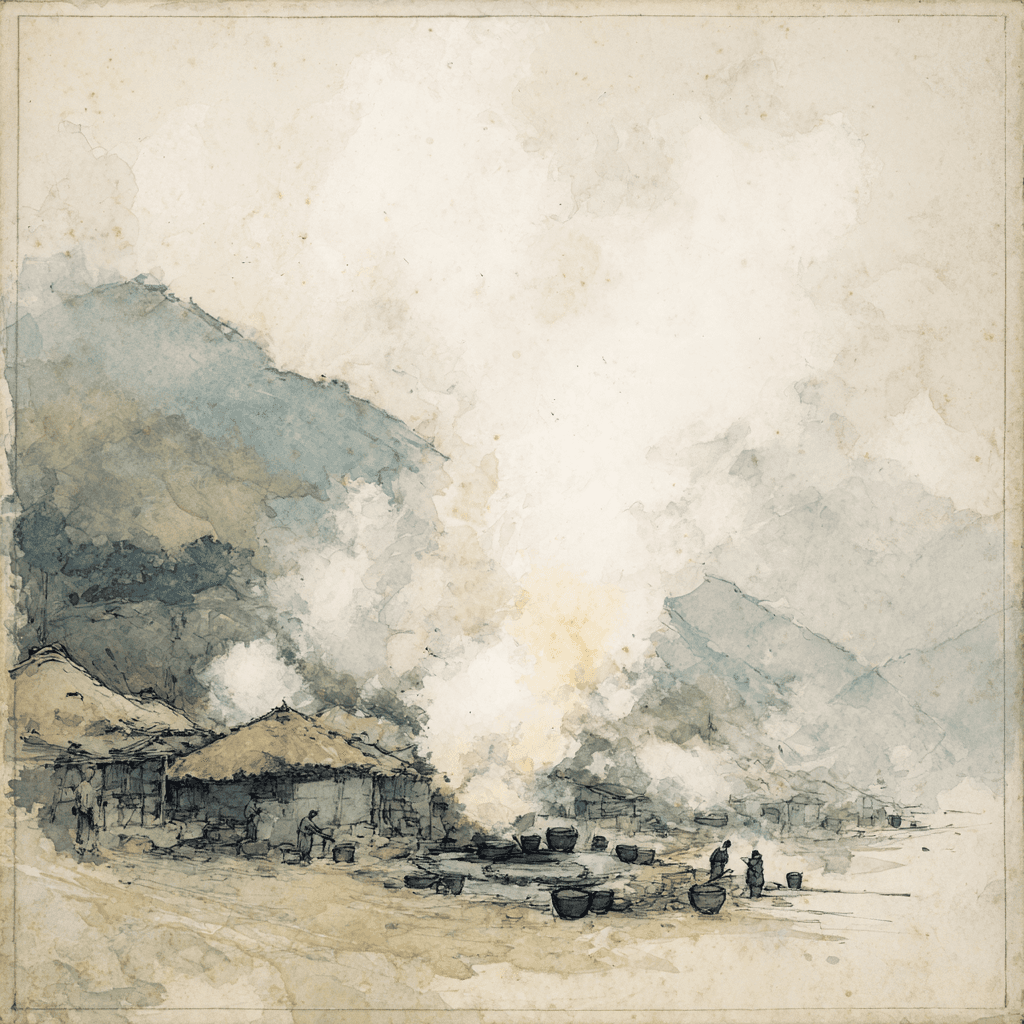
In the winter of the thirty-fifth year of Kangxi, 1696, the gunpowder magazine in Fuzhou caught fire and more than five hundred thousand catties of sulphur and saltpetre burned. Saltpetre could still be found on the mainland. Sulphur was harder. The Qing court had taken Taiwan into the empire only thirteen years earlier and set up one prefecture and three counties. The northernmost, Zhuluo, nominally reached as far as Jilong, but its yamen still sat in the south at Jialixing and would not move to Zhuluoshan until 1704. At the island's northern end, beyond the government's reach, in the hills around Jilong and Tamsui, there was sulphur.
Yu Yonghe, a scholar from Renhe County in Zhejiang, had served since 1691 as a private secretary in the Fujian administration. He volunteered to go to Taiwan and gather sulphur. He set out from Fuzhou in February 1697 and reached Anping, the outer harbour of the prefectural city, on 25 February. He spent a month and a half in the prefectural city buying cloth, oil, sugar and pans for refining. The cloth was to trade with the indigenous people of the north for sulphur earth, and the tools alone cost him 980 taels.
On 7 April he set out north by land. Off the boat he rode in ox carts led by men on foot, passing through one lowland village after another and fording river after river. It took twenty days, and he reached Tamsui only on 27 April. In his book he described the western plain along the way: "A plain as far as the eye can see, and nothing but dense grass." Han fields had not yet reached so far north.
At Beitou he put up grass huts near the sulphur vents and negotiated with the headmen of the twenty-three villages around Tamsui and Jilong. The terms came roughly to one basket of sulphur earth for seven feet of cloth. The earth was carried back and boiled down with oil in the pans into sulphur.
That winter he finished the refining, and after nine months in Taiwan he left.
The climate of the north laid his companions low one after another. He wrote: "The sick lay all around me, and I heard nothing but groans and shivering." A typhoon blew for three days and nights: "a great wind uprooting trees, three days and nights without pause, and of more than twenty grass huts, over half collapsed." On the hills the water "poured down from ten thousand slopes at once and flooded everywhere." Under such conditions the refining went on to the end of the year.
He also recorded the land he saw in the north. The book says that after an earthquake three years earlier this area had sunk into a great lake. Later writers called it the Kangxi Taipei Lake, and scholars still argue about how large it was and how it formed.
Yu Yonghe's view of the indigenous people differed from that of many writers of his day. He criticised those who treated them as another kind of being: "They too are human! Their limbs, their skin and bones, what part of them is not human?" He also criticised the village contractors who controlled trade with each village, saying they fleeced the people "without limit, treating whatever they owned as no different from their own." The remedy he proposed in the book was to civilise them through poetry, history, rites and music. It was still a Qing scholar's answer, only he had first granted that they were human.
That winter he finished the refining, and after nine months in Taiwan he left. Back home he wrote the journey up in three volumes as Small Sea Travel Diaries, also called the Sulphur Diary, with twelve bamboo-branch poems on Taiwan and twenty-four on its indigenous people appended. It was the first travel account of the Qing period written by a literatus who had walked the west of Taiwan himself.
Yu Yonghe came of his own accord. He had been a private secretary in Fujian for six years, and he volunteered for the sulphur mission himself. He rode ox carts, fording rivers and sleeping in grass huts, and noted down the villages, rivers, terrain and people he saw, one after another.
His pen had the habits of the writers of his time, and its exceptions. He called the indigenous people "fan", yet wrote, "their limbs, their skin and bones, what part of them is not human?" He gathered sulphur for the throne, yet condemned the village contractors for fleecing them "without limit". He left Taiwan after nine months and wrote the three volumes of Small Sea Travel Diaries. The book became a record no one studying early Qing Taiwan can get around.
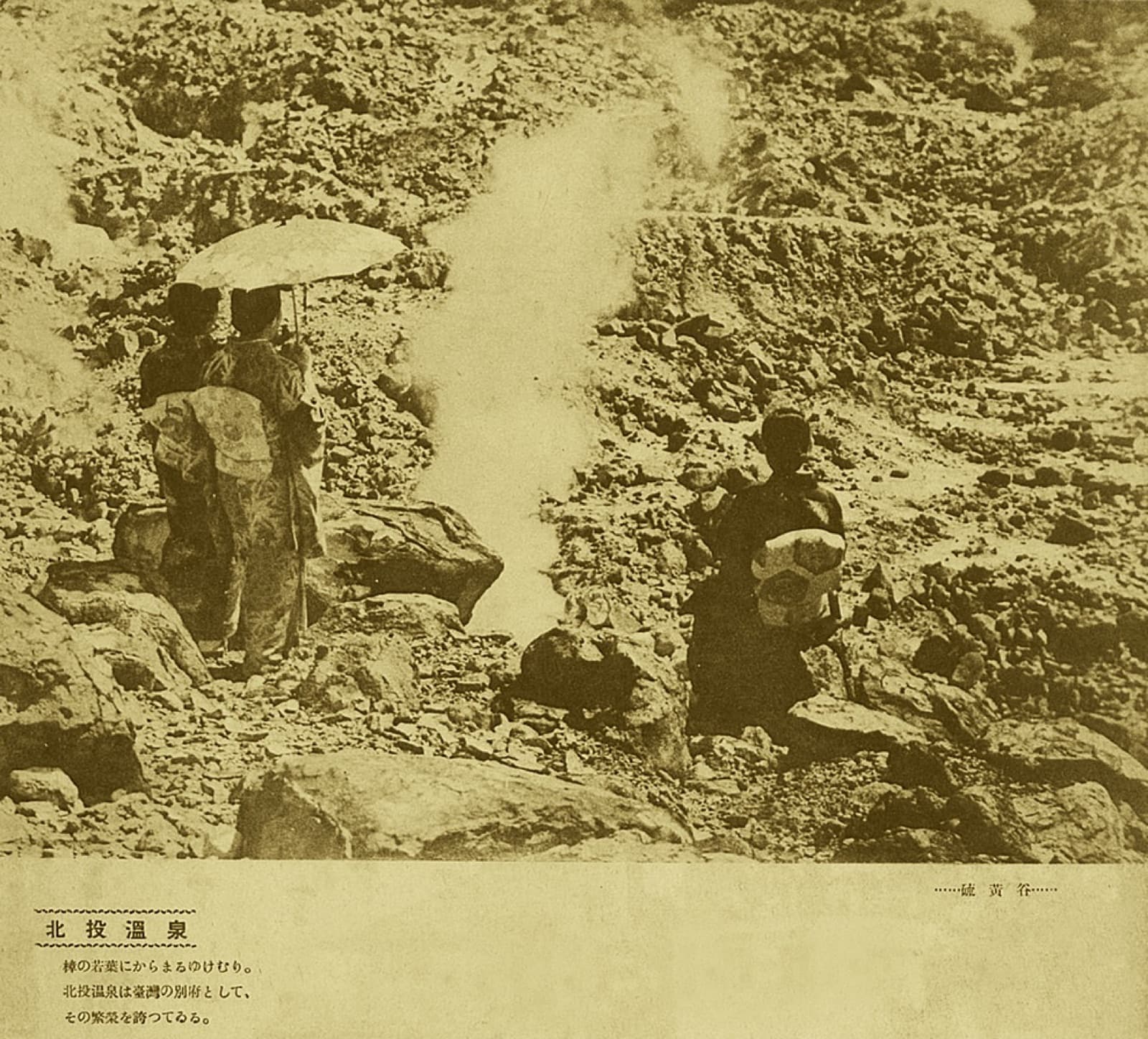
The sulphur valley at Beitou hot springs in the 1930s, from Scenic Taiwan, published in 1939. Yu Yonghe had built his grass huts and refined sulphur in these hills some 240 years earlier.
Scenic Taiwan, 1939