


The Silicon Shield
In April 1976, nineteen engineers from the Industrial Technology Research Institute flew to Pennsylvania and moved into an RCA plant for training. Their average age was twenty-eight, and what they had come to learn was a seven-micron process for integrated circuits. The transfer agreement cost about three and a half million US dollars, and there were legislators at the time who asked why the government was paying that much for a business somebody else was preparing to shut down.
After those men came home, the Hsinchu Science Park opened in 1980 and United Microelectronics was founded the same year. In 1987, Morris Chang, fifty-six years old and six years into his life in Taiwan, took 48.3 percent from the Executive Yuan's development fund and 27.5 percent from Philips and started a company that did nothing but manufacture to order: no products of its own, no brand of its own, and never any competition with a customer. In the semiconductor value chain this was the bottom, the thinnest margin available. Intel sent people to Hsinchu to qualify the plant in 1988, and that was the first large order the company got.
What later turned this into a matter of state had nothing to do with sentiment. It was capital. A three-nanometer fab costs somewhere around twenty billion US dollars, and very few companies can afford the ticket for the next generation. Fab 18 in the Tainan Science Park began mass production at three nanometers in December 2022. More than ninety percent of the world's sub-ten-nanometer capacity sits in Taiwan, concentrated in three parks — Hsinchu, Taichung, Tainan — less than three hundred kilometers apart.
In January 2021, the German economics minister, Peter Altmaier, wrote to Taiwan's economics minister, Wang Mei-hua, aski…
In January 2021, the German economics minister, Peter Altmaier, wrote to Taiwan's economics minister, Wang Mei-hua, asking Taiwan to help increase production of automotive chips. Japan and the United States asked for the same thing shortly afterward. A cabinet minister of one country writing to a cabinet minister of another to ask her to persuade a private company to reorder its production queue: there was no precedent in diplomatic practice to work from.
The phrase "silicon shield" comes from a 2001 book by Craig Addison. The argument is that the fabs are themselves a deterrent, because a war would cut the supply line for everyone. The opposite argument has always been available too — writing an industry into national defense paints a target on it. TSMC announced an Arizona plant in 2020; the Kumamoto fab opened and ground was broken in Dresden in 2024, and "de-Taiwanization" became a term Taiwan argued about with itself.
The costs landed elsewhere. In the drought of 2021 the government suspended irrigation on 74,000 hectares of farmland, the largest such measure ever taken, and kept the water for households and industry; that year the water trucks in Hsinchu ran past midnight. One company's electricity consumption approaches eight percent of the national total. Park salaries lifted housing prices in Zhubei, and pulled away the people other industries could not hire.
When those nineteen men came home in 1976, nobody described what they were about to do as guarding the country. The phrase arrived more than forty years later, from other people, and what it praises is not a technology. It is a description of a predicament.
A fab does not shut down. Stop a tool and the temperature curve inside the furnace has to be run again from the start, so people fit themselves to machines: three shifts a day, and somebody always in a bunny suit in the middle of the night. There are no windows in a clean room, the suit leaves only the eyes, you talk through an intercom, and a single shift can be measured in kilometers walked. The first thing a new hire learns is how to move without touching a wafer. For a while the compensation was profit-sharing in stock, which is why Hsinchu in the 1990s produced engineers who owned apartments in their thirties; after the 2008 rule change that expensed those shares, the road narrowed considerably. The reasons for staying became other things: this yield, these tools, this generation of the race. Housing in Zhubei started being compared with Taipei around then. Some people leave at forty-five and say they have already lived two lifetimes of night shifts.
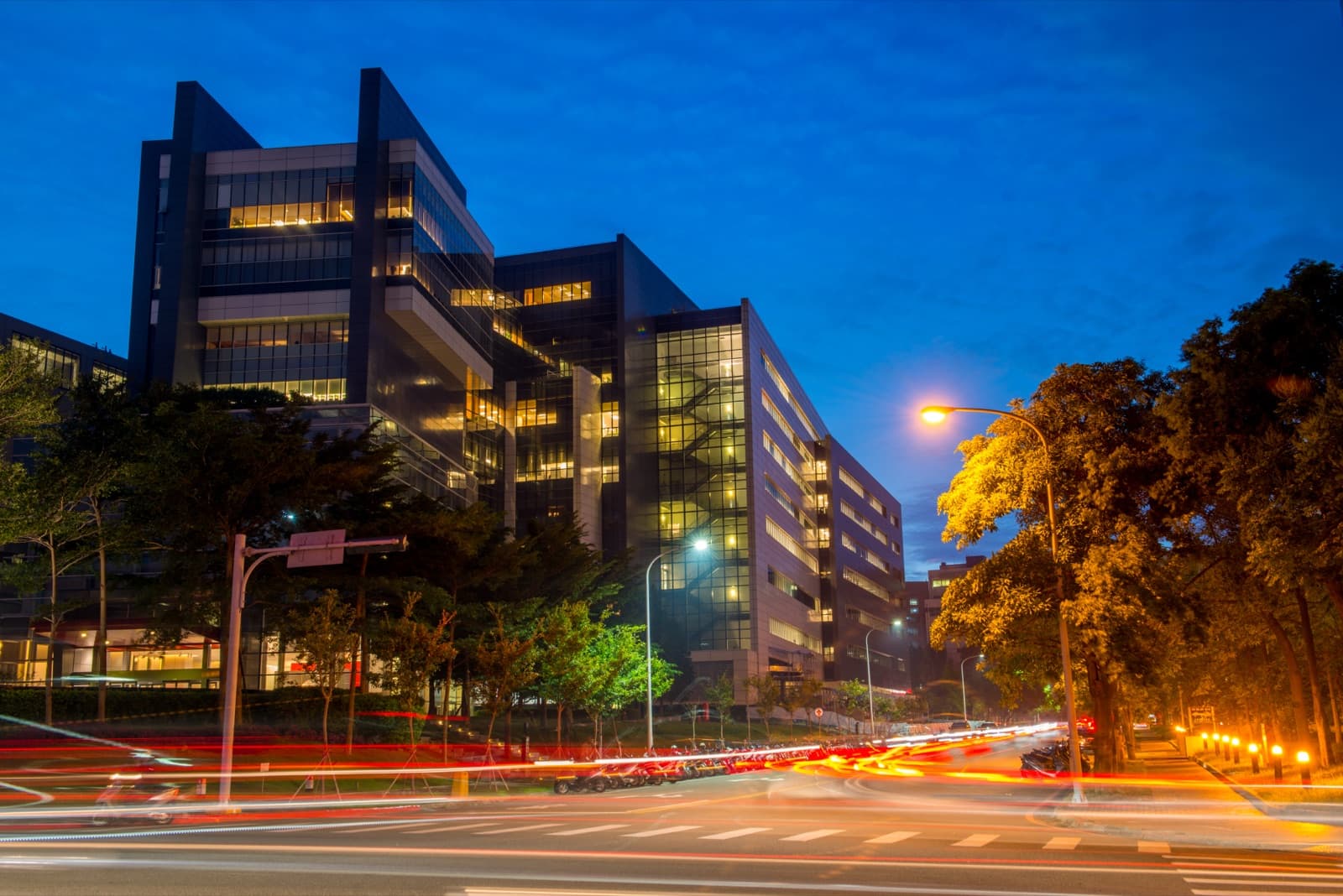
TSMC's Fab 12A in Hsinchu. A fab is a building without windows or expression, yet its clean rooms hold the most advanced process nodes in the world — the fact on which Taiwan's security argument came to rest.
Tseng Cheng-hsun / CC BY 2.0 via Wikimedia Commons
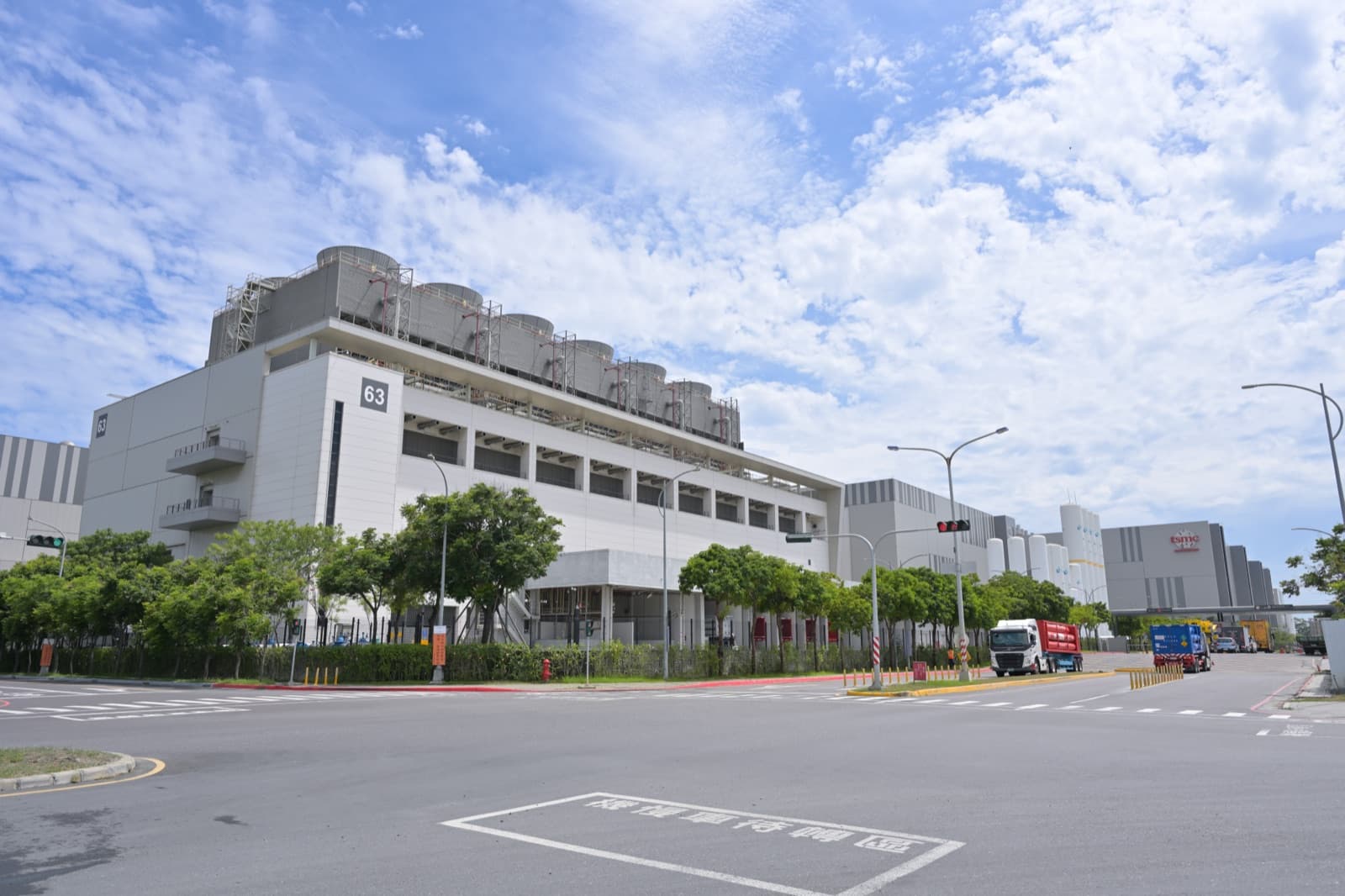
TSMC's Fab 18 in the Tainan science park, where five- and three-nanometre nodes are made. The phrase 'sacred mountain that guards the country' moved from industry talk into politics, writing one company into national security.
4300streetcar / CC BY 4.0 via Wikimedia Commons
Isle of Time