


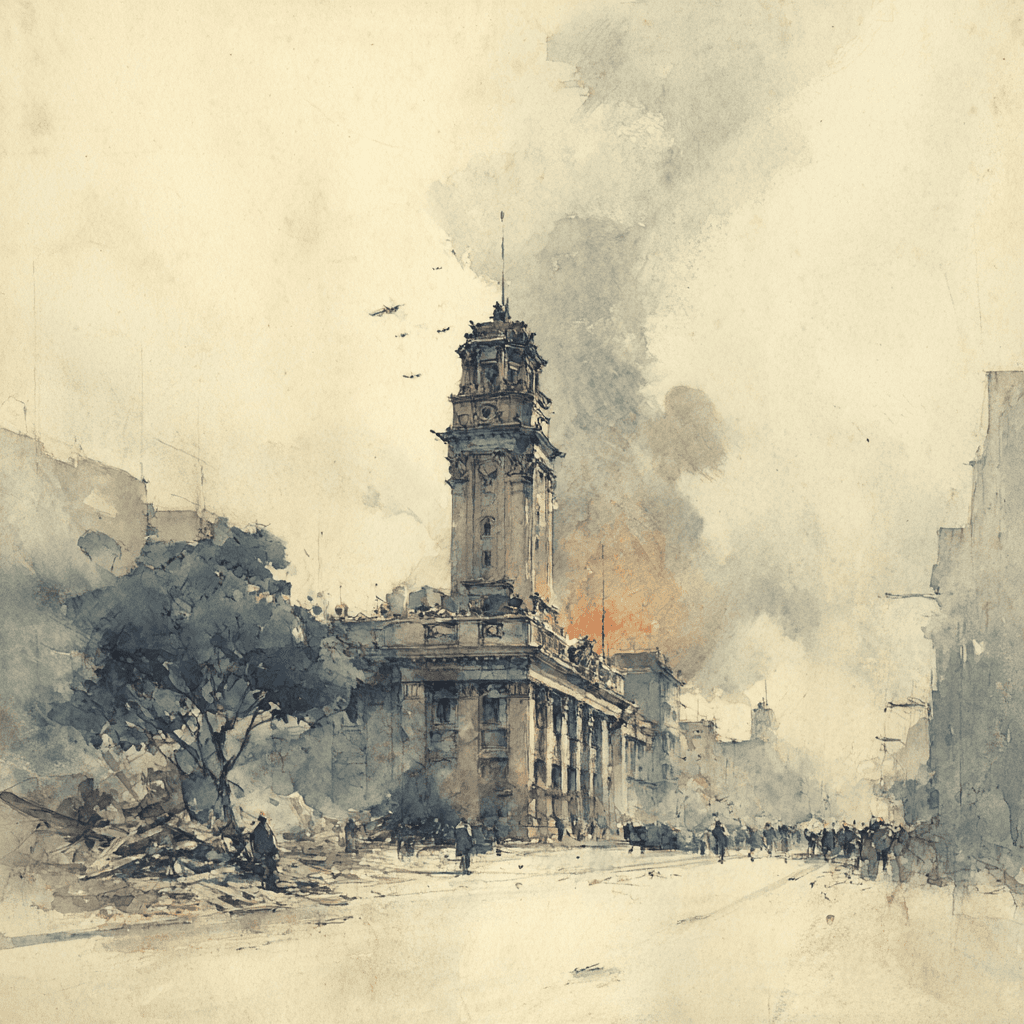
On 25 November 1943 thirty American aircraft wrecked the runway at Hsinchu. It was the first American attack on Taiwan. A year later, from 12 October 1944, the bombing became routine. In the same month the air battle off Taiwan and Okinawa all but wiped out Japan's fighter units on the island, and from then on American planes came and went through Taiwan's sky and were rarely intercepted.
People in Taipei learned to look up that year. From late 1944, twice a day, planes passed overhead in groups of twenty or thirty. The Government-General moved schoolchildren and families out to the countryside, and to keep fires from spreading it tore down more than 708,000 square metres of housing in the city, opening strip after strip of firebreak.
At ten in the morning on 31 May 1945, one hundred and eighteen B-24 bombers from four groups of the US Fifth Air Force arrived over Taipei. The bombing went on until one in the afternoon without a pause. That day they dropped 310 tons of bombs, among them 1,260 ninety-pound fragmentation bombs and 195 thousand-pound general-purpose bombs.
The target was the walled city, the block bounded today by Zhongxiao West Road, Zhonghua Road, Aiguo West Road and Zhongshan South Road, and the garrison units there, including the 1st Infantry Regiment and the 48th Mountain Artillery Regiment. The Government-General's Office took a direct hit on its front. Bombs struck the front left side, the central hall and the north wing, and the fire burned for three days. The Railway Hotel, the Government-General's Library and the Taihoku Imperial University Hospital were hit too. Outside the city walls, the main hall and left corridor of Lungshan Temple in Bangka were destroyed.
The burned-out shell of the Government-General's Office survived the war.
How many died has never been settled. The Taihoku Prefecture tally at the time was 759 dead, 15 missing, 96 seriously injured and 88 lightly injured. Another Japanese record gives 1,768 deaths from air raids in the prefecture over ten months. Most later accounts put that single day's dead at over three thousand. By the American count, from 12 October 1944 to 10 August 1945 the bombing of Taiwan killed 5,582 people, wounded nearly nine thousand, and destroyed or damaged 45,340 buildings.
A fourteen-year-old boy had been evacuated with his family to the country between Banqiao and Tucheng a few months before the end of the war. That day he saw the whole sky turn white as more than a hundred planes came over together. He could hear the anti-aircraft guns but could not see where the bombs came down. When he returned to Taipei in September, around what is now Chongqing South Road and Hengyang Road, he found bomb craters deep enough to stand in up to his neck. His family's house behind Taipei Station was untouched.
The day then dropped out of the schoolbooks. The Taiwan history textbooks published in 1977 left it out, and the major histories did not list it until 1990. In 2009 Hung Chih-wen of the geography department at National Taiwan Normal University found the aerial photographs from that time in the GIS centre at Academia Sinica. On 15 July that same year, a construction site for the MRT Xinyi Line near Chiang Kai-shek Memorial Hall turned up two unexploded bombs.
The burned-out shell of the Government-General's Office survived the war. In 1947 the provincial government began restoring it, paid for with private donations and some eighty-one thousand workers, and the job was finished at the end of 1948, looking much as it had before. The building was renamed Chieh-shou Hall, in honour of Chiang Kai-shek's sixtieth birthday. In 1950 it became the Presidential Office.
In the Fifth Air Force's operational planning, Taipei was a fortified administrative centre. The Government-General directed the island's wartime mobilisation from there, the 1st Infantry Regiment and the 48th Mountain Artillery Regiment were garrisoned inside the city, and the station and railway linked the ports and airfields of the north and south. After the air battle off Taiwan and Okinawa there were no fighters worth mentioning left on the island to rise and intercept, and heavy bombers could line up on their targets in daylight, at medium altitude, taking their time.
On 31 May four groups sent one hundred and eighteen B-24s, which bombed from ten in the morning until one in the afternoon. They dropped 310 tons: 1,260 ninety-pound fragmentation bombs and 195 thousand-pound general-purpose bombs. The mission reports recorded targets, ordnance and accuracy. The figure of 5,582 dead across the island between 12 October 1944 and 10 August 1945 was compiled only afterwards.
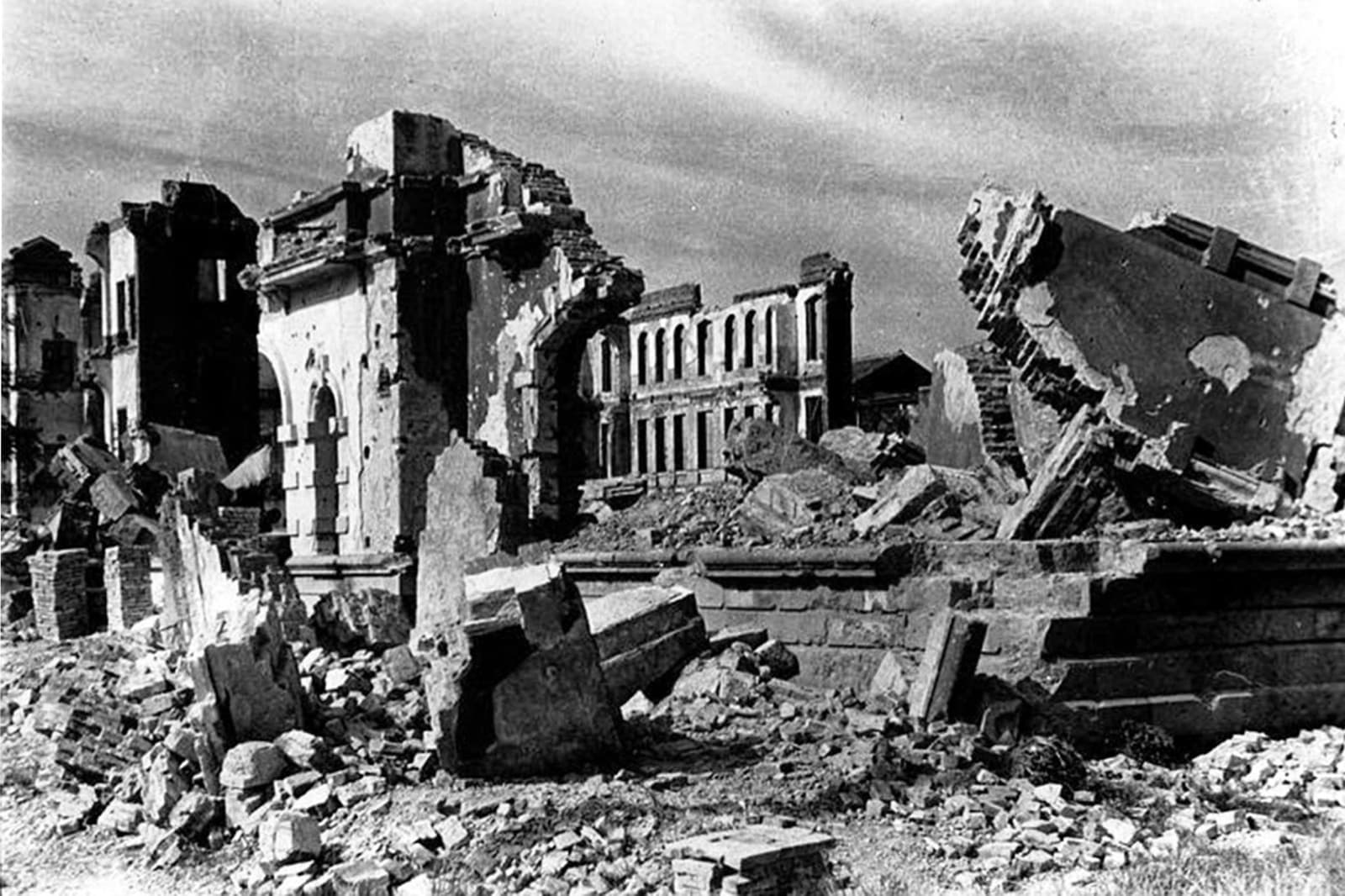
The ruins of the Government-General Library after the bombing of 1945. The building had begun as the Lottery Bureau, then housed the Bureau of Industry's museum, and became the library after the museum moved to New Park.
Public domain, photographer unknown
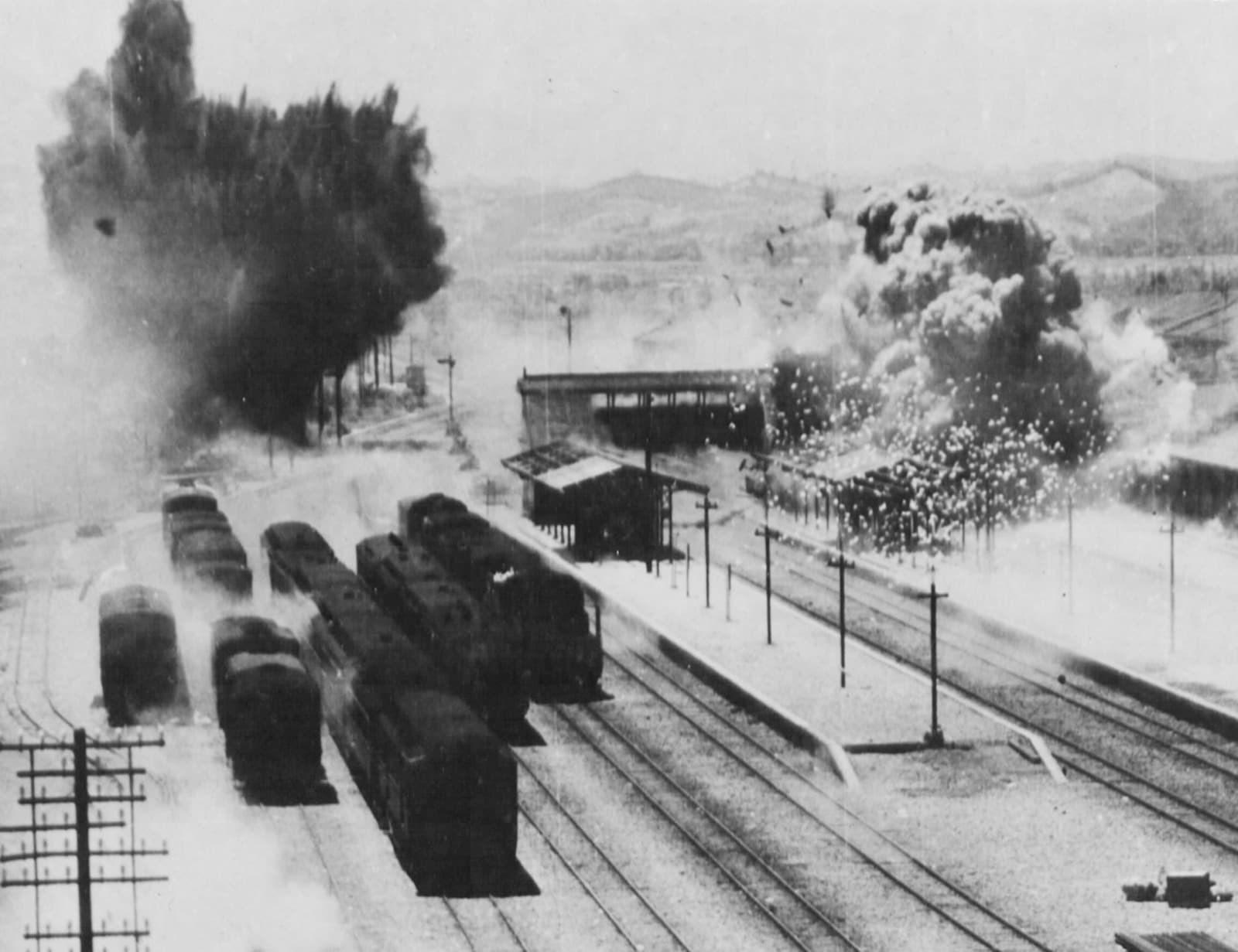
US B-25 bombers strike Chikunan Station on 17 May 1945. Scattered on the platform at right are leaflets as well as bombs. The raid on Taipei came two weeks later.
US Army Air Forces