


The Greatest Thief
In the early twentieth century in northern Taiwan, while the Imperial Japanese Government-General forged the island into an iron-bound police state through the strict baojia system and the omnipresent "branch-station" Japanese police, in the damp midnight of Taipei's Dadaocheng a dark figure was moving — gliding across the red-brick roofs of Baroque-style mansions, leaping rooftops in the night sky like a swallow.
It was an age in which the people of Taiwan kept silent under the heavy hand of the Japanese police. Yet among the tea houses, wine pavilions, and merchant mansions of Dadaocheng, one name circulated — a name that made the elite Japanese police gnash their teeth even as the city's poor Han laborers and Luohanjiao quietly cheered it on. That name was Liao Tianding.
Liao Tianding, the story's protagonist, was born in 1883 to a poor farming family in Qingshui, Taichung. As a youth he came alone to bustling Dadaocheng to make his living, drifting through the rough-and-tumble streets of Bangka (Wanhua) and Dihua Street. Dadaocheng was then thick with merchant wealth from the "tea gold" trade, but the wealth was all in the hands of Japanese officials, merchants, and a few pro-Japanese Han compradors. The laboring Taiwanese at the bottom could only sweat and bleed under the harsh sun while enduring open discrimination. Under such extreme class and colonial oppression, the nimble, rebellious Liao Tianding resolved to declare war on the system in his own way.
Liao Tianding's legend was a dark nocturnal aesthetic. He was not tall, but his legs were powerfully built, and he had mastered hand-to-hand combat and the art of running across rooftops. His most famous weapons were a razor-sharp dagger and a sash several meters long that he wore tightly wrapped around his waist. In action, he could throw the sash over a high wall or onto the balcony of a mansion, push off with his legs, and vault as if spring-loaded onto roofs several meters high.
He chose his targets carefully: pro-Japanese Han merchants, corrupt officials, and the residences of Japanese officials. He worked with astonishing speed, slipping in during the gaps in Japanese patrols, prying open safes, sweeping up foreign silver and jewels, then vanishing into the night. What humiliated the Japanese police most was that Liao did not rob simply for his own gain — late at night after each haul, he would toss heavy silver dollars into the broken thatched huts of Dadaocheng's poor or hand them out to the starving coolies on the wharves.
On one occasion he was bold enough to slip into the official residence of the Japanese chief of police, silently making off with the chief's ceremonial sword and official seal, and leaving on the desk a slip of paper that read defiantly: "The Great Thief Liao Tianding." This act of "tilling the soil on the head of Jupiter" — provoking the most powerful — left the Government-General mortified. They immediately issued the island's highest-priority arrest warrant, dispatched hundreds of officers and informers, and vowed to tear Liao Tianding to pieces.
Yet what followed on the streets of Taipei was a modern game of cat and mouse. Liao was a master of disguise. One day he might pass an officer as a shoulder-pole peddler; another day he sat in Dadaocheng's most elegant restaurant, the Jiangshanlou, dressed in a Western suit, sipping wine and watching the Japanese police search the streets for him outside. Several times, surrounded by the police, he managed in plain sight to use his sash to leap a wooden bridge across the Tamsui River, or to seize an officer's bicycle and race off through narrow lanes — leaving the proud Japanese police to fire their guns into empty air.
Yet the legends of heroes often end most tragically at the hands of those closest to them.
In the autumn of 1909, as the Japanese police drew their cordon ever tighter, Liao's room to maneuver collapsed. He was …
In the autumn of 1909, as the Japanese police drew their cordon ever tighter, Liao's room to maneuver collapsed. He was forced to leave bustling Dadaocheng, fleeing north until at last he hid in the Guanyin Mountain region of Bali-fen (today's Bali, New Taipei City), across the Tamsui River from Taipei. Deep within the screwpine forests and bamboo groves of the Laoqiankeng valley there was a hidden natural cave — a place later generations would call "Liao Tianding's Monkey Cave."
By this point Liao was starving, freezing, and exhausted. The man bringing food and messages up from below was his longtime trusted friend Yang Lin. But the Japanese police had been watching Yang Lin all along. Through threats and inducements — a heavy reward and the cancellation of prior offenses — they shattered Yang Lin's underworld code of loyalty.
On the morning of 18 November, Guanyin Mountain was draped in heavy mist. Yang Lin entered the Monkey Cave carrying a basket of freshly steamed sweet potatoes and a bottle of rice wine. Months of flight had made Liao deeply wary, but seeing the friend who had survived alongside him, he finally let down his guard. He devoured the sweet potatoes, drank down the strong wine, and — exhausted by sleepless days — fell into a deep sleep at the back of the cave.
Watching the sleeping Liao, greed overcame fear in Yang Lin's eyes. He did not, as planned, climb down the mountain to alert the police. He turned silently, picked up the heavy iron spade left at the mouth of the cave for chopping firewood, and with trembling hands walked to Liao's stone bed. Aiming at the head of the man known across Taiwan as "the Greatest Thief Under Heaven," he brought the spade down with all his strength.
A muffled thud. Blood ran red across the cave's stone walls. Liao Tianding did not even have time to open his eyes. His life was cut short, at the age of twenty-six.
Yang Lin carried Liao's belongings down the mountain and reported to the authorities. When a swarm of Japanese police arrived at the Monkey Cave and confirmed that the lifeless young man lying in a pool of blood was indeed the Liao Tianding who had tormented the empire for years, they finally exhaled. To make an example of him, the police hastily buried Liao in a graveyard near Bali-fen.
But the Government-General, believing the killing of Liao Tianding would settle colonial rule, did not foresee that even as his body died, his soul would, overnight, become a folk emblem of resistance to oppression. Across Taiwan, the common people sang his story unprompted — in tea houses, in budaixi puppet theatres, and in storytellers' tales, Liao Tianding was reshaped into a "righteous thief myth," a hero who could fly across the sky, vanish into the earth, punish the Japanese police, and rescue his countrymen. People came secretly to his grave to burn incense in his honor, addressing him with respect as "Lord Liao Tianding."
Liao Tianding's story was the wildest and most romantic collective release for Taiwanese living under the high-pressure "police state" of early Japanese rule. With his dagger and his rooftop arts, he punctured the invincible dignity of the colonial regime. Today, when we visit the "Liao Tianding Temple" (Hanmin Shrine) in Bali, New Taipei City, and see the constantly smoke-wreathed hall heavy with incense, that curling smoke still tells the story of a hundred years ago — of the dark figure under the Dadaocheng night sky who dared to defy an empire.
The story went like this: he took a sword from the quarters of a Japanese policeman, took a gold chain from the upper floor of a merchant's house, gave the money to the poor, and the authorities could never catch him. The storytellers told that passage in the tea houses and at the temple gates to a full room, pausing at the point where the police arrived to find nothing, letting the laughter run before going on. The Liao Tien-ting in the record is not so clean. Born at Qingshui in Taichung in 1883, he came to Taipei as a boy, went to prison repeatedly for theft from 1902, and in 1909 committed a run of robberies around Taipei. On 18 November that year an accomplice named Yang Lin killed him with a hoe in a cave at Bali. He was twenty-six. Among those he robbed were Japanese and Taiwanese householders alike, and no record anywhere says he gave the money to the poor. The legend grew afterwards — radio began telling his story in the 1950s, and Wu Le-tien's storytelling programmes made him a household name in the 1980s. By then he had been dead seventy years.
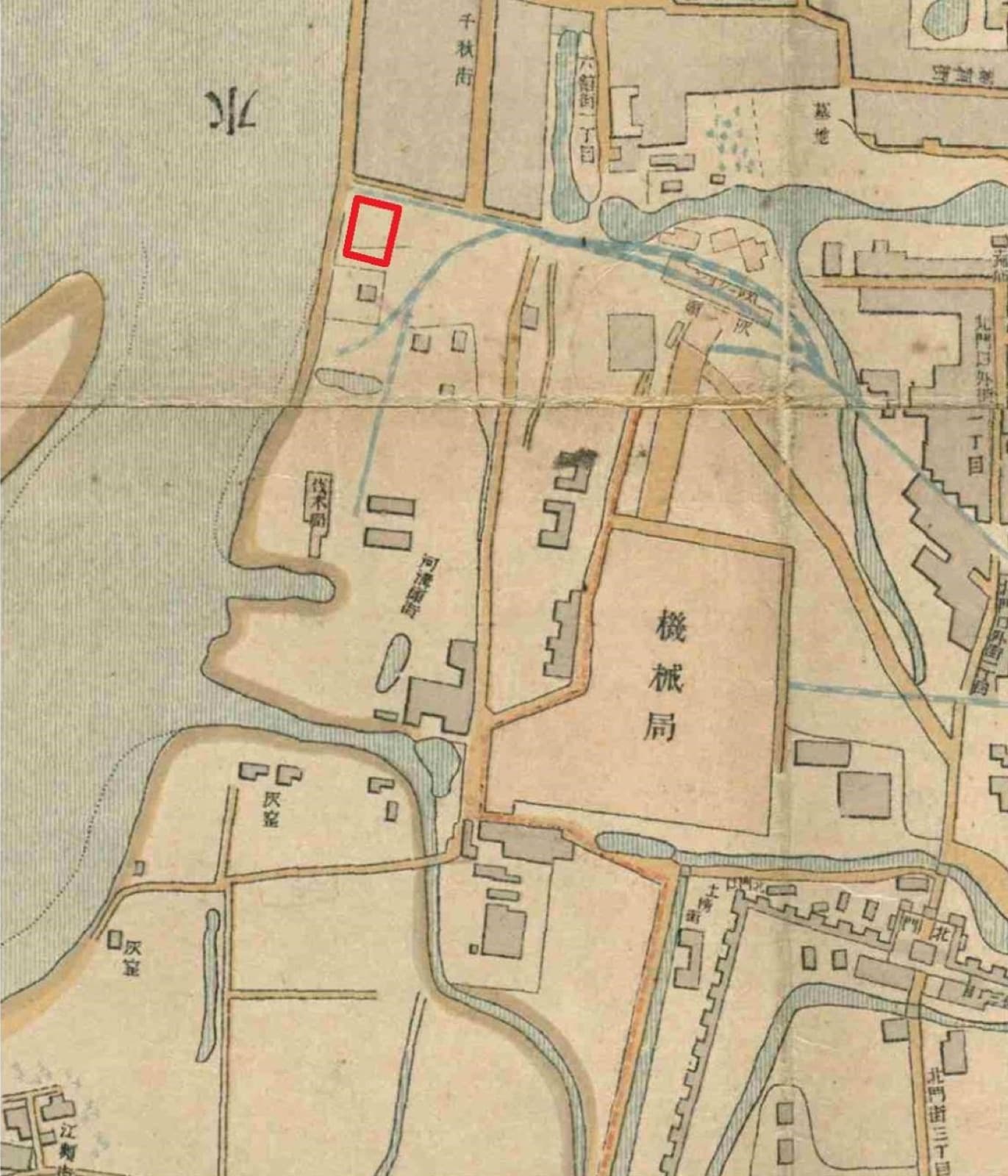
A plan of Taipei from 1897, with Dadaocheng and Bangka side by side west of the walled city. The rooftops Liao Tian-ding crossed at night lay among these blocks.
Public domain; photographer unknown
Isle of Time